Max Schrieber, an art student at Washington University in St. Louis, placed a performative pro-Palestinian piece in Tisch Park, inviting passersby to add their own words and reflections. The installation, intended as a public expression of solidarity, was quickly removed under WashU’s Facilities Access Policy.
For some on campus, the episode captured a larger dynamic. “Incidents like that, to me, are the clearest example of how antisemitism has become a tool to be weaponized, not an issue to be solved,” said Penelope Thaman, an activist and protest organizer at WashU. “This artwork wasn’t threatening.”
Others see the removal as part of a broader pattern. Gregory Magarian, a professor at the Washington University School of Law and national First Amendment expert,, said he worries about the university’s approach to speech. Policies, he said, change without public discussion. “I am very critical of and concerned about the free speech environment at WashU,” he said. “The administration has been known to sort of change policies without any sort of public deliberation or awareness.”
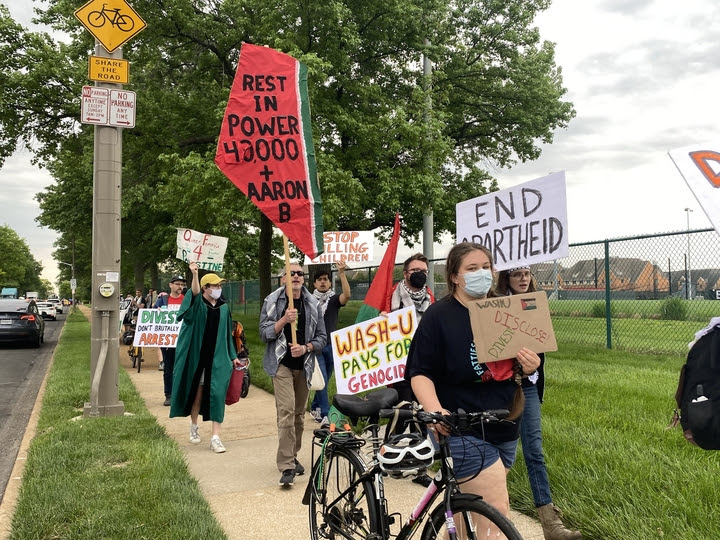
Magarian attended a pro-Palestinian protest on April 27, 2024, where police were ultimately called. He left before law enforcement intervened but described the demonstration as peaceful and organized. The administration later said police were summoned because protesters began constructing a small encampment, a rationale the chancellor repeated at a faculty senate meeting. Magarian disputes the account. “None of that was accurate,” he said. “The story that the administration told changed from statement to statement.”
Twenty-three students were suspended, with the university citing trespassing and policy violations and saying protesters ignored repeated warnings. Some demonstrators, including non-students, were injured and required medical attention.
Magarian pointed to what he views as inconsistencies in how WashU evaluates expressive conduct. He recalled a 9/11 memorial in 2011 when a conservative student group planted thousands of small American flags on the main quad. After a Muslim student removed some of the flags, the chancellor denounced the student and expressed support for the conservative group.
“The administration is sort of saying, ‘Okay, these are unauthorized. You can’t have an encampment. You can’t put up an art installation on university property without some kind of permission,’” Magarian said. “And yet, when a conservative group planted thousands of flags in the ground, the act the administration took issue with was when someone removed those flags. There seems to be some inconsistency.”
For some faculty, the consequences have been severe. Steve Tamari, a Palestinian American and retired professor at Southern Illinois University Edwardsville, was arrested during the April protest at WashU and cracked nine ribs. Because of ongoing cases involving WashU and the suspended students, he declined to discuss that day. But he said he had experienced similar issues at SIUE, where he advised the Muslim Students Association, the Arabic Club and Students for Justice in Palestine. “[Universities] don’t treat [speaking up about Palestine] well,” he said. “I think everybody was shocked about how hard university administrations came down on students for expressing solidarity with Palestinians during what most people agree is a genocide taking place in Gaza.”
(Publisher’s note: Not everyone agrees Israel’s response to the terrorist attack of Oct. 7 was genocide. Israel and the United States deny it.)
Tamari said the crackdown risks chilling future activism and could scare away international students. Universities “have had a real chilling effect,” he said. “People do not want to get arrested or get sent to a detention center somewhere.”
National trend
Concerns about uneven treatment are not limited to WashU. Graham Piro, a Faculty Legal Defense Fund Fellow at the Foundation for Individual Rights and Expression, said universities have complicated matters by straying from viewpoint neutrality. “It was a little bit tough to take [universities] seriously when they said, ‘We uphold the right to free speech,’ but then punished speech that’s protected by the First Amendment,” he said.
Following the April protest, students and faculty held a teach-in to revisit the events and continue conversations about Palestine. Yet some Jewish students said pro-Palestinian activism has made them feel unsafe. In an interview with KSDK, campus rabbi Jordan Gerson described the April rally as “an anti-Israel, anti-Jewish hate rally,” characterizing chants as calls for violence and noting violations of campus policy.
Others view the climate differently. Aaron Segal, president of the MU Student Jewish Organization at the University of Missouri, said his campus has supported his First Amendment rights and those of pro-Palestinian students. “Because the school is so open to letting everyone talk, sometimes it gets really hard to make sure everyone feels safe,” he said. Still, he believes rallies at MU have largely focused on advocating for Palestinian statehood rather than targeting Jewish students. Phrases like “From the river to the sea,” he said, carry different meanings depending on who is listening. “It can make students feel uncomfortable,” he said, but remains protected speech. “I think every person has the right to that.”
But the University of Missouri has also been accused of violating Palestinian student rights. This fall U.S. District Judge Steven Bough ruled that President Mun Choi violated the First Amendment rights of Mizzou Students for Justice in Palestine by barring the group from the homecoming parade. It has been the second year in a row the group was banned. The judge ruled there was more than a “fair chance” that Choi excluded the group “for its viewpoint on Palestine and Israel.”
Meanwhile, WashU has begun removing diversity, equity and inclusion language from various school websites, including design, engineering, math and law. The university library also deleted a DEI statement and the biography of its DEI director, Rudolph Clay, head of Inclusion, Diversity, Equity and Access (IDEA) Engagement at WashU Libraries and subject librarian for African and African-American Studies, according to reporting from the St. Louis Post-Dispatch.
The tension has moved into the courts. Missouri resident Kaitlyn Killgo was arrested during the April 27 protest and later detained again in Eureka after, according to her attorney, Washington University Police issued a “wanted” notice instructing officers to detain her until she consented to questioning. Killgo is now suing WUPD. “The idea that an employee of a private institution can issue an arrest order…without getting a warrant or the judge’s involvement raises serious constitutional concerns,” said her attorney, Maureen Hanlon of ArchCity Defenders.
As protests continue and polarization deepens, questions about whether students and faculty can freely express themselves remain unresolved. “It’s very concerning,” Magarian said. “I think the administration here, the chancellor in particular, talks a good game about free speech, and does not live up to those purported commitments when it counts.”
Caroline Steidley is a journalism major at the University of Missouri.
