Four days short of the 250th birthday of the United States, Chief Justice John Roberts delivered a powerful opinion reasserting the founders’ vision of a refuge from oppression where everyone is born a citizen.
Roberts reminded the nation and its president of the words of the great Revolutionary War pamphleteer, Thomas Paine, and Black abolitionist, Frederick Douglass, who championed the American promise of birthright citizenship.
The reminder about the nation’s true national character was timely after 18 months of unprecedented actions that have separated Donald Trump from presidents before him and that have astonished a large segment of Americans who worry about a loss of democracy.
Upholding birthright citizenship, Roberts recalled that Paine described the nation as an “asylum for mankind.” That vision was realized, Roberts wrote, as “the young Republic attracted tens of thousands of émigrés from the Old World—Scotch-Irish, French, German, Welsh, and many more, some of whom hoped to stay only a short time, others of whom hoped never to leave.” Together they made us “a nation of immigrants,” Roberts wrote.
The Dred Scott decision of 1857 – which Lincoln called “an astonisher in legal history” – threatened that vision by holding that no Blacks, whether free or slave, were human enough to be citizens or part of “We the People.”
But abolitionist Frederick Douglass’ broader vision won out. Roberts explained that Douglass insisted, “We are American citizens…The Constitution knows all the human inhabitants of this country as ‘the people.’ All I ask of the American people,” said Douglass, “is that they live up to the Constitution, adopt its principles, imbibe its spirit, and enforce its provisions. When this is done,” Douglass predicted, “the glorious birthright of our common humanity will once again become the inheritance of all the inhabitants of this highly favored country.”
Roberts pointed out that it took a Civil War to get to that destination. “The people—eventually—would overrule the Court” and its “odious” Dred Scott decision, Roberts wrote. “It took more than a decade—and the addition of names such as Antietam, Gettysburg, and Chancellorsville to our national canon—but Douglass’ vision of ‘our common humanity’ would be fulfilled.”
The Fourteenth Amendment was intended to repudiate Dred Scott, wrote Roberts. After the Civil War “The… goal was even grander—to put the‘great question of citizenship beyond the legislative power altogether, to settle the issue once and for all.”
Building on long paragraphs of careful legal analysis and deconstruction of Justice Clarence Thomas’ dissent, Roberts concluded: “The colonists demanded the ‘rights of Englishmen’ more than 250 years ago. And abolitionists lauded the “ancient and universal” rule of citizenship by birth alone as “an ordinance of Heaven.” Citizenship, then and now, was the right to have rights— to freely participate in our political community. The Framers of the Fourteenth Amendment extended that promise to ‘every free-born person in this land.’”
The chief justice’s full-throated embrace of the vision of a nation of immigrants and asylum for humankind is welcome after two decisions last week where the court opened the way for Trump to deport Haitians and Syrians with temporary protective status and to stop immigrants fleeing oppression from crossing the border to claim asylum. It also comes after a decision recognizing a unitary executive giving this president and all future presidents extraordinary power to replace technocrats in regulatory agencies with political yes-men. That decision overturned a precedent that was nearly a century old. In recent years the court has also overturned the 49-year-old Roe abortion precedent and affirmative action precedents in addition to eviscerating the Voting Rights Act in a series of decisions in which Roberts was instrumental. Post Watergate campaign reforms went up in smoke as well as the court opened up political parties as direct conduits of huge special interest money that Citizens United blessed early in the Roberts court.
Still, this term’s actions by the Roberts court have been important checks – striking down the president’s illegal tariffs, permitting states to count mail-in ballots that arrive after election day and a December 2025 emergency action blocking the deployment of the National Guard in Illinois. It also took some courage for the court to reject Trump’s appeal of a $5 million judgment awarded by a jury after his sexual assault on writer E. Jean Caroll in the 1990s.
Meanwhile lower federal courts have ruled against multiple Trump actions violating the First Amendment. Lawfare, the most reliable source of information about legal challenges to Trump, is tracking 332 active cases challenging his administration’s actions.
The courts’ pushback together with the approaching mid-term elections could result in new checks on Trump’s power and actually restore checks and balances to something more resembling their historic vitality. It was significant that the 5-justice majority in the birthright citizenship decision included Roberts, a Bush nominee, and Amy Comey Barrett, a Trump nominee who is getting grief from the MAGA movement.
An unprecedented moment in history
On the nation’s 250th birthday, a citizen might ask: Has there ever been a president like this one. The answer is no.
After running for president as a champion of the First Amendment and the common man, Trump has undermined the core American values that the drafters bravely proclaimed to the world 250 years ago at the risk of death. Those promises were liberty, equality and a government deriving its “just powers from the consent of the governed.”
In the extraordinary first 18 months of his second term, Trump has constructed a cult of personality that is ethics and truth free. He has turned the justice system against his political enemies, handed out pardons to big contributors and rioters, undermined democratic norms, draped huge banners of his face on federal buildings, lined White House walls with gaudy ornamentation, knocked down the East Wing without permission, put his name on buildings and money, accumulated two billion dollars for his family, coarsened politics with crude claims that would have once shocked everyone, defunded public media, tried to defund the Voice of America, excluded reputable journalists from the White House and Pentagon press rooms, undermined the Stars and Stripes, targeted female journalists with demeaning comments calling them “stupid,” blocked the promotions of Black and female officers in the military, contributed to the deaths of hundreds of thousands in Africa through U.S. AID health cuts, weakened the most successful and prestigious medical research network in the world at NIH, pressured quaking law firms, media companies and universities to pay him $10s of millions in settlements for specious legal claims and left immigrant families fearful that mom or dad might not come home and that the lives they built over years in the land of opportunity could end overnight.
Trump has accused dozens of political opponents of treason or sedition even though no legal authority would seriously suggest they are guilty of those crimes. The list grows by the day: former Presidents Obama and Biden, the New York Times and Wall Street Journal, James Comey, Nancy Pelosi, Liz Cheney and six members of Congress, including astronaut Mark Kelly, who advised military officers not to follow illegal orders.
Meanwhile in dozens of speeches he has laid claim to being the greatest president of the United States. Some days he defers to Washington and Lincoln as possibly greater. Many days in recent weeks he has said in the morning that peace in Iran is at hand only to threaten a new bombing offensive by nightfall, giving a modern meaning to the “credibility gap” that Johnson and Nixon created. Trump’s social media calls out the “Dumocrats” and memes of AI generated content depict Trump as Christlike or Kinglike or flying a jet to dump excrement on protesters.
Freedom of religion is contorted into plans to post the Ten Commandments in public schools and indoctrinate public school children with Bible studies in class, even though nearly a century of Supreme Court decisions have identified those actions as establishing religion in a way that violates the First Amendment and the beliefs of many of the founders whose main reason for the treacherous voyage to America was to escape religious persecution.
We shouldn’t forget that Thomas Paine’s description of an “asylum for mankind” quoted by the chief justice went on to say it was an asylum for the “persecuted lovers of civil and religious liberty from every part of Europe.”
Trump has denied any conflict of interests, but historian Douglas Brinkley told NBC there is no precedent for his huge earnings, about $2 billion from crypto and additional money from shaking down friendly or frightened media companies.
“What strikes me as remarkable is how many pies Trump has his fingers in,” said Brinkley, the professor at Rice University. “There is no precedent to compare it with. No president in the 20th or 21st century has had something that’s vaguely comparable.”
In an article published by the ABA’s Civil Rights and Social Justice section, Sayrav Ghosh concludes, “The Trump administration’s pay-to-play approach presents a fundamental challenge to the framework of laws and norms that have long guarded against corruption in government, which appears to be failing the stress test that Trump has forced on it…None of this is normal, and viewed as a whole, it presents a clear threat to American democracy.”
Again and again the refrain returns – this has never happened before.
Breaking the Justice Department
Trump’s yes-woman and yes-man attorneys general have destroyed the proud department’s good name and dependability, firing lawyers who were involved in investigating Trump for his attempt to block certification of the 2020 presidential election. Dozens of top lawyers have followed them out the door. The attorneys general also botched the release of the Epstein sex scandal files at Trump’s behest and in the face of criticism from stalwart conservative Republicans.
Paul Friedman, a federal judge in D.C., who has ruled recently against Secretary of War Peter Hegseth’s changes in press policy, bemoaned last fall the, “Loss of what lawyers and judges refer to as the ‘presumption of regularity’ which is an important element of the rule of law.” The presumption of regularity is the extra-constitutional norm that assumes the government and its representatives will tell the truth in court and not mislead judges.
This is not normal,” said Friedman. “We’ve never seen anything like this before.”
Ryan Goodman, an NYU law professor and co-editor of the nonpartisan publication Just Security, documented in March an increasing number of cases in which federal judges have criticized the Justice Department as unreliable — 34 cases of failing to comply with judicial orders and 90 cases of court distrust of Justice Department lawyers’ statements and assurances in court.
Former special counsel Jack Smith, who charged Trump, put it this way this week in an MS Now interview: “I think we are facing an attack on the rule of law that is different in kind and scope to anything I have seen in my lifetime.”
Prosecutorial abuse in Operation Midway Blitz
Operation Midway Blitz, the Chicago ICE crackdown last fall, has further stained the department’s reputation. The prosecution crumbled recently with the dismissal of charges against the Broadview Six protesters arrested during anti-ICE demonstrations near an ICE facility in Broadview, Il.
U.S. District Judge April Perry said she was shocked in late May when she saw what had been redacted from grand jury transcripts she initially received from the government. Upon seeing the full transcripts she saw “immediately and glaringly” the errors made by the prosecutors. She found improper “prosecutorial vouching,” where an assistant U.S. attorney put “her personal credibility and trustworthiness on the line in support of the charges.” The prosecutor also excused grand jurors who had disagreed with the government’s case in an earlier proceeding.
Even before the manipulations of the grand jury, the U.S. Supreme Court had reached down to stop the National Guard deployment to Chicago. In a surprising Dec. 23 action the court issued a three-page opinion stating that “the Government has failed to identify a source of authority that would allow the military to execute the laws in Illinois.” The decision was based in part on the Posse Comitatus law that prevents the military from engaging in civilian law enforcement without specific congressional authorization. The point of the law is to protect the civil liberties of citizens.
Excesses during the ICE crackdown in Minneapolis, which included the killing of two American citizen protesters, were a tipping point in public attitudes toward the immigration crackdown. The claims by former Homeland Security Secretary Kristi Noem that the two citizens killed were involved in “domestic terrorism” were so obviously untrue that the backlash led to the drawdown of the ICE surge and eventually contributed to Noem losing her job.
Chief U.S. District Judge Patrick J. Schiltz wrote in January that “ICE is not a law unto itself,” citing 96 orders ICE has ignored in more than 70 cases.
In early March, Judge James Boasberg, chief judge of the federal courts in the District of Columbia, quashed a pair of subpoenas in U.S. Attorney Jeanine Pirro’s investigation of former Federal Reserve Chair Jerome Powell. The problem with the government’s case was that there wasn’t any evidence of a criminal act.
Trump called the judge “Wacky, Nasty, Crooked, and totally Out of Control.” Pirro reacted with an angry press conference and a slim legal brief. Lawfare’s editor Benjamin Wittes wrote that the brief was “scarcely less of a temper tantrum than Pirro’s press conference. It clocks in at a scant nine pages long … And Judge Boasberg is not exaggerating when he says that it contains ‘essentially zero evidence to suspect Chair Powell of a crime.’”
Just last month, Trump lost in the Supreme Court in his attempt to fire Fed member Lisa Cook without due process on a weak charge of mortgage fraud – the same grounds the Justice Department used unsuccessfully in its politically vengeful prosecution of New York Attorney General Latisha James. Trump reacted by saying the court’s decision was just “procedural” but the procedure he’s talking about is due process – one of the cornerstones of justice.
Ed Martin facing ethics charges
Former St. Louisan Ed Martin played a major role in firing Justice Department lawyers and took over as weaponization czar before he was sidelined for poor results.. He remains the Justice Department pardon attorney, having long advocated for pardoning the Jan. 6 rioters, an action Trump took shortly after taking office.
Martin also engineered the pardons of 77 people involved in putting together alternative slates of electors to overturn the certification of Joe Biden as president. They include Rudy Giuliani, Sidney Powell, Boris Epshteyn, John Eastman and Mark Meadows — and 72 other individuals allegedly associated with the effort to upend the 2020 election results.
The electoral slate pardons will have little effect in that the president can only pardon people for federal crimes and most of the prosecutions were by states. Only Trump among former presidents has sought to overturn a presidential election by encouraging protests at the Capitol and organizing alternative electoral slates. Trump is continuing to abuse the powers of the Justice Department to pursue the false claims about the 2020 election by the seizure of Fulton County, Ga. election records this spring. FBI Director Kash Patel recently assigned an army of 260 investigative analysts to the “priority” investigation.
Liz Oyer, the pardon attorney fired by the Trump administration, is a frequent critic of Trump’s pardons, most recently the pardon of Juan Orlando Hernández, former president of Honduras, who was serving 45 years in prison after a federal jury convicted him of a massive drug trafficking conspiracy. Roger Stone, Trump’s confidante and himself a recipient of a Trump pardon, said he delivered the letter to Trump seeking the Honduran’s pardon.
As for Martin, he faces an ethics complaint before the D.C. Bar for having threatened the former dean of Georgetown Law school, William M. Treanor, with repercussions if the school continued to support DEI. Treanor replied sternly that Martin was interfering with Georgetown’s free speech and Jesuit mission. Martin could avoid discipline because the Trump Justice Department has proposed a rule that would allow the attorney general to block state bar investigations of Justice Department lawyers.
Nixon and Watergate nearest comparison
The closest presidential comparison to Trump over the past century is Richard M. Nixon who lost his presidency to the Watergate scandal after using campaign money to pay for political burglaries such as the break-in of the Democratic National headquarters. Like Trump, Nixon had his enemies. He even had an enemies list that included the Post-Dispatch and some correspondents in its Washington Bureau. Nixon’s vice president, Spiro Agnew attacked the press as “nattering nabobs of negativism” – not as tough as Trump’s enemies of the people, but more alliterative.
Vice President JD Vance recently said the idea that Watergate brought down Nixon’s presidency was “crazy” and it was the “deep state” that forced him out. It’s worth noting that Vance had not been born when Watergate occurred.
President Clinton was impeached like Trump and escaped removal like Trump. He lied to a grand jury about having sex with Monica Lewinsky, an intern at the White House – a transgression that could have led to removal from office.
Presidents from Truman to Nixon lied about Vietnam as the Pentagon Papers proved. Johnson lied about the Gulf of Tonkin to create a phony excuse for escalation that eventually killed 50,000 young Americans and millions of Vietnamese. President George W. Bush justified the invasion of Iraq with claims about Saddam Hussein’s weapons of mass destruction that turned out not to exist.
Presidents Carter, Reagan and Trump fell into the Iran trap – Carter with the 444 day hostage debacle that cost him the presidency, Reagan with Iran-Contra, and Trump, who invited Israeli Prime Minister Benjamin Netanyahu into the situation room to plan the February 2026 attack – apparently without the foresight to realize that their powerful military forces could run aground on Iran’s blockage of the Strait of Hormuz.
Trump’s faltering Great American State Fair to celebrate the nation’s birthday is a reminder of the 1970 Honor America Day that President Nixon organized to bolster popular support for the Vietnam War.
The timing in 1970 was not good. Nixon had expanded the war with the secret bombing campaign in Cambodia triggering huge demonstrations on campuses that spring. One of the demonstrations led to Ohio National Guardsmen killing four students at Kent State. Mississippi state police killed two students at Jackson State and wounded 15.
Like Trump, Nixon had trouble lining up entertainment for Honor America Day because of the obviously partisan nature of the event. Critics said organizers had booked “fossils and dinosaurs.” The biggest personalities were Bob Hope, the Rev. Billy Graham and Lawrence Welk. Humor columnist Art Buchwald joked that “any professional politician knows that when the public sees Billy Graham, Bob Hope and Lawrence Welk on the platform, the Nixon Administration will be the only ones enjoying the fireworks.”
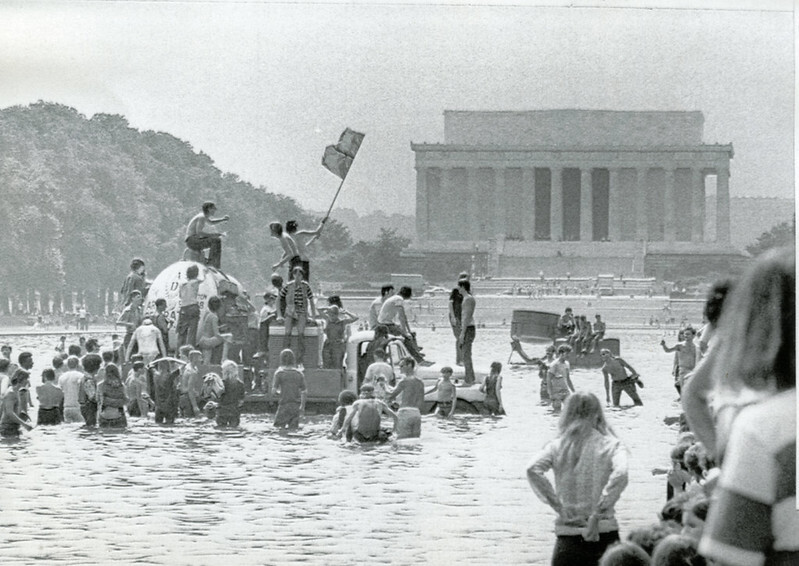
The Reflecting Pool caused Nixon problems too, but in a different way from Trump’s issues with his blue paint flaking off and the National Guard stationed nearby to detain anyone looking suspicious. In 1970 the problem was that hippies jumped into the Reflecting Pool during a marijuana “smoke in”, many nude and some waving Viet Cong flags. Police used tear gas on anti-war protesters, but the fumes drifted into the crowd sending protesters and middle class celebrants scuttling away.
Honor America Day is a reminder that the nation has been sharply divided before. The Kennedy brothers, the Rev. Martin Luther Jr. and Malcolm X had all been assassinated during the 60s. Chicago police had killed Black Panther leader Fred Hampton after the 1968 Chicago Democratic convention ended in a riot. Thousands of American soldiers were dying in Vietnam. The violent wing of the radical left, the Weathermen, rampaged through downtown Chicago on a Day of Rage in 1969 breaking windows on the Gold Coast. Meanwhile, the Weather Underground was inching toward a Capitol bombing in 1971. Hard hat construction workers attacked war protesters in New York and other cities including St. Louis where Boilerworkers attacked a group of Vietnam veterans for peace in front of a home on Lindell across from Forest Park.
In 1970s the Pentagon Papers were a year away. The Watergate break-in two years away. The Supreme Court sealed Nixon’s fate four years after Honor America Day by forcing him to turn over the White House tapes revealing the offenses that even loyal Republicans thought were impeachable. Sen. Barry Goldwater, the 1964 GOP presidential nominee went to Nixon to tell him he’d lost party support. It is difficult to imagine any current Republican who would tell Trump to stop his shenanigans or that Trump would listen if Mitt Romney showed up.
The president’s July 1 flight to North Dakota on the new Air Force One donated by Qatar is an indication that, despite his often keen political instincts, Trump doesn’t appreciate that it’s a bad look to set off on July 4th celebrations on a plane provided by a hereditary monarchy in the heart of the Middle East. Another indication is his quote earlier this year to the New York Times when asked about mixing business and politics: “I found out that nobody cared.”
William H. Freivogel is the publisher of GJR. This column will be featured in the summer print issue of the magazine.

