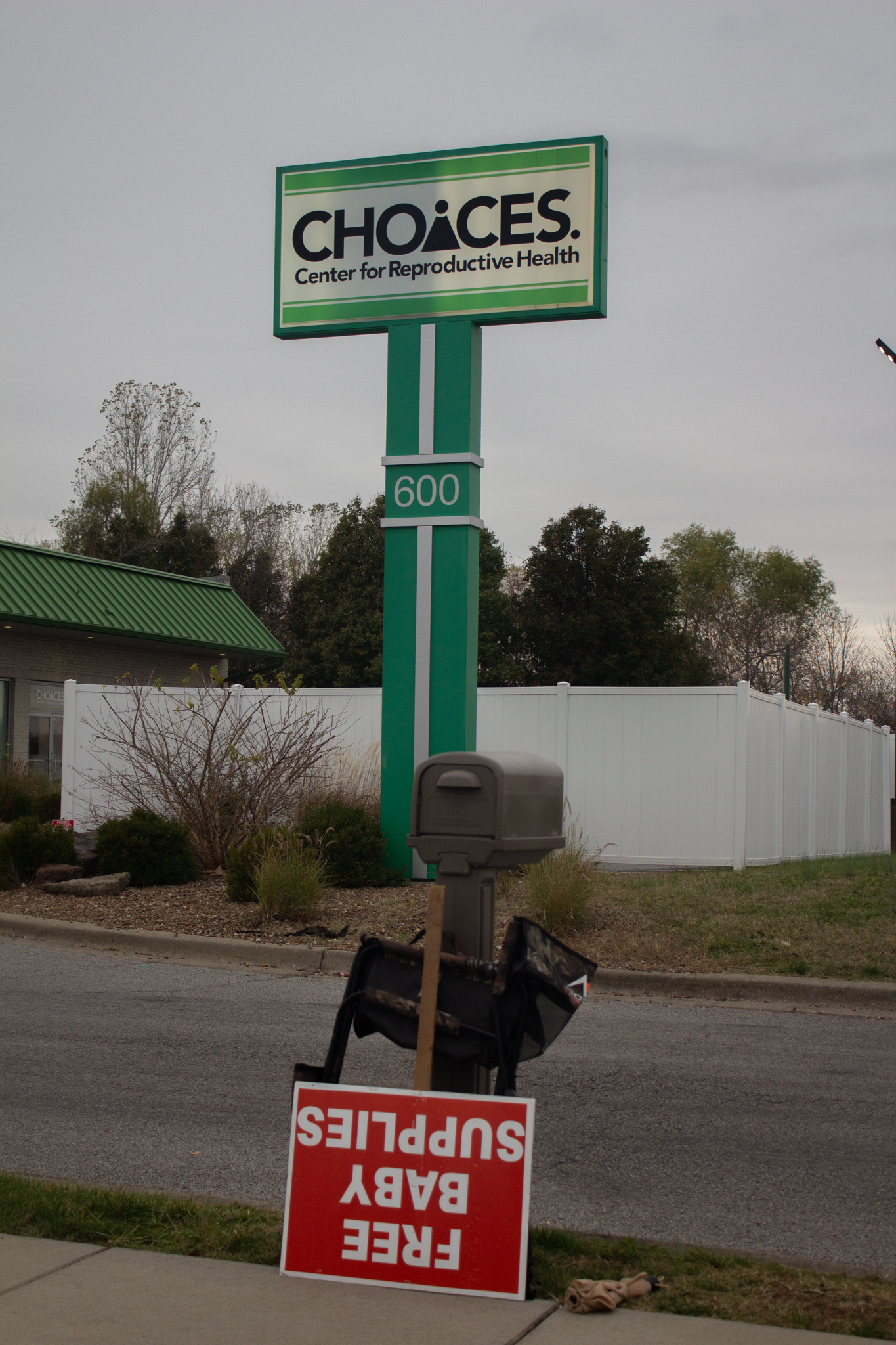
A quarter century after the U.S. Supreme Court upheld a state statute creating a speech-free bubble zone around healthcare facilities, Hill v. Colorado remains at the forefront of free speech and abortion rights debates. Coalition Life, a St. Louis-based organization that participates in “sidewalk counseling,” is a leader in seeking more First Amendment rights to approach women near abortion facilities to persuade them not to have abortions.
Meanwhile, in Indiana, faculty representatives claimed that Indiana University officials and state politicians tried to shut them down for their support for abortion rights and for an OB-GYN in the medical school who performed an abortion.
The Coalition Life anti-abortion group attracted nationwide attention to Carbondale, Illinois with their challenge to the 2000 Hill decision ruling that the First Amendment was not violated by a Colorado statute that prevented anti-abortion activists from approaching within eight feet of another individual without their consent within a 100-foot zone surrounding medical facilities. While clinic workers and abortion rights supporters consider these zones a protection of patient privacy and safety, abortion opponents consider it a violation of free speech.
In the wake of Dobbs v. Jackson, which overturned Roe, anti-abortion groups are arguing that Hill is now a constitutional outlier and that Dobbs puts the constitutionality of bubble zone laws into question.
Time, place and manner restrictions
When Colorado passed a bubble zone statute in 1993, the state maintained that the decision was content-neutral, but many saw it as a response to anti-abortion rhetoric.
Leila Jeanne Hill, alongside other “sidewalk counselors,” a term for anti-abortion activists that attempt to speak to women before they enter clinics, challenged the statute as a violation of their First Amendment right to free speech. They asked for a court order to stop the law, but the district judge turned them down, stating that the restrictions met requirements for time, place, and manner regulations.
Neutral laws that regulate the time, place and manner of street demonstrations and street performances generally do not violate the First Amendment. The 1989 decision Ward v. Rock against Racism turned down a rock band’s challenge to a New York City law that required quieter sound equipment for Central Park concerts after nearby residents complained.
The U.S. Supreme Court eventually agreed to take Hill’s case, ruling on June 28, 2000 that the statute was constitutional.
According to Cindy Buys, a professor of constitutional law at SIU’s Simmons Law School, time, place and manner restrictions are a way to balance “competing rights.” She said the government can regulate when, where and how demonstrations can take place “so that it protects patient safety and privacy, or that it doesn’t impede the flow of traffic,” but cannot regulate content.
In January 2023, a law similar to Hill passed in Carbondale, Illinois. The college town had previously never seen an abortion clinic, but after Roe v. Wade was overturned, three reproductive health clinics opened because Illinois was surrounded by states that banned abortions.
At a Carbondale City Council meeting, public commenters said they’d witnessed disruptive behavior from demonstrators outside of clinics. They claimed individuals had posed as clinic employees and directed patients to fake check-in stations and reported that some even used ladders to peek over security fences. Afterward, the council voted unanimously to amend its disorderly conduct ordinance.
The update defined the following acts as disorderly conduct: crossing the bubble zone without their consent “for the purpose of passing a leaflet or handbill to, displaying a sign to, or engaging in oral protest, education or counseling,” and intimidating, interfering with or injuring another person “by force or threat of force or by physical obstruction.” The update also mentioned that the overturning of Roe led to “frequent acts of intimidation, threats, and interference” at clinics in Carbondale.
Free speech debate
Coalition Life has a presence at the Carbondale clinics. Executive Director and Founder Brian Westbrook said that the City’s ordinance was not content neutral.
“It completely ignored things like selling Girl Scout cookies or persuading people to have an abortion,” Westbrook said, adding, “This becomes unconstitutional because it focuses specifically on the activity of pro-life individuals versus those people who would persuade them to have an abortion.”
Coalition Life sued the City of Carbondale shortly after its ordinance was updated. Thomas More Society, a Chicago law firm that primarily takes up conservative causes, represented the organization. Two lower courts dismissed the challenge, citing Hill v. Colorado. Then, in July 2025, just three days before Coalition Life would petition the Supreme Court to review the case, the Carbondale City Council rescinded the ordinance in a special meeting that lasted just four minutes.
The City said the law was never enforced. Steve Crampton, legal counsel of Thomas More Society, said that irreparable harm had occurred.
“It is an egregious violation of the First Amendment rights, not only of the (sidewalk) counselors, but of the folks that might have wanted to receive that information that will never be recaptured,” he said. “It’s a one shot only opportunity, and it’s gone.”
Coalition Life pressed forward with its petition. Their case, along with a similar one in Englewood, New Jersey, sat on the Supreme Court’s docket for months before justices declined to take both up. If the cases had received the four votes necessary for review, the Supreme Court would have reconsidered the Hill decision.
Justice Clarence Thomas dissented from the Carbondale action, writing, “I would have taken this opportunity to explicitly overrule Hill. For now, we leave lower courts to sort out what, if anything, is left of Hill’s reasoning, all while constitutional rights hang in the balance.”
The City of Carbondale is currently facing another lawsuit over its ordinance regarding temporary signs, which states that signs cannot be “erected on, suspended over, or encroach upon the public right of way,” but does not provide a definition for right of way.
Brandon Hamman, who participates in sidewalk counseling with the group Gospel for Life, said that he was demonstrating in Carbondale in April when a city official threatened to issue a citation and eventually called the police.
Hamman said there was another church demonstrating with signs that had messages such as “free baby supplies,” and that the city official said they weren’t classified as demonstration signs. According to Hamman, he went to retrieve different signs and told the official that he had a right to demonstrate, to which the official replied “No, you don’t.”
On behalf of Hamman, the American Center for Law and Justice, a conservative legal organization that opposes abortion, filed a lawsuit against the City, claiming that the ordinance is unconstitutionally vague and can invite arbitrary enforcement.
To Hamman, signs are a way to communicate a message to people when he can’t have face-to-face conversations. He said that he was demonstrating at Planned Parenthood one day with a sign featuring a picture of a mother and her baby and the phrase “Choose life, your mother did.” He said that there was a non-English speaking patient sitting low in a car who saw the sign and decided to keep the baby.
“If I’d have been out there that day by myself, she never would have been able to see that picture because the city won’t let me put them out there,” Hamman said.
Abortion rights supporters have First Amendment conflicts
Abortion rights supporters have faced their own First Amendment battles as well. In 2023, the American Civil Liberties Union spoke out against bills in Iowa and Texas that required internet providers to block websites that give information about abortion.
In 2022, faculty leaders at Indiana University were told they violated IU policy after they wrote a letter opposing a proposed state abortion law and defending Dr. Caitlin Bernard, an OB-GYN and professor at the School of Medicine, who provided an abortion to a 10-year-old rape victim.
In an email, Chief Compliance Officer Mike Jenson said the message led people to believe the letter represented IU’s position, as it did not clarify that a personal opinion was being expressed. He said the message was not approved or reviewed by “any university official with the authority to authorize.”
Steve Sanders, a law professor at IU, published an analysis about the situation in Medium, writing “IU policies currently create the possibility that faculty may be censored or punished for statements they make as participants in shared governance or as scholarly experts.”
In Illinois, the Patient and Provider Protection Act solidifies access to abortion care and protects physicians who provide reproductive health services to out of state individuals. Andrea Gallegos, executive administrator of Alamo Women’s Clinic, said that she sees many patients from states where abortion is banned, but few referrals. She speculates that this could be due to a fear of being reported if they told a doctor in their home state that they were considering terminating a pregnancy.
Safety concerns
As executive administrator of Alamo since 2020, Gallegos has encountered demonstrations against abortion in many states, including Texas and Oklahoma. Post-Roe, the organization remains open in Albuquerque, New Mexico and Carbondale, where she said she encounters demonstrations on a daily basis.
“The tactic here in Carbondale is you see protesters wearing what look like security vests. They have cameras on the front of them, and they’re not holding signs or anything like that… They will kind of stand sometimes in the middle of the driveway and almost force patients to stop while they smile and wave,” Gallegos said. “And their goal is to get patients to roll down the window and start talking so that they can start telling them all the reasons why they shouldn’t be doing this.”
Gallegos said the individuals often provide misinformation to patients, showing them inaccurate model babies and claim that there is a reversal to medication abortion, although scientific research into the practice is lacking.
“They’re out there giving false information, and it’s harmful,” she said. “Patients come in scared, they come in confused, they come in angry, they come in, you know, maybe more emotional. A lot of times, because they’re like ‘those people at the corner, like, what was that about?’ Some of them quickly understand… But some of them don’t necessarily realize it when they’re being stopped, and so they feel ashamed that they fell for it and stopped. They feel angry that some stranger is trying to tell them that they know better for them.”
Buys, the SIU law professor, said the Supreme Court has identified false speech as protected speech, although it doesn’t always work perfectly in practice. “The theory is that more speech is better than less speech, and that if someone does say something that is not true, then everyone has a right to counter that with better information,” she said.
Still, Gallegos considers the demonstrations she’s encountered to be aggressive. “People are literally blocking clinic entrances for patients who are just trying to get to a health care appointment,” she said, adding, “I think that’s incredibly intrusive for somebody who, again, is just trying to access health care — safe and legal health care.”
While the term “privacy” is not explicitly mentioned in the U.S. Constitution, Buys said it is implied through other rights, such as the Fourth Amendment, which protects citizens from unreasonable searches.
A 1960s Supreme Court decision protecting contraception, Griswold v. Connecticut, said privacy is found in the “penumbra” of various parts of the Bill of Rights, including the Fourth Amendment.
Ultimately, Gallegos is a supporter of freedom of speech, but she said she believes there’s a line to be crossed when it comes to privacy, safety and accessing health care.
“You want to stand on a corner and hold up a sign that says you don’t agree with abortion, fine, but when they start pulling patients over and giving misinformation… I mean this, this is really damaging,” she said. “I think that crosses the line of infringing patients’ rights and our (clinic workers’) rights too. I mean, I mostly worry about patients. I can drive by them every day, that’s fine, and ignore them, but it’s patients that get lied to and tricked, and I don’t think that’s right.”
Abortion rights opposers persist in fights
McGee, the ACLJ lawyer, said the preliminary injunction in the sign case was argued back in August, and that they are still waiting on a ruling.
Westbrook said Coalition Life works to have peaceful conversations, and denies any claims that they’ve provided misinformation. He said the organization is continuing to look for other opportunities to overturn Hill.
Thomas More Society was involved in a similar case in Westchester, New York. In August 2025, a federal court ruled that the county’s 2022 bubble zone ordinance had violated the First Amendment and awarded nominal damages. The case was not appealed all the way to the Supreme Court, which is what it would take for Hill v. Colorado to be overturned.
Crampton said he wants Hill to be overturned because he believes the First Amendment needs to be protected against all challenges. “Once it’s lost for one side, it’s pretty much lost for everybody,” he said.
Gallegos said her clinic is going to work to continue to protect their patients.
Carly Gist is the deputy editor of the Daily Egyptian at Southern Illinois University Carbondale.
