Media
Hacking sources crosses the line
British journalists seem to have been reading too many of Stieg Larsson’s books about the Girl with the Dragon.
British journalists seem to have been reading too many of Stieg Larsson’s books about the Girl with the Dragon.
A Cook County judge became the second state judge in Illinois to rule that the state’s tough eavesdropping law is unconstitutional. The judge said the law, which makes it a felony to record audio without the consent of all parties, criminalizes potentially innocent conduct.
The Gateway Journalism Review followed this story for over a year. Here are some of the previous stories posted on the issue:
Kirkwood High School in suburban St. Louis is the latest public school to get caught in the uncertainties about how much free speech students have on social media.
The Kirkwood Call, the school’s top-notch student paper, reported (story) this week that a student was suspended for three days for a Tweet cursing a teacher. The student, Josh Spiller, sent the Tweet early this month after the teacher sent him to the office for refusing to surrender his cell phone. Spiller admitted his Tweet was wrong, but he still thought his rights were violated.
Principal Michael Havener explained that the high school considered tweets to be the equivalent of face-to-face communication. “…vulgar language toward a staff member or threats is just like saying it to the staff member,” he said in the Call story. “When you use it in a negative way toward staff members, it’s just like you’re saying it in the classroom.”
The press generally applauded this month when the Senate Judiciary
Committee voted to require the U. S. Supreme Court to televise
proceedings. Sen. Richard Durbin, D-Ill., was one of the big
proponents.
As a card-carrying member of the press, I have reservations.
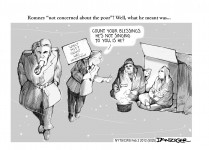
The New York Times showed admirable restraint in reporting Mitt Romney’s inartful and possibly revealing comment about the poor, on page 17 of Thursday’s paper.
But by the time a reader had finished with the front section, that restraint had been buried in editorial overkill. The lead editorial focused on the comment – Romney said he was “not concerned about the very poor” because they had a safety net – as an example of the “darkening tone” of the Republican campaign.