Media

Credibility questions sidetrack investigative journalism

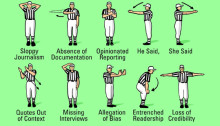
BY SCOTT LAMBERT / Sports Illustrated’s recent series of articles chronicling cheating at Oklahoma State University were meant to reignite a long-running conversation about the seedy culture of big-time college athletics. Instead, Sports Illustrated started a conversation about cred­ibility and perceptions of bias that overshadowed its original plan.
Media

Information doesn’t mean bias

BY SCOTT LAMBERT / Perceptions of media bias continue to rise in Americans, and those perceptions aren’t going to change anytime soon. A 2012 Pew Research Center study reported that the number of Americans who believe political news coverage is biased rose 6 percentage points in 2012 compared to 2008. The idea that media cover news stories from a strictly neutral position is seen as a fairy tale, and the term “lamestream media” is a common phrase on the right whenever a story perceived as negative is presented.

Media

Website showcases political spectrum

Trying to eliminate the Internet noise during political season seems almost impossible. Myriad news stories from multiple news sources float around in cyberspace. Blathering political pundits on television and radio spew their opinions constantly, with what seems to be little regard for truth or objectivity. Fact-checkers desperately try to keep up with the claims and falsehoods tossed around by politicians and their political mouthpieces.

Media

CNN, Fox got it wrong and hurt all news media’s credibility

Let’s all repeat the first rule of journalism: Get it right.

Rule number two may state that you also want to get it first, but getting it right is so much more important. And that fact seems to be disappearing in this age of skip the copy editor and get the story online immediately.

It’s all a rush to get it first. A few months ago, Joe Paterno was reported dead a day before he died. A reporter lost his job for that. He got it first but he got it wrong.

Things like that kill credibility.