
Media

Newspapers’ photo-finish sanctions

Newspaper photographs should be accurate. Readers know that. So do photographers, photo editors and managing editors.

But what should a news organization do when a photojournalist’s work is less than accurate – or not completely truthful? When the Sacramento (Calif.) Bee discovered earlier this year that Bryan Patrick’s page one nature photo was actually a compilation of two photos, the newspaper suspended the award-winning photojournalist. Was suspension the right response of the newspaper, or was the Los Angeles Times correct when it fired Brian Walski in 2003 when he also merged two war-front photos to create a more dramatic image?
Media

Times coverage of Romney suggests bias

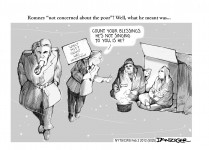
The New York Times showed admirable restraint in reporting Mitt Romney’s inartful and possibly revealing comment about the poor, on page 17 of Thursday’s paper.

But by the time a reader had finished with the front section, that restraint had been buried in editorial overkill. The lead editorial focused on the comment – Romney said he was “not concerned about the very poor” because they had a safety net – as an example of the “darkening tone” of the Republican campaign.

Media

Framing Paterno’s legacy

Media like their subjects to be easy: their heroes to be heroes, their villains to be villains.

Celebrities are wonderful, until they do something that proves they aren’t wonderful. Stories must be framed to make it easy for readers to understand what really is happening.

And then a story like that of Joe Paterno comes along and it makes media’s job so much more difficult. For 50 years, Paterno was the ideal of college football coaches. His 409 wins were the most of any Division I football coach. He graduated 80 percent of his students. He gave money back to his school. He was easily framed as the granddad of college football — until last fall when news about Jerry Sandusky broke. Sandusky, the former Paterno assisted is currently charged with over 40 counts of sexual abuse with boys under the age of 15. Another Paterno assistant, Mike McQueary told Paterno that he saw Sandusky raping a young boy. Paterno notified his superiors but never approached Sandusky or the police about the incident. Paterno could have done more than just report his knowledge of Sandusky’s misdeeds. He should have helped those kids.

Media

Mary Junck of Lee Enterprises named new AP board chairman

NEW YORK – The Associated Press Board of Directors announced today that Mary Junck, chairman and CEO of Lee Enterprises, Inc., will become its new chairman.

Junck succeeds William Dean Singleton, chairman of MediaNews Group Inc., who has completed a five-year term as chairman of the AP board, which oversees the not-for-profit cooperative of U.S. newspapers and broadcasters. She will take over after the Associated Press annual meeting, in April.

Media

Silicon Valley wins round one in SOPA fight

Over the past week, Silicon Valley’s internet powerhouses out-communicated Hollywood, stopped internet piracy bills pushed by the big studios and even prodded the Republican presidential candidates and President Barack Obama to agree on something — that Hollywood’s internet piracy bills threatened the innovation of the web.

Traditionally, Silicon Valley has been reluctant to play by Washington’s rules. Microsoft did not build a major Washington presence until the late 1990s when it faced a big anti-trust suit. But last week, the industry demonstrated its power through a concerted campaign of shutting down some sites and posting notices on others about the industry’s opposition to the internet piracy bills.