Tag: ESPN

In smaller newsrooms, some sports reporters are covering 10 sports at once

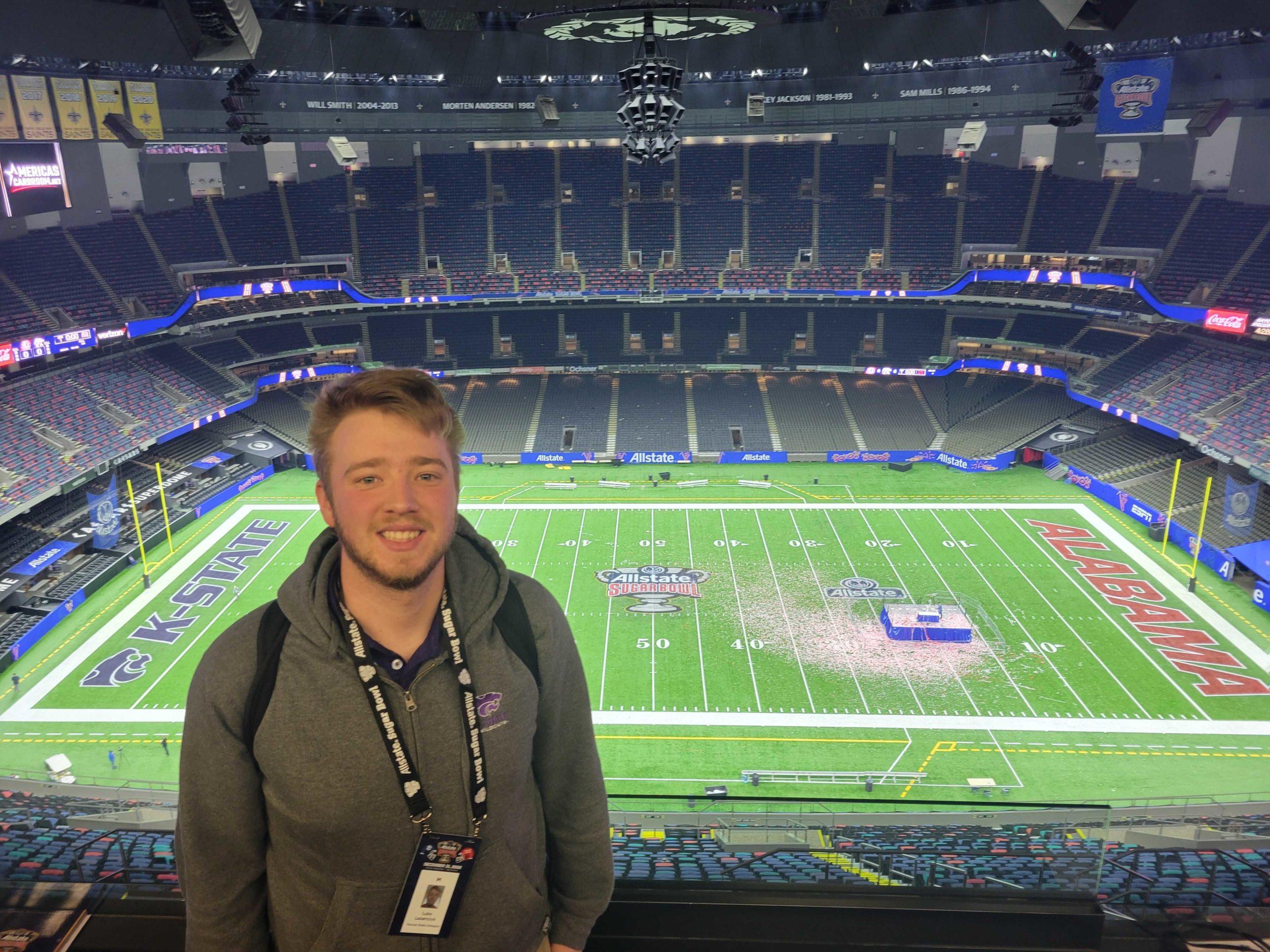
On New Year’s Eve in New Orleans, Kansas State Wildcats football fell to the world-renowned Alabama Crimson Tide, 45-20 in the Sugar Bowl. Kansas State finished a historic season for the program, taking me to the press boxes of the Superdome in New Orleans and AT&T Stadium in Arlington, Texas, for the Big 12 Championship Game. 

Just under 1,000 miles away in Manhattan, Kansas, the Kansas State Wildcats men’s basketball team defeated then-No. 24 ranked West Virginia 82-76 in an overtime thriller. The men’s basketball team’s 12-1 record shocked many but still were not the main Manhattan storyline. Not yet at least.

The author covers the Sugar Bowl in New Orleans on Dec. 31, 2022. Photo courtesy of Luke Lazarczyk

Seventeen days later, back in Manhattan, I found myself in the press section in Bramlage Coliseum as the Wildcats won another overtime thriller. This time against No. 2 ranked in-state rival Kansas Jayhawks 83-82. The Wildcats now held a 16-2 record and were the No. 13 ranked team in the country. As the student section enveloped the court in a matter of seconds after the final buzzer rang, head coach Jerome Tang and the team had become the next Kansas State team to take the nation by storm. 

As newsrooms shrink and beat reporters compete with scarce resources, most local sports journalists must cover multiple sports these days, sometimes simultaneously.

“Kind of sad actually,” National Sports Media Association executive director Dave Goren said about the sports writer job market. “A lot of people have gotten laid off lately, including a handful of our award winners who were just here.”

Just recently, ESPN announced layoffs of many highly known on-air personalities. The Athletic also laid off 20 reporters in June of 2022. Goren said that the issue would need a major commitment to fix the issues causing layoffs in sports and news journalism.

“It would take somebody to invest millions and millions of dollars in news gathering or news reporting organizations,” Goren said. “There are a handful now of these nonprofit organizations that are trying to make a go of it. I wish them the best of luck. It’s good for us as a society.”

Depending on the circumstances, the work can be both rewarding and time consuming. That was the case for Jason Martin, former writer at the Daily Journal in Indiana from 2003-2009. Indianapolis was home to two very prominent teams in the NFL’s Colts and the NBA’s Pacers. 

“When you’re in a relatively small market and you’ve got two good teams you’re going back and forth and we’re limited staff” with three full-time reporters,” Martin said. “We’re still trying to cover our local high school and whatever came up. We were very, very busy but it was so exciting to be a part of.”

For Martin, his main job was covering the Colts who were at their peak, winning the Super Bowl in 2007 while serving as the backup reporter for the Pacers. With limited staff, any major moment with the Pacers would require his immediate attention. One of those occurrences was one of the most infamous moments in sports history: The Malice at the Palace.

The Malice at the Palace was a brawl between Pacers players, most notably Ron Artest, and Detroit Pistons fans that went into the stands of The Palace in Auburn Hills, Michigan, right in the middle of the Colts season. Martin was sent to Ron Artest’s press conference the next day, just the day the Indianapolis Colts would go on to play against the Chicago Bears, adding a new wrinkle to his schedule. 

Covering multiple professional teams may have a reporter’s schedule become discombobulated. That case could be even more so for those covering multiple high school sports exclusively.

“I never worked a consistent schedule,” said Les Winkeler, former Sports Editor of The Southern Illinoisan. “You might cover one game in the afternoon one day and the next day you’re covering a game right out into (the) deadline. You really had to be flexible and adapt.”

The variety of sports to cover in high school sports is much greater than professional sports. Winkeler said he covered up to 10 sports, from football to cross country. That’s a lot of sources to maintain. Winkeler said his staff could keep up with the event coverage but then had to figure out when coaches were free for interviews. Winkeler would ask all the coaches when their breaks were during the day and kept a hand-written list to know when coaches would be available.

“You had to use a little ingenuity when covering that many people,” Winkeler said.

 Both Martin and Winkeler also were challenged by having to learn new sports well enough to cover expertly during their reporting careers. For Winkeler, it was soccer.

“I had never really been around soccer at all,” Winkeler said. “That was a pretty severe learning curve. There were times when I would rely on other people there or officials working the clock or whatever to explain things to me.”

In Martin’s case, he headed into Indiana knowing about two sports the city was infatuated with, basketball and football. Still, Martin found himself with limited knowledge of one of Indiana’s favorite sports: Motorsports. The heart of Indiana’s motorsports love is the Indianapolis 500, one of the most famous automobile races in the world. Martin had to learn the sport from people he knew beforehand and then by experiencing the event and the environment itself as a reporter.

“You’re not going to be the expert in everything,” Martin said. Most people come to sports journalism having played sports at some level. “Then they’ve got the ones that they’re passionate about following themselves,” he said. “I think inevitably, especially if you’re in the general assignment kind of situation, you can end up with a lot of things, a lot of possibilities.”

Martin, similarly to other sports journalists, was thrown into a sport and an area which he knew little about. Martin became accustomed to the area’s love of motorsports and more by leaning into his skills. For those in the sports journalism world, as much as the assignment is to cover the sport, the work goes beyond learning the intricate details of each sport there is to work on. In the end, the journalist must adapt and lean into their skills as a pure journalist, no matter the sport.

“What you can rely on is just your reporting skills, telling stories of a person,” Martin said. “So much of sports journalism is telling the stories about people with the added element of competition that draws people to it and makes people want to read what you’re writing.”

Luke Lazarczyk is a Kansas-based sports reporter. 

Corporate alliances put squeeze on sports journalism

Editor’s note:  This is an opinion article by John Shrader.

Sports journalism is dead.

That was the notion in late August, when ESPN abruptly ended its relationship with PBS’ “Frontline.” ESPN had partnered with “Frontline” for more than a year on a documentary film examining the NFL’s handling of head injuries. It looked like the perfect collaboration of the hard-hitting documentary team and the biggest, most powerful media machine the sports world has ever known.

One thing apparently got in the way: reality. ESPN has a $15 billion relationship with the NFL. ESPN had just re-signed to do “Monday Night Football” through 2021, and it wasn’t about to mess with that mojo. However, the network apparently was about to mess with it until NFL commissioner Roger Goodell, according to a report in the New York Times, stepped in and pressured ESPN to get out of the deal with “Frontline.” ESPN’s president, John Skipper, and the commissioner denied that’s the way it came down. The denials are unconvincing.

The documentary project was scheduled for a two-part airing on PBS in October, titled “League of Denial: The NFL’s Concus­sion Crisis,” which is critical of the way the NFL handled head injuries. The project was reported and written by two ESPN investi­gative reporters: brothers Steve Fainaru and Mark Fainaru-Wada. The two also have writ­ten a book by the same title.

It has been clear to many of us for years, and now clear to many in the sports-viewing world, that business relationships trump journalism. ESPN’s talking-head programs and the game broadcasts are filled with storytelling narratives generated to protect and enhance these relationships. The network is in the business of making money, account­ing for about half of Disney’s operating profits, according to the New York Times. Airing your partner’s dirty laundry in public is not particularly good for the bottom line – although if any network could survive it, ESPN likely could. At least that must have been the thought process when ESPN agreed to do this deal with “Frontline.”

Most of ESPN’s rights deals are good through 2020 and are worth a collective $41 billion. That’s a lot of partnership build­ing and partnership protecting. The most lucrative of these deals are with the NFL ($15.3 billion), the college football playoffs ($7.3 billion) and Major League Baseball ($5.6 billion). The deals also include the NBA and four college conferences.

Some in Bristol, Conn., the worldwide headquarters of ESPN, think doing journal­ism is an important component of what they do. They’ve been hiring newspaper and maga­zine writers – some already with jobs, others off the unemployment line – for years now. But they are sending mixed messages.

The large stable of reporters spends most of its time writing and talking about who’s starting this week, who’s injured and which coach is on the hot seat. These reporters use Twitter to discuss these developments and blab about them on the many talking-head shows. Interesting, but well-trained and experienced journalists could and should be doing more.

Regional sports networks don’t have the same volume or money at stake, but they do have many of the same concerns. Mark Shuken is vice president and general manager of a relatively new regional sports network in Los Angeles, Time Warner Cable Sportsnet (TWC.) (Full disclosure: I do play-by-play of MLS soccer games on this channel as a contractor.) Shuken told me via email that TWC’s mission is to provide “exclusive content, depth and access to fans of the teams with which we partner,” which include the L.A.-based Lakers, Sparks and Galaxy – and, next season, the Dodgers.

Shuken says sports journalism has a place on his regional sports network.

“Absolutely,” he said. “Today’s fan and TV viewer expects more than just live games. The access, connection and passion they feel for their favorite teams is best real­ized through the storytelling and personal relationships creators and journalists can provide.”

Ross Jernstrom is certain there is a place for sports journalism on TV. He says that’s what he’s been doing for more than 30 years, as a sports anchor and reporter at WOWT-TV in Omaha, Neb. He says station manage­ment has never told him to hold a story.

“As long as I have the facts right, I can do the story,” he said.

The biggest, baddest dog in his sports kennel is the University of Nebraska football team. It can be intense. The coaches expect good coverage, the players are adored and the fans are … well, fanatical.

“No pressure at all,” Jernstrom says. “If I was a hit-and-run guy, that would be a differ­ent thing. I have enough sources. People trust me. It helps to be here as long as I have.”

Dennis O’Donnell has worked in sports television in San Francisco for nearly as long, first as a producer and then as an anchor. He says he feels some pressure to maintain rela­tionships with the biggest pro teams in town, especially the popular San Francisco 49ers.

That relationship was put to a severe test in September 2010. The 49ers were a struggling team with an inexperienced coach, Mike Singletary – inexperienced both in the coaching business and in media relations. Yahoo.com had published a critical piece about one of Singletary’s assistant coaches. O’Donnell asked the coach about that on their weekly coach’s interview, which was re­corded on Thursday and scheduled to air on the KPIX-TV Saturday night preview show. Singletary was defensive and almost abusive of O’Donnell, who kept his cool.

“I didn’t think it was that big a deal,” he said.

He got through the interview, the coach looking worse for wear than O’Donnell.

“The 49ers didn’t want us to air it,” O’Donnell told me recently.

Not only did they air the segment on their Saturday night show, they put a rather lengthy clip on the news that Thursday night.

“If I thought the questions were conten­tious, derogatory or combative, I would have understood,” he says. “The way I posed the questions was very fair.”

As it turns out, that was the last inter­view O’Donnell did on that show with the coach.

“The 49ers and our general manager agreed it would be best if Kim Coyle, our sports reporter, did the interviews for the rest of the season,” he says.

The relationship between KPIX and the 49ers was, in the end, more important to station management than the relationship between their sports director and the coach of the 49ers.

“I didn’t agree with it,” O’Donnell says, “but I get it.”

Shuken, the sports regional executive who worked with me more than 20 years ago as a young producer in San Francisco television, says he thinks journalism – sports and otherwise – has gotten worse rather than better, “given predispositions, biases and the desire for ratings above all.” But he says the true fan can tell the difference “between fluff and meaningful content, and that’s where the opportunity lies.”

Meaningful content is always the goal of the storyteller. We hope, especially for the sports journalist, it is being presented with minimum interference from the business partners who help keep the doors open but also provide so many of the most interesting story lines.

John Shrader is an assistant professor of journalism at CSU-Long Beach.  He was a TV and radio sportscaster in San Francisco for more than 30 years and covers L.A. Galaxy soccer on Time Warner Cable Sportsnet.

Credibility questions sidetrack investigative journalism

Unintended consequences often prove fruitful.

Sports Illustrated’s recent series of articles chronicling cheating at Oklahoma State University were meant to reignite a long-running conversation about the seedy culture of big-time college athletics. Instead, Sports Illustrated started a conversation about cred­ibility and perceptions of bias that overshadowed its original plan.
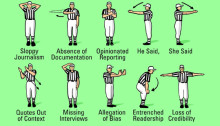
Sports Illustrated’s series consisted of five parts. Part one alleged illegal cash payouts to football players; part two alleged academic fraud; part three detailed reports of illegal drug use; part four concentrated on stories of sex between hostesses and recruits; and part five examined the lives of athletes discarded by Oklahoma State. The writers are Pulitzer Prize-winner George Dohrmann and Oklahoma native Thayer Evans. The investigation claimed to have lasted more than 10 months and included interviews with more than 60 former Oklahoma State football players.

Sports Illustrated trumpeted its series with boasts of a searing look at the underbelly of a major football program. The results were something else. Backlash started almost immediately after the first part ran. Evans’ former co-worker and ESPN national sports columnist Jason Whitlock sent out numerous tweets disparaging Evans’ credibility.

He even went on Oklahoma radio and called him a “hack.” Former Oklahoma State quarterback Brandon Weeden accused Evans of a bias against Oklahoma State and relayed an interview he did with Evans, when Evans asked when his team would pull another “Okie Chokie.”

Then players who had been interviewed started recanting their stories. Multiple players told Oklahoma news sources they had been misquoted, or that their quotes had been taken out of context. Oklahoma media started poking holes in the Sports Illustrated series by questioning Evans’ credibility, and by report­ing on the number of players recanting what was said (even though many said at least some recanting would be expected). News sources reported many of the players interviewed were players who had been kicked off the team, or left for multiple reasons. The focus of the series shifted, at least on the Internet, from Okla­homa State to Evans and Sports Illustrated.

More stories reported what was wrong with SI’s reporting than praised its efforts. Na­tional news media sources joined the chorus. ESPN and Deadspin both found mistakes in Sports Illustrated’s stories by doing some simple fact-checking and calling the school’s registrar to ask questions. They found that none of the professors in programs accused of academic fraud had been interviewed. A for­mer SI fact-checker went on record saying that Sports Illustrated’s fact-checking was lacking.

At the same time, Yahoosports.com ran a story about Southeastern Conference football players receiving illegal benefits, complete with documentation and names. (http://sports.yahoo.com/news/ncaaf–documents–texts-reveal-impermissible-benefits-to-five-sec-players-202513237.html) This led to another hole in the Sports Illustrated story. The Sports Illustrated story took 10 months and had in­terviews with more than 60 people, but it had no documentation. It was one large “he said, she said” piece.

Compared to the article written by YahooSports, the Sports Illustrated series didn’t measure up. Interviews are crucial to an inves­tigative piece, but there must be some form of documentation to support those interviews. Sports Illustrated never backed up its asser­tions, making the story completely about its own credibility.

This allowed opinion to become the major factor in deciding whether to believe the story or not. Evans defended his lack of a bias against Oklahoma State in an interview with Sports Illustrated.

Bias and perception of bias played a key role in the story. Readers who read the piece (and reporters who wrote about it) carried their own perceptions and bias into the story. Will Leitch wrote on www.sportsonearth.com that our perceptions have become so entrenched that the story seldom makes a difference on our opinions. In a story titled “Shock and Yawn” Leitch wrote (read his entire story at http://www.sportsonearth.com/article/60758436/): “One of the major lessons we’re learning about journalism in this day and age is that, no matter how high-quality the piece (a level of quality that far exceeds this one), you’re just not going to change anybody’s minds anymore. We are all entrenched. Some­thing like this enters the public sphere, we all come out of our corners, take turns whacking at it, and then retreat to our corner. We always stay in our corner.”

Leitch’s argument that the audience is so entrenched in its own opinions and unable to change its mind is troubling. The Oklahoma State series serves as an anecdote that can be used to support Leitch’s opinion. Whitlock, who inserted himself into the narrative early by bashing Evans on Twitter (and later on Oklahoma radio), chimed in with his longtime argument that big-time college sports needs to change the entire “plantation” system that profits off the backs of athletes and discards them. The stories of cheating, through Whit­lock’s eyes, miss the point altogether.

Others took what they wanted out of the piece and used that for their arguments. Some looked at the story with the jaded eyes of those who have seen this story done ad nauseum over the years and simply say, “So what?”

The efforts by Oklahoma media to discredit the story, or to point out major flaws in it, certainly played to readers with a pro-Oklahoma State point of view. While many in Oklahoma reported that at least some of the story must be believed, the stories were writ­ten for an audience that tilted pro-Oklahoma State. If a reader wants to take the time to look at all the articles written about this story, everything seems to come with a point of view. That includes the original Sports Illustrated piece.

That piece was not a nuanced story about a big-time sports program. The story came with an opinion and failed to mention the millions of dollars oil investor T. Boone Pick­ens invested in the program during the years Sports Illustrated was investigating. Too much was missing from the Sports Illustrated piece.

Sports Illustrated set out to tell a story about all that’s bad about big-time college football. YahooSports did the same thing by using travel documents to verify violations in NCAA football. Sports Illustrated took the wrong approach. Selling the argument that Oklahoma State became a big-time program through hundred-dollar handshakes, grade fix­ing, drugs and sex wasn’t going to work. It had all been said and written before.

What Sports Illustrated really did was open up a conversation about investigative journalism. Credibility still ranks as the most important tool a journalist can have, and damaging that credibility with a series that was opinionated (and old news to start with) was not in the best interests of journalism as a whole. Risking credibility to become the centerpiece of an argument that already has entrenched opponents leads to an unhappy ending. Risking that credibility at the same time another organization brings out a similar piece with documented proof is even worse.