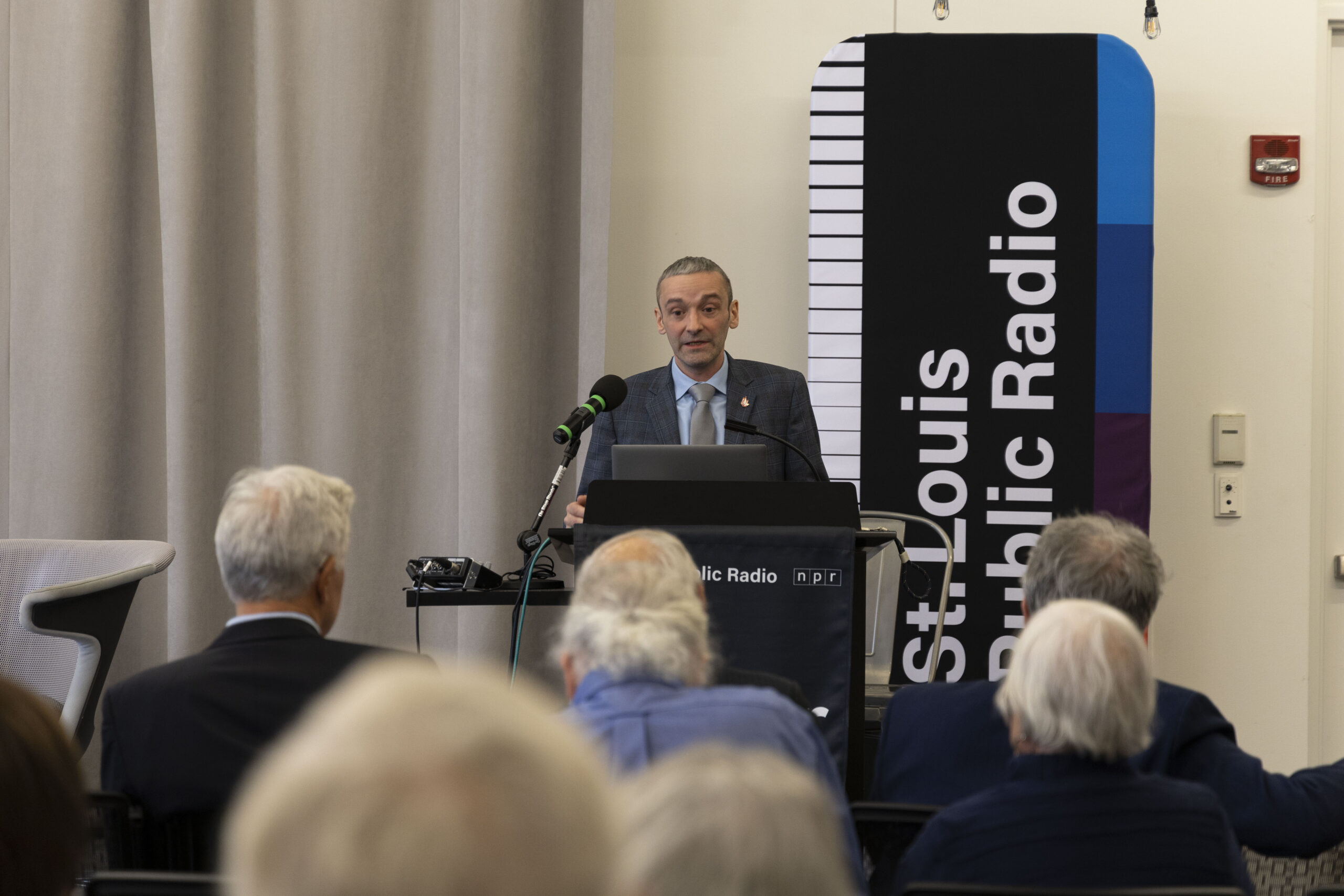
Klotzer worries about Trump tsunami but says U.S. is unlike 1930s Germany

Given his boyhood in Nazi Germany, one of the most obvious questions Charles Klotzer can be asked concerns the parallels he may see between that time and place and what is happening in the United States today.  His answers are somewhat encouraging.

Klotzer acknowledges he is surprised by the degree and speed with which President Donald Trump has been able to consolidate power.  “I never thought the democratic impulses (in the United States) would decline as much as they have already,” he said.  

Congress and the Supreme Court have yielded to the Executive Branch, he said, amidst little protest from the old-time (Republican) elite. “Their silence (the Bush/Reagan Republicans’) is partly responsible for the emergence of the Trump tsunami,” he said.

But on the whole, he said, he is still “confident” that what is happening now in the United States is only “a passing phase.”  Klotzer acknowledges he is optimistic by nature.

People on both the left and right in the United States, he said, profess loyalty to the Constitution, “the backbone of American values.  And I think there are enough people who (really) are loyal to it. … Even some of the judges he (Trump) appointed oppose some of the things he does.”

The American free press, Klotzer noted, also stands in stark contrast to the information environment in Nazi Germany, where Hitler used the Reichstag fire of February 1933 to terminate press freedom. In the United States today, the decline of local newspapers is “another dismal aspect of everything,” but strong national media institutions have done “a reasonably good job” of standing up to Trump, Klotzer said.  

Finally, the U.S. economy is immeasurably stronger than the crushed economy Hitler used to help him take power. 

All of this means the environment in the United States today is very much different from the one in Germany in the 1930s. 

“In Germany the whole population was caught up in the hypnotism,” Klotzer said. In contrast, Trump has made himself so unpopular that Klotzer  thinks the Democrats will do well in the 2026 election if it is free and fair — and the likelihood, he thinks, is it will be. By 2029, he adds, a Democrat could well be back in the White House.  

On a related topic, Klotzer also doesn’t see anti-Semitism in the United States as remotely comparable to what it was in Germany. 

Of course there is anti-Semitism in America, he said, but it “cannot be compared to the infiltration of the poison throughout Germany” during the Nazi period.

The Israeli government’s war policies in Gaza have contributed to the rise in anti-Semitism here, he added in an interview in September, a month before the recent cease-fire.  Those policies have been “unacceptable,” he said, and entirely contrary “to what Judaism represents, at least what it represents to me.”   

On His 100th Birthday — A Tribute to Charles Klotzer

When the earth unspools before the sun on Nov. 1, its cargo will include a human population of some 8.2 billion.  Of that total, the number able to claim residence for 100 years or more will be a mere 722,000 – .0088 percent. 

Roughly 1,300 of that group will be Missourians – of whom only about 200 will be men.   

One lives in University City and will be celebrating his centenary that very day.  A cane notwithstanding, he will still be walking with an erect carriage. His daily routine will still feature several hours reading The New York Times and the St. Louis Post-Dispatch (hard copies).  And he will still start most days by writing an email assuring his daughters that all is well.  Daughters, after all, must be humored.

This man is Charles L. Klotzer.  From an actuarial standpoint, he is one in 40,000.  From any other perspective, he is one in millions.   

His life story would challenge fiction writers, let alone statisticians: an Act I in Berlin, Germany, where three nights before his scheduled Bar Mitzvah his synagogue was destroyed in the Kristallnacht rampage; an Act II in Shanghai, China, where he spent nine years in conditions many refugees there found unbearable  (typhoons, intense heat, freezing cold, malaria, hunger); and an Act III – starting in 1948 – in St. Louis, where he achieved local and even a degree of national renown as the founder of the St. Louis Journalism Review (SLJR), now the Gateway Journalism Review (GJR).    

Klotzer will be publicly honored Sunday, Nov. 2, at the GJR’s First Amendment Celebration, at the Frontenac Hilton Hotel. The annual benefit. which previously has featured such eminences as Bob Woodward, Carl Bernstein and Judy Woodruff, will be headlined this year by Marty Baron, the former top editor of both the Washington Post and the Boston Globe. 

At least one ingredient in the GJR’s ability to lure heavyweights like Baron has been Klotzer himself.  He is widely respected not only for having founded the SJR in 1970 with help from his wife, the late Rose Klotzer, but for having personally subsidized it for decades despite modest personal circumstances.       

Written by volunteers from the local media and edited by Klotzer himself, the SLJR revealed issue after issue how journalism was not only a calling but a business. It also kept local journalists on their toes by exposing shortcomings in the way news was covered. It pulled no punches and won national as well as local journalism awards.  

Klotzer ran it until 1995; then gave it to Webster University; then took it back 10 years later when the university decided it would not subsidize its print edition any longer and would instead take it online – a plan Klotzer abhorred; then held onto it until finding a new sponsor in Southern Illinois University Carbondale (SIUC) in 2010. Editorial leadership is now provided by William Freivogel, a veteran St. Louis journalist and professor in the Charlotte Thompson Suhler School of Journalism and Advertising at SIUC, and Jackie Spinner, another veteran journalist and a professor at Columbia College Chicago.  Klotzer continues as an adviser.  

The GJR is now the last print journalism review in the country. (It publishes online too.)    Immodest as it may be to say so in these pages, it is a mouse that roars. Its circulation, print and online, is microscopic. But its coverage of such issues as racism, politics, the courts and police accountability has won it a footlocker’s worth of national reporting awards, including at least one in each of the last five years.  

Given his biography and legacy, the opportunity to honor Klotzer on his centennial is of course obvious.  But the reasons for celebration go much deeper.  Conversations with those closest to him show that the man is simply revered.

In part this is because the unselfish commitment he has shown in his journalistic endeavors is typical of his approach to life. “One of the great lessons that I think I learned growing up with him is, you do what’s right regardless of the outcome,” said Miriam Rushfinn, of Charlottesville, Va., his eldest of his three adult children. The others are Ruth Baruch, or Chicago, and Daniel, of St. Louis. Klotzer also has four grandchildren    

Publishing the SJR on his own nickel is only a part of the story.  Klotzer and his wife Rose resisted the white flight that seized University City in the late 1960s and unlike many other white parents, kept their three children in the public schools.  After Rose entered a long decline that ended in her death in 2019, Klotzer initially served as her “nonstop caretaker” at home, Rushfinn recalled.  Then, after she had to be institutionalized, Klotzer “was there all day long every day.  He just took his computer, he took his papers, and he was there with her every day.”  

In the broader world beyond the family, this strong moral compass typically points left. For example:

  • Having arrived from Shanghai in San Francisco, he chose St. Louis as the family’s destination in part because he thought one of the other options presented – in the South — would be too racist. (He also thought the Mississippi would be lined with restaurants, like the Seine or Danube.) 
  • Only a few years after arriving in St. Louis, he protested the exclusion of Blacks from the swimming pool at the YMHA (Young Men’s Hebrew Association). 
  • His first publication, FOCUS/Midwest, a magazine he and Rose published from 1962 to 1982, devoted significant space to social justice issues and carried columns by such noted liberals as Minnesota Sen. Hubert Humprey and former Post-Dispatch editorial page editor Irving Dillard. (It also featured poetry selected by no less an authority than Washington University’s Donald Finkel.)  
  • In 1988 he headed the presidential campaign in Missouri of Illinois Sen. Paul Simon, another strong liberal (and the person who, remarkably enough, gave him his start in journalism by hiring him, when he was still literally almost fresh off the boat  in 1948, as assistant editor of his family-owned Troy (Ill.) Tribune. Klotzer held the position until 1951.)  

What experiences forged this orientation? More specifically, when did it form? 

Sitting at his dining room table in a room crowded with file cabinets and papers, Klotzer looked this reporter in the eye and deadpanned, “November 1, 1925.” 

A trace of a smile followed. Then he added, “The social compact between people is now considered left.  But if you believe in Judaism, there’s no alternative.  The commitment to justice is paramount.” 

That commitment can exact a price, of course, and Klotzer at times has  been forced to pay it.  Receiving a draft notice in 1951, during the Korean War, he thought he would be excused when he explained he was the sole support of his elderly parents. But when the chair of the draft board made a racist comment during his interview, Klotzer let him know what he thought of it. 

He spent the next two years in the Army. 

A boyhood experience in Shanghai may be telling in this regard.  While Klotzer was a teenager, a group of anti-Semitic Russian refugees beat him up once after work.  A Jewish man who became aware of the situation invited him to join a boxing club. Klotzer went on to fight 12 matches, winning the first 11.  His last bout — for the lightweight championship of Shanghai – ended in a draw. 

“While I consider boxing a sport that should be banned,” he later wrote, “I must confess that the exercise and training instilled in me a lasting measure of self-confidence.”  

Rita Csapo-Sweet is a filmmaker and University of Missouri St. Louis faculty member who became close to Klotzer while making a documentary about him a couple of decades ago. Klotzer has an appealingly courtly, old-world manner whose impact is reinforced by his German accent, and “is a very kind person,” she said in an interview.  But he is “no one you can push around. There’s a border with him, a line in the sand.”    

With that kind of makeup, at least in Klotzer’s case, goes a quiet pride and self-confidence, as well as independence of judgment and action. Physically, those characteristics can be seen in his posture and gait. Verbally, they’re in his unwillingness to describe himself as a “Holocaust survivor,” Rushfinn said.  And in the details of his life story, they are everywhere.  

Klotzer was still a teenager when, due to “family dynamics,” he effectively became the head of his family, he told me.  (His mother, he says, was a down-to-earth woman who ran a toy store in Berlin, his father a well-liked actor and poet with tendencies toward fabulism and groundless optimism. By the time they reached Shanghai, Klotzer’s father was already in his late 60s, equivalent to what now might be his 80s.) In Shanghai Klotzer’s schooling, except for some business classes, ended at 17, at which time he got work to help support the family.  After the family had moved to St. Louis, they spent only a week in the “horrible” hotel selected for them by the Jewish Family Services Agency before Klotzer moved them – without permission – to a better one.  

It can hardly be a surprise, then, that after everyone Klotzer consulted told him that a magazine about social issues in the Midwest would surely lose boatloads of money, he started FOCUS/Midwest anyway.  (The advisers proved correct.)  

Nor should it be a surprise that in 1954, when he founded a short-lived newspaper for the St. Louis Jewish community, he justified the venture by arguing that the existing publication “was just a house organ for the Jewish Federation.”  And it also might have been predicted that when he started the St. Louis Journalism Review, he arranged for it to be funded out of a separate company, his FOCUS/Graphics typesetting firm, so Review advertisers – precious few that there were – could not influence the publication’s coverage.

 “Charles always had a firewall between advertising and the news and editorial sections of the paper,” Csapo-Sweet noted.  “In today’s world of corporate ownership of everything, he still stands out as a kind of example of how journalism can be done right.”   

Klotzer’s own account of his life story, published in the GJR three years ago, is notable not only for the story it tells but for the understated, just-the-facts style in which he tells it.  

A documentary film released in 2002, “Shanghai Ghetto,” depicts the environment in which the Klotzer family lived for nine years as a seriously overcrowded, unsanitary, diseased, impoverished hellhole. In his written account, Klotzer acknowledges that some of those who saw the film “wondered that the impression they had from me was not as depressing as the film.”

But for him, it really wasn’t that bad, he insisted in one of our three conversations in his dining room. “My own experience was much milder than what I saw there,” Klotzer said. “It wasn’t scary to me, it wasn’t exciting.  It wasn’t traumatic.”

(The room – crowded with stacks of papers, file cabinets, and boxes of awards and other memorabilia – is clearly much more about work than the consumption of food. Other rooms are stacked with book cases, overflowing and even reaching to the ceiling. Walls not covered by books are adorned with family photos, Judaic art, and prints by the likes of the Post-Dispatch editorial cartoonist Bill Mauldin and the prominent late artist LeRoy Neiman, who made them for covers for FOCUS/Midwest. The overall impression is not one of chaos, but it’s clear that learning and the preservation of history have lapped order as priorities in this house.)         

Klotzer enjoyed an active membership in the Boy Scouts in China, he said, as well as in a “Tikvah” club  (Tikvah means “hope” in Hebrew) where he socialized with other boys and young men, some of whom went on to careers of distinction in America and Israel. The Japanese occupiers were not hostile to the Jews.  Above all, he – and everyone – knew their situation would not last forever. The war was going to end.  

Her father, Rushfinn told me, simply had an ability, “based on his personality and outlook,” to “not absorb or act on the trauma.” She is grateful for this, she said, “because I think it helped in my upbringing to not have a father who was impacted by the Holocaust and Shanghai ghetto life in the same way as others.”   

In describing the family’s Shanghai years Klotzer does write touchingly about his mother wistfully eyeing a cup of coffee she could not afford to buy, and about her selling her wedding ring to pay for his tuition to classes at Shanghai Business College. But there is no pathos in his description of the Shanghai years for himself, despite all the obvious hardships.   

Likewise, in discussing his publishing ventures in St. Louis never mentions how hard he and Rose worked to simultaneously raise three children and put out two money-losing publications and run a typesetting business. Nor is there one word in this account of any of the honors or awards he has won. 

After Klotzer saw the first cut of Csapo-Sweet’s documentary about him, he was upset, she recalled. He thought Rose deserved more credit and screen-time. So Csapo-Sweet added more Rose. 

Klotzer met Rose Finn (don’t let the last name fool you, she was Jewish) at a Hillel (Jewish student union) event in 1948 at Washington University, where she was a student.  A native St. Louisan, she was extroverted, nature loving, and witty.  Soon thereafter he took her to a synagogue dance and found he liked the “very sensitive” way she responded to his lead.  Not long after that he asked her to marry him. 

No, she said.  She wanted to finish her education.  Five years later, with her M.A. in social work in pocket, she relented.  Everyone who spoke to the GJR about Klotzer said he is nothing if not persistent. (In that regard, it might also be noted that in 1954 Klotzer earned his own B.A. from Washington University in political science and English, having taken most of his classes at night from 1948 to 1951 and just his final year full–time. The thanks for the final year go to the G.I. Bill and, in turn, to the draft board chair who didn’t like his attitude.) 

Rose made one serious mistake during her many years of schooling, he told me in his customary wry deadpan. “She learned typing.”

That gave her the skills to help him with his typesetting business and his publications. So Rose, dropping her social work aspirations, joined Klotzer in his business ventures –and enabled them, actually, because paying a non-family member for what she did would have been impossible.   

It was not a reluctant partnership, observers agree.  Rose was all in.  In fact, Csapo-Sweet so deeply admired the collaborative relationship she saw between the Klotzers that it was one of the reasons she and her late husband “fell in love” with them, she said, and that she chose some 25 years ago to make her documentary about them. (“Who’s Minding the Media” can be found on her website at https://www.csapo-sweet.com/film-video/.  She is currently updating it.)  

Dancing with his wife was one of the great pleasures of Klotzer’s life.  “In dancing with Rose I felt like the conductor of a symphony,” he told me.  “We both followed and led.”

The couple would dance at Casa Loma or one of the other ballrooms in St. Louis on a monthly basis, he recalled. They won at least one tango contest. 

Dancing also fed his self-confidence, Klotzer said in a separate interview many years ago. As did, of all things, table tennis. 

Klotzer took up the sport decades ago and became accomplished. For years he played for hours at a time three days a week and traveled for tournaments. In his 80s, he was reportedly ranked ninth in the country for his age group. He loved not only the sport and the competition but the involvement with people with backgrounds and experiences he never would have otherwise met.  

Mark Sableman is a St. Louis lawyer who is also one of Klotzer’s longtime associates and close friends. “There is a joyfulness, friendliness, and attractiveness to Charles that belies all of the hard experiences of his life,” he said.  

“People like him,” he added.  “That’s why they want to help him.  He has charisma.”  

Jessica Z. Brown-Billhymer is a Gateway Journalism Review board member who has helped organize the annual First Amendment Celebrations for the GJR since their inception in 2011.   

“The reason I’ve done so much for the Review is because of Charles Klotzer,” she said flatly.

“He is a very humble man.  And genuine. And charming. And he knows what he wants. He sticks to what he believes is going to be right for the Review.”

Notice how that thought ends – with Klotzer’s support not for himself, but for the Review.  Perhaps this is his most distinguishing trait, intimates say: With Klotzer, it’s not about Klotzer. 

During his days in Shanghai it was about taking care of his parents. In St. Louis, it’s been about, first his wife and children and parents, then his publications and ideas, which is another way of saying his community. (Note: Klotzer’s parents died in their 80s, his father in 1962, his mother in  1973.  Both had lived the rest of their lives in St. Louis after arriving with Charles in 1948, and both, as previously noted, had depended on him for financial support.) 

As the GJR has attracted its roster of top journalists to speak at its First Amendment Celebration over the years, many people in Klotzer’s position would have made it their business to talk with them personally. The opportunity to enjoy at least a bit of reflected celebrity, if not do some network building, would have seemed like an obvious perk.  

Klotzer shakes his head. He can’t remember ever doing anything of the kind.  

Neither Rushfinn nor Csapo-Sweet is surprised. 

Said Rushfinn: “I don’t think it even occurs to him to have people pay attention to him just for him.”

 Said Csapo-Sweet: “That’s why I have to make the movie, especially in this period of cynicism and despair about the media.  

“A man like Charles L. Klotzer has to be celebrated.” 

Episode 1: When a billboard becomes a battleground

When a Proud Boys billboard went up near a high school in rural Illinois, the community had to decide where free speech ends and hate begins. In this episode of “The Free Speech Files,” GJR publisher and host William Freivogel talks with Capitol News Illinois reporter Molly Parker, who covered the controversy, about how a small town’s outrage led to the billboard’s removal — and what it reveals about the tension between First Amendment rights and community values.

A newsroom silenced: Inside Indiana University’s battle over student press independence

Update (11/5/25) Indiana University retreats from censorship decision; fired adviser files First Amendment suit

On Oct. 14, 2025, after weeks of dispute over what type of coverage could be printed in the 158-year-old newspaper, the university fired the IDS’ longtime adviser Jim Rodenbush and discontinued all print editions. While the university framed the move as a larger part of restructuring student media, the student editors, who refused to comply with their order of printing solely themed content without news, said they believed it was an act of retaliation.  

According to reporting by the IndyStar, the university’s decisions caused IU alumni to pull over $1 million in donations following the university’s decisions. 

In a letter to the IDS editors published on Oct. 30, IU Chancellor David Reingold said the IDS would be allowed to continue using its budget to print editions through June 30, 2026. While he stood by his claim that the decision to cut print “had nothing to do with editorial content,” he recognized that the university’s actions did prompt concern. 

“But perception, even when it is not grounded in fact, can carry the weight of reality,” he wrote. “I recognize and accept that the campus has not handled recent decisions as well as we should have. Communication was uneven and timing imperfect.” 

Following his letter, Mia Hilkowitz and Andrew Miller, co-editors-in-chief of the IDS, published their own letter, writing that they believe the decision was the “correct call” and that they’re now “on a solid trajectory toward real solutions for student media.” But they reported that they have yet to be engaged by IU administrators face-to-face, and requested for greater involvement of student leaders in The Media School’s plan to improve sustainability. 

“This is a win for student journalism, for editorial independence and our fight to bring quality journalism to our community — but more is needed,” the editors wrote. “We look forward to being at the table and taking more steps in the right direction.” 

The editors also called for more clarity on the university’s initial decisions. 

In Reingold’s letter, he said that the university cannot speak about the details of Rodenbush’s firing. Rodenbush filed a lawsuit against Indiana University on Oct. 30, allegeding his termination was a violation of his First and 14th Amendment rights. 

“This case presents the Court with an opportunity to serve its originally intended purpose: as a check on the executive and legislative branches, and to show the people of Indiana that it will not bend to the will of a government that suppresses the speech of its citizens and silences the press,” the statement of the case reads. 

Below is the original reporting by Carly Gist on Rodenbush’s firing and the initial university decision to block future print editions:

BLOOMINGTON, INDIANA — After officials at the Indiana University Media School ordered the Indiana Daily Student to stop printing hard news this fall and to limit its paper editions to themed or promotional content, co-editors-in-chief Mia Hilkowitz and Andrew Miller pulled out two sticky notes and drafted a plan for their next edition. If administrators rescinded their order, as the student journalists had requested, staff would print what they wanted, as they always had. If the restriction stayed in place, they’d ignore it and run an editorial on the front page condemning the attempt to control their coverage.

But before they could follow through on either plan, longtime adviser Jim Rodenbush was fired, and university officials blocked any future print editions of the 158-year-old paper.

The university framed the move not as retaliation but as part of a larger restructuring of student media. The timing told a different story. Two days before the Indiana Daily Student’s special homecoming edition was set to print – an issue that included both feature coverage and hard news – David Tolchinsky, dean of Media Arts, announced an update to the Action Plan for Student Media, a strategy that was created in October 2024 to eliminate budget deficits and preserve student media outlets. 

“As you may recall, the Action Plan, which was endorsed by IU Bloomington campus leadership, outlines a shift from print to digital platforms,” Tolchinsky wrote in an email to the editors. “In support of the Action Plan, the campus has decided to make this shift effective this week, aligning IU with industry trends and offering experiential opportunities more consistent with digital-first media careers of the future.”

Tolchinsky’s message left no room for negotiation.

On Thursday, Oct. 16, the day the print issue was originally scheduled to be out, the IDS published online only. Big red letters on the front page of the e-edition read “CENSORED.” Instead of ads, which they’d typically sell for print, the staff ran black boxes with messages about lost sales. 

The decisions, which followed a weekslong-dispute over what content could be printed, has led to scrutiny from First Amendment advocates and raised questions about press freedom and administrative control. 

“This is not about print itself. This is about the breach of editorial independence that the university is detecting,” Miller said. “We’re not going nuclear over print being cut. We’re going nuclear because the university cut print after deciding to censor our paper.” 

Timeline of events

When the action plan was first announced, IDS printed weekly, distributing copies on campus and in Monroe County. Beginning with the Spring 2024 semester, the plan reduced the paper to seven special editions per semester, which it identified as “high-revenue issues.” 

In addition to publishing online, the student journalists continued to print news coverage, and included the special editions as inserts in the paper. In an Oct. 20 interview with the Gateway Journalism Review, Rodenbush said the reduction saved the program around $20,000 during the spring semester, while continuing to generate revenue. Everything was working out great, he said, until IU leadership started pushing for the paper to focus solely on the themed content. 

“When the fall was coming, when things were about to crank up, is when I started to hear that the provost was concerned that he was still seeing newspapers in the newsstands,” Rodenbush said. “I believe that he likely thought that he was going to see ‘Homecoming Guide.’ But instead, he’s looking down and seeing the front page of the IDS with ‘Homecoming Guide inserted.’”

Following the second edition of the semester, which printed on Sept. 11, Rodenbush said the request became a topic of many meetings with administrators at the media school. He said he would relay the requests to the editors, but left the final decision to their discretion. As student media director since 2018, Rodenbush believed it was his duty to not interfere with content. Student media should be left alone, he said, because “it’s the perfect setup for training reporters for the real world.” 

On Sept. 25, the IDS printed the edition that would be their last. Rodenbush was called into another meeting, which he described as “animated” and says he was yelled at. 

Jim Rodenbush sits for a portrait near Dunn’s Woods at Indiana University Oct. 20, 2025, in Bloomington, Indiana. (Photo from Carly Gist).

“That was really when I first pushed back about what I was being asked to do,” he said. “I mean, I was basically being asked to ensure that the wishes of the provost were executed. And I began to push back about what that meant and censorship and editorial independence, and it’s not my decision — it’s a student’s decision.” 

Rodenbush said he persisted in his beliefs through two more meetings after that. On the evening of Oct. 7, he sent an email to Hilkowitz and Miller explaining what had been discussed: their next edition was to contain solely information about Homecoming; “no other news at all, and particularly no traditional front page news coverage.” He told the students that as an alternative, news could be distributed in the city of Bloomington, but not on campus. 

“It’s my understanding that this is an expectation, not a suggestion,” he wrote. 

On Oct. 14, Rodenbush was fired in a short meeting with an HR representative and Tolchinsky. The dean wrote in a termination letter that Rodenbush’s “lack of leadership and ability to work in alignment with the University’s direction for the Student Media Plan is unacceptable.” But the student editors say they believe it was a scare tactic — one that’s created a “chilling effect.” 

“We have other professional members, a lot of journalists and faculty, who swore to protect our First Amendment rights and support journalists,” Hilkowitz said, “and we just had a faculty member who had been doing this for years who was fired for doing just that.” 

The termination meeting took place at 4:30 p.m. Later that day, at 7:19 p.m., just before publishing an editorial on Rodenbush’s firing, Hilkowitz and Miller learned through email that IDS print was being discontinued. They asked for clarification, but did not receive a response. 

“I think they canceled print as a way to try to cover their tracks,” Hilkowitz said. “And I just hope that people realize that this is retaliatory.”

Dean Tolchinsky and Provost Rahul Shrivastav could not be reached for an interview. IU Chancellor David Reingold said in a statement that the decision “concerns the medium of distribution, not editorial content,” according to an IDS letter from the editors.  

“We uphold the right of student journalists to pursue stories freely and without interference,” Reingold said.

But as the situation reached national news, the backlash mounted. Ursula Stickelmaier, an arts editor at the IDS, was disheartened by the university’s response, and said administration “doesn’t value student journalism in a way that is substantial.” A Seattle native, Stickelmaier said she came to IU specifically for the newspaper. High-profile alum Mark Cuban, who donated $250,000 to the IDS months before print was cut, according to reporting by the IndyStar, took to X to express his disappointment, writing “censorship isn’t the way.” The Indiana University Bloomington Association of University Professors released a statement on Oct. 16 asking the university to reconsider its actions, which the organization described as “a clear violation of First Amendment protections of freedom of the press.” 

While the university said its decision to cut print was driven by business considerations and a shift to digital media, Hilkowitz and Miller say the move was unnecessary. They reported that the first three editions of the semester generated $11,000 from advertising, which they’ve now had to cut ties with, and that they’ve already largely focused on digital content. 

“We’re getting hundreds of thousands of page views every single month,” Hilkowitz said. “We have a very successful podcast. We just won a pacemaker for our multimedia…They’re going to say it’s a business decision. That is a completely illogical argument.” 

Rodenbush said that IU’s action plan made sense initially, when the paper was reduced to seven special editions, because it was content neutral. “The minute they made it about content is the minute that it crossed the line,” he said.   

The censorship debate 

In 1988, the United States Supreme Court ruled in Hazelwood v. Kuhlmeier that it was not a violation of student journalists’ First Amendment right to free speech when school officials at St. Louis’ Hazelwood East High School prevented the publication of controversial articles on student pregnancy and parental divorce in their student newspaper. Because it was a public high school, and the newspaper was sponsored by the school, the court ruled that the articles were state-sponsored speech and not public forums. 

IDS receives some funding from the university’s Media School; it is not funded by state tax dollars. In its fundraising disclosure, the IDS notes that it may accept funding directed at covering certain topics, but “remains completely independent of such funds in order to produce the highest quality journalism that best serves our audience.” 

Whether the Hazelwood decision applies to college publications has long been debated.

“If there is some sort of decision like cutting print, then that alone, in a vacuum by itself, is not onerous to the First Amendment,” said Jonathan Gaston-Falk, an education law attorney at the Student Press Law Center. “It’s when we have these connections where that is a retaliatory effort to stifle that voice, then we have a First Amendment problem.” 

Rodenbush said that he has served as an adviser for four university newspapers, including Penn State University, during the time that The Daily Collegian reported on Jerry Sandusky’s child sexual abuse. He said IU was the first time he’s experienced “attempted influence” from a university. 

But IU’s recent decisions are not the first time the IDS has been at the center of controversy. Hilkowitz said they’ve dealt with threats online and in person: angry emails, reporters being doxxed and readers visiting the office to confront staff. 

On Nov. 7, 2024, after Donald Trump was elected president for a second term, the IDS’ front cover featured an illustration of Trump accompanied by negative quotes from his former political allies. In a post on X, then Indiana Lt. Governor-elect Micah Beckwith incorrectly claimed that state tax dollars were funding the student newspaper, and wrote, “This type of elitist leftist propaganda needs to stop or we will be happy to stop it for them.” 

“We’re very used to receiving threats from outside, from people outside of IU, from other students outside the media school institution,” Hilkowitz said. “This is the first time where I feel like it’s a call coming from inside the house.” 

What now? 

Josh Moore, assistant director of SPLC, said it’s too early to tell whether the events at IU have spiked similar cases around the country. But requests to their legal hotline, which allows student journalists to speak directly with attorneys, has increased by 42% over the last two academic years due to many different threats. 

“This should be something that every single collegiate publication across the country is worried about. IDS, we’ve been around for 158 years. That’s a long time and we have a lot of resources, we have a lot of history behind us,” Hilkowitz said, adding, “If IU was allowed to do this, I worry that administrators at different schools who are looking to censor their student publications and their students will look at this almost as a blueprint for what to do there.” 

On Oct. 20, Tolchinsky, the media school dean, announced a formation of a student media task force at IU. In a press release, Tolchinsky said the task force, which will consist of faculty, staff, students and alumni, is to be appointed in the coming weeks. The goal of the initiative is to “develop recommendations ensuring both the editorial independence and financial sustainability of student media at IU.” 

Gaston-Falk, the SPLC attorney, said that he would like to be fully optimistic about the initiative, but that at first glance, it appears to be a distraction. 

“Administration is keeping itself busy, making it look like things are happening in order to assert its legitimacy, instead of actually engaging with some of its stakeholders on the ground like IDS editors and staff,” he said. 

Rodenbush, Hilkowitz and Miller have all been in talks with legal counsel. Rodenbush said his current intention is to sue IU. 

Despite his firing, Rodenbush said he never wavered in his decision.

“I understood that there were possible severe consequences,” he said. “But I had to do what was going to help me sleep. So I’m comfortable in that.” 

For now, Hilkowitz and Miller say they’re seeing support. Staff at Purdue University’s The Exponent published special edition newspapers in solidarity and drove two hours to deliver them on IU’s campus. Hilkowitz said she didn’t realize the workers at a nearby coffee shop knew her name until they offered her a free drink shortly after news broke that print had been cut. While preparing for a portrait on Oct. 20, a campus tutor stopped to tell them to keep up the good work. 

“We’re going to keep producing really great journalism,” Hilkowitz said. “We’ve been really lucky that this has really sparked a fire under so many of our staffers, and they’re ready to keep doing this important reporting. So as much as IU is going to try to stop the reporting from getting out there, they’re not gonna let that happen. We’re not going to let that happen.” 

Editor’s Note: This story is part of a series for the Gateway Journalism Review, produced with funding from the Pulitzer Center on Crisis Reporting. 

Carly Gist is the deputy editor of the Daily Egyptian at Southern Illinois University Carbondale.

Opinion: Who calls out the lie? Journalism’s crisis of courage under Trump

If you call a tail a leg, how many legs does a dog have?  The answer is four — because calling a tail a leg does not make it so.  That, in short, is both a lesson and a challenge for contemporary journalism.

The Trump Administration proudly shares video of our destruction of small boats in the Caribbean, killing all persons on them. Trump officials claim all were smuggling drugs. That untested claim then is extrapolated as a reason to: ignore international law; skip the legal steps of Coast Guard boarding, seizing, charging; and building an argument that our nation is at war with drug cartels—likely a fig leaf for attacks on Venezuela, even though other nations are more prolific in sending illegal drugs into the U. S. With rare exceptions, journalists do not challenge this nonsense. Those who do are assailed by Trump acolytes who claim they clearly are soft on drug cartels.

Congress struggles through a shutdown. Republicans on Capitol Hill falsely claim that Democrats are seeking to extend health care benefits to illegal aliens. President Trump even takes to social media to post manipulated images of House Minority Leader Hakeem Jeffries in a sombrero. Many major news organizations pushed back on both the falsity and the juvenile post, but several did not.

The Trump Administration claims unprecedented authority to make and modify tariffs, deploy the military in American cities, and scoff at the Constitution’s Emoluments Clause as Trump and his family rake in money from government-connected grifting.

Trump insists that his hires adhere to a trio of false claims: that he was not assisted in the 2016 campaign by Russian interference, that he actually won the 2020 election, and that the numerous prosecutions of him (including one that yielded guilty verdicts on 34 felony charges) all were illegitimate. These solidly debunked claims are a nefarious trilogy that serve as a pretext to his political prosecutions of anyone who stood in his way, and firings of anyone who refuses to assist in the revenge.

So, how should news organizations respond to this firehose of falsity? Aggressive, critical, and independent reporting is a must, but unfortunately many news outlets and other media organizations are going in the wrong direction. As July came to a close, Washington Post Fact Checker Glenn Kessler took a buyout and ended almost 28 years, more than 14 as lead fact checker, at that news outlet. He estimates that during that time he wrote or edited roughly 3000 fact checks, rating claims of both Democrats and Republicans on a Pinocchio scale. It was Kessler who tallied Trump’s first term at scoring roughly 21 lies per day, a figure that only escalated as Trump obtained a second term.

Kessler wrote, “Social media helped fuel the rise of Trump —and made it easier for false claims to circulate. Russian operatives in 2016 used fake accounts on social media to spread disinformation and create divisive content —tactics that led companies such as Meta to begin to use fact-checkers to identify misleading content. But the political forces which benefited from false information —such as Trump and his allies —led a backlash against such efforts, saying it was a form of censorship. Now tech companies are scaling back their efforts to combat misinformation.”

At the start of this year, Mark Zuckerberg ended independent fact checking on his Facebook and Instagram platforms, retreating to  wimpy “community notes” replies modeled after Elon Musk’s X / Twitter. Google has ended its ClaimsReview program that elevated fact checks in search results.

Of course, 2024 closed with both the Los Angeles Times and Jeff Bezos’ Washington Post spiking endorsements of Kamala Harris for president. Bezos has gone on to dictate that his editorial page henceforth will be devoted to advocating free markets and personal liberties. Recent staff departures and the hiring of three conservative columnists seem to be steps to advance that decision.

ABC News capitulated on a Trump nuisance lawsuit about whether the civil judgment finding him liable for sexual assault can be simplified to rape. CBS News did something similar on a dubious lawsuit on video editing, and later gets stuck with a right-wing columnist as its news editor in chief. Both parent companies, Disney and Paramount/Skydance, appear from the outside to be greasing the skids for business deals by trying to mollify the whiner-in-chief.

We are slipping into a pattern of billionaire owners quelling good reporting that questions when government officials call a dog tail a leg. The opposite direction is what is needed. Add fact checkers and highlight their work. Look askance on any news story that includes the phrase “Trump said…” His veracity is suspect on a scale not even close to that achieved by other politicians. Quote Trump less and look more into his actions and those affected by them. Do not cover his speeches live. Too much malevolence and lying will pour forth ever to be corrected adequately. Comedy programs should consider replaying his speeches with sound effects, like buzzers for lies and slide whistles for personal attacks.

Those of us in journalism education must stress the absolute primacy of accuracy. Secondary virtues, such as fairness and balance (part of early Fox News slogans) cannot be used as a cudgel against accuracy. We do not need to quote or put in a broadcast a flat-earther every time we cover a story involving a spherical Earth. Not all ideas are created equal. Some are well established by empirical science; others are logical fallacies or dubious speculation that skip peer review and confuse correlation with causation.

These are perilous times for both journalism and democratic self-governance. Journalism must not shrink before the challenge by promoting puffery or slipping into the dodge of “both sides,” when one side is using that trope against both accuracy and informed self-governance.

Mark Harmon is a professor of journalism and media at the University of Tennessee, Knoxville.