Tag: war reporting

Hostile training uses virtual reality for journalists to prepare them better for conflict zones

Two American journalists were killed within days of each other this week in Ukraine,  a reminder of just how dangerous it is for correspondents covering war.

Award-winning Arkansas filmmaker Brent Renoud and Fox News cameraman Pierre Zakrzewski  both died on the urban battlefield in Ukraine. Ukrainian journalist Oleksandra “Sasha” Kuvshynova, also reporting for Fox, was killed alongside Zakrzewski.

But while their deaths grabbed headlines and highlighted the particular risks for war correspondents, journalists who report on civil unrest in the United States also encounter dangers.

(Photo courtesy of Eric Huybrechts via Flickr)

To address that, a new company created by former conflict reporters is training journalists using VR technology to help better prepare them for risky assignments at home or abroad.

Head Set was formed by Aela Callan and Kate Parkinson, journalists who worked for a combined three decades covering wars, natural disasters and high risk assignments all over the world.

The London-based company uses VR instead of the more common conflict training called HEFA, or Hostile Environment and Emergency First Aid courses, which many conflict reporters take before heading into war zones. HEFA also relies on simulations but does them in real time, with actors. 

“You’re reliant on the quality of the actors who do that and you always know it’s a simulation,” Callan said. “With VR, it tricks the mind and ignites the physiology of what you’re feeling.”

Callan added that there still is a place for traditional HEFAT courses, but the technology used by Head Set could be a game changer.

U.S.-based journalists also rely on HEFAT for domestic dangers while reporting. The International Women’s Media Foundation, for example, works with reporters on first aid training during protests. 

“We’re not saying there’s not a place for that anymore. We’re saying journalism has moved on. The threats are different, the way we approach it is different and now we have the technology to do something that really changes the game,” Callan said.

The company plans to add modules for conflict, particularly given what is happening right now in Ukraine.” As you can imagine, VR would be extremely effective at simulating live weapons fire, etc. ” The creation of these will be driven, of course, by funding and demand from clients. One scenario that is being explored is several organizations co-funding this.”

Head Set is developing a scenario right now with the international nonprofit Internews, “which directly applies to online threats reporters who are covering the war in Ukraine are facing,” Callan said.

Along with five other journalists, this reporter took part in a recent Head Set training at no cost over Zoom (with the VR headset sent in advance) that was sponsored by the James W. Foley Legacy Foundation.  And while the VR experience was the most unique aspect of it, it only lasted about 20 minutes of the four-hour session. The rest of the time was focused on discussion of what took place, the experiences of the attendees, and perhaps most importantly, how to recognize and deal with levels of stress. 

As for the VR itself, the civil unrest module (the company also has an extreme weather course) put the participant in the middle of a London protest that turned violent. The “people” in the VR are composed of vector lines, which while they do not look “real” — because of the sound effects and conversations heard, still give one the feeling of actually being there.

“When I first looked at the graphics I thought, ‘I’m not going to feel like I’m in that space,’ but a minute or so in, I had the same feelings I would have in those real situations,” said Angus Mordant, a New York City-based freelance photographer who has covered civil unrest related to the murder of George Floyd and Covid-19 mask protests. “I started to sweat a little bit and my adrenaline started to shoot up, so it definitely worked.”

For Philadelphia-based photographer Kriston Jae Bethel, it was comforting to be able to make a mistake without it costing anything.

“I think being able to experience that in a safe space where a mistake won’t cost you a trip to the hospital or worse is very valuable,” Bethel said.

Callan said there is a reason why the VR characters do not appear very lifelike.

“There’s this thing in computer game development called the uncanny valley which is the more realistic you try to make computer animation, the less our brains trusts it. So, we let their mind find in the blanks with the visual style that we created using motion capture and it tricks us into thinking we’re surrounded by people when actually we’re surrounded by vector lines,” she said.

Add to that realistic sound effects, and it is not hard for participants to believe they are actually in a dangerous situation.

“I was kind of blindsided by how realistic the sound and emotional undertones of the situation we were put into,” said Jonathan Cherry, a Louisville-based freelance photographer. “It’s less about how good everything looks rather than the context of the situation and the amount of details.”

Along with the James W. Foley Legacy Foundation, Head Set is currently working with Vice Media, Thomson Reuters, Associated Press, BBC and Internews, Callan said.

“They are a women-owned company so that was appealing,” said Foley Foundation Education Program Director Thomas Durkin. “We also liked that they were people who worked in hostile environments. And for the cost of covering HEFAT training for between five and nine journalists a year, we can now cover 30,” Durkin said.

Head Set provides the VR headsets and a trainer for each organization it works with, tailoring the experience for each one depending on its needs, Callan said. An additional positive is that participants can attend the course from their home — saving money on traveling and reducing any COVID-19 concerns they have while the pandemic continues on. The company is also working on new features that will allow the user to see his heart rate and stress level in real time. 

She added that the motivation remains the same — to try and keep journalists as safe as possible and to try and ensure people want to keep working. 

“Right now journalism is under threat from all angles,” Callan said. “We wanted something to empower journalists to feel like they want to stay in the job. We want journalism to survive, especially freelance journalism and that’s what drives us to do this.”

Bob Chiarito is a Chicago-based freelancer who has written for The New York Times, Chicago Sun-Times, Agence France-Presse and Thomson Reuters.

Local news outlets can help readers vet credible sources of information on invasion in Ukraine

This morning as soon as I woke up, I went immediately to search for news from Ukraine. It’s hard to imagine a more important, more devastating story gripping the world right now.

It is not a local story for much of America, yet, and its significance is undoubtedly greater to those of us who lived through the Cold War. I spent much of my childhood with the possibility of war with Russia, with nuclear bomb drills and fictional depictions on TV that didn’t seem far-fetched.

The top foreign policy story that consistently captivates many Americans these days is climate change, according to the latest Pew Research survey.

(Photo courtesy of Mark Steele via Flickr)

Russia still matters. It mattered enough to be a survey question for Pew, which asked respondents whether limiting the influence and power of Russia should be a top foreign policy priority of the US government; between 37 and 45 percent indicated it would, a spread that reflects whether they believed international cooperation was beneficial to solving the problem. 

It begs the question: what role, if any, do local news outlets have in even covering this story?

We are the referee in a news information battle, throwing flags when we need to and making the hard call after seeing the replay. People trust us, at least more than they trust national news.

We have an obligation to our readers to point them to credible news sources about Russia and Ukraine, even if we may not be covering the story ourselves. Russia’s propaganda machine is effective at influencing our readers. We know this well from the 2016 presidential election. At the smallest, most local levels, the Russians were there to steer our readers in one direction, to create dissent, to occupy the agenda. They’re already in our comment sections. Do our readers know how to spot a troll? 

This is the time to partner with a local public radio or TV outlet, to team up to promote news literacy on this story. Instead of simply interviewing the Russian and Eastern European experts at the community college or other educational institution, I would ask them to help explain to readers where readers can go to find more information, to find credible information. I’d share the Instagram names of Ukrainian photographers; they’re not hard to find. I’d provide links to English-language Ukrainian news outlets like the Kyiv Independent. Let people get news directly from the source if they don’t like our filter.

Even if our readers have grown tired after 20 years of war in Afghanistan, we can explain why this is different. For 77 years, international order has maintained that big countries don’t take smaller ones by force. Such an order has given us peace for decades even though it may not seem that way. 

Even with the civil wars and regional conflicts, that order has enabled global cooperation to bring people together to try to solve problems of climate change, refugees, terrorism and yes, even the pandemic. It has opened trade.

A world in which Russia can grab what it wants because of its size and military power is not a world that makes the lives of our readers better. In fact, it’s a world with deep economic costs. It’s a world that will make it harder to solve the local problems that vex us because we will be too distracted by the big ones. 

I personally do not want my children to grow up under the threat of nuclear war. I don’t want them to grow up in a world in which America’s power continues to be diminished, where big is better, where small is at risk. I don’t want our external threats to hog the attention; our internal ones, which the Jan. 6 insurrection showed, are also real.

But mostly, I don’t want our readers to turn away, and I know, after decades in the business, that they will if I don’t give them a reason not to.

A version of this story first appeared in Publisher’s Auxiliary, the only national publication serving America’s community newspapers. It is published by the National Newspaper Association. GJR is partnering with Pub Aux to re-print Jackie Spinner’s monthly “Local Matters” column on our website. Spinner is the editor of Gateway Journalism Review. Follow her on Twitter @jackiespinner.

Local news outlets should avoid false equivalency in reporting on Covid vaccine

A recent investigative report from NBC News highlighted the danger of our pursuit of false equivalency. 

As the Covid-19 vaccines have started to roll out across America, anti-vaxxers are increasingly getting the kind of mainstream news attention they’ve long sought from local news.

Outlets reporting on the vaccine have described the anti-vaccination activists as advocates for “medical freedom,” or “informed choice,” the same language the movement uses to elude online content moderators and appeal to the mainstream media, the report found

We have an obvious obligation as journalists to report critically on the vaccine, including what is already emerging as a potential risk for people with a history of severe allergic reactions. We also should report on concerns our community members may have about the vaccine. That is our role.

Machinist’s Mate (Nuclear) 1st Class Jason Zeger, assigned to the U.S. Navy’s only forward-deployed aircraft carrier, USS Ronald Reagan (CVN 76), receives the COVID-19 vaccine on Commander, Fleet Activities Yokosuka (CFAY). (Art from Flickr)

But anti-vaxxers as a movement do not deserve our attention unchecked. They certainly do not deserve the same weight in our news coverage as scientists and members of our health care organizations. 

Few local news segments featured doctors or public health advocates to counter the anti-vaccination misinformation, according to the NBC investigation. That means the anti-vaxxers, who already have caused serious damage, are getting a pass to oppose the Covid-19 vaccine as we justify including “both sides.”

Just as there are not two sides as to whether masks can prevent the spread of the coronavirus, there are not two sides on science-based reporting on the vaccine. 

Anti-vaxxers are responsible for measles outbreaks in Western countries where the measles virus was previously considered eliminated. We, as journalists, cannot allow them to gain traction on the Covid-19 vaccine, particularly among communities of color that are rightfully suspicious of the vaccine given the long history of experimentation on them against their will.

The anti-vaxxers are taking advantage of the fact that most of our newsrooms do not have the health reporting expertise to question the language they are using. In acting as stenographers and not reporters, we are doing a disservice to our communities in helping them spread a message that has been debunked.

The anti-vax movement started out of unfounded fear that childhood vaccines could lead to autism. They do not. My oldest son is autistic, and I remember someone asked me once if I were scared to vaccinate my middle son. No, I wasn’t. I was more afraid of my infant getting measles before he was old enough to be vaccinated. My uncle died as a toddler of complications from the disease before it was introduced in 1963.

As a war reporter, I saw villages in Afghanistan ravaged by polio, long after most of the world had successfully eradicated the disease. 

I read science-based journalism, and I consider myself an informed parent and medical consumer. You don’t have to be an expert to question.

It’s important that we don’t get bullied into his notion that anti-vaxxers deserve a loud voice in our stories, not if we aren’t willing to question their claims. We can do stories on how the movement is taking advantage of fears in the pandemic. We can do stories about the movement in our communities. But we should not allow them to be “the other side” to stories reporting on the Covid-19 vaccine.

It is not responsible. It is dangerous. It is wrong. 

A version of this story first appeared in Publisher’s Auxiliary, the only national publication serving America’s community newspapers. It is published by the National Newspaper Association. GJR is partnering with Pub Aux to re-print Jackie Spinner’s monthly “Local Matters” column on our website. Spinner is the editor of Gateway Journalism Review. Follow her on Twitter @jackiespinner. 

‘If the coronavirus is a war, Americans have picked a team’

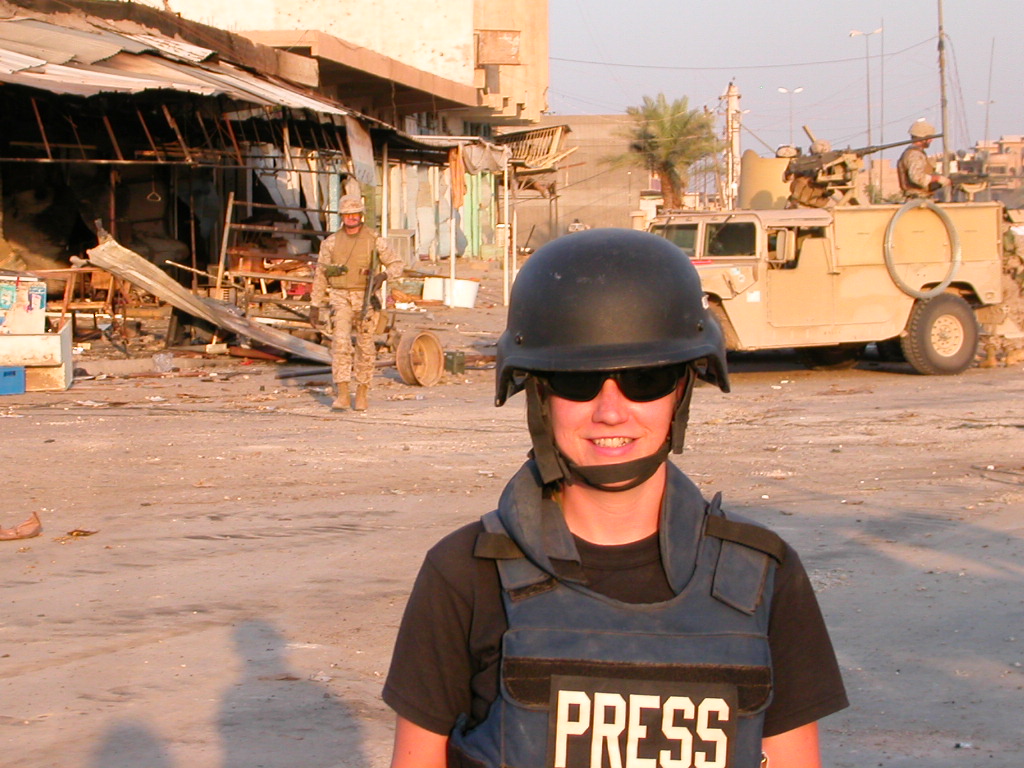
There is a weariness about life at that moment that I haven’t felt since I was in Iraq reporting on the war.

War reporters are used to risk calculations, and it’s an odd thing to get used to, but we do it because otherwise everything would feel too dangerous or nothing would. When nothing feels dangerous, it’s time to go home. That’s when reporters take risks they shouldn’t and end up getting hurt. It’s necessary but exhausting having to think through every decision.

I thought once I put my flak jacket away that I wouldn’t be making those kinds of calculations again.

(Photo courtesy of Jackie Spinner)

But when I went for a haircut this summer, my first since the pandemic started, I found myself doing the same checks I used to do before going on an embed with the Army. I sat in the quiet of the car for a few moments to get focused. Before I got out, I put sanitizer on my hands and checked my facemask to make sure it was sealed properly. At the door of the salon, I looked inside to see if everyone was wearing a mask. When I went in and learned my stylist was late, I left immediately to wait outside in the fresh air. As people walked past, I moved back to give us both space. I was in the same mode when I went on a foot patrol with the military. It unsettled me how easy it was to slip back into the kind of alertness, the mindset that everyone could potentially be a threat.

If you’ve never been to war, you may not understand. In fact, if I shared this story on social media, I’m sure I’d hear from all sides of a polarized America. If the coronavirus is a war, Americans have picked a team. But my calculations had nothing to do with politics. For most reporters in a war zone, for most soldiers even, politics don’t enter into risk calculations.

That makes it challenging to cover this story, particularly when many of our readers are making decisions based on politics. We can’t be divorced from the actual experiences of our readers because we are living them, too. But we also can’t afford the appearance that we have abandoned our attempt to be objective in telling them.

On a recent assignment in rural Indiana, I listened to understand someone I didn’t personally agree with, although he didn’t know it because I didn’t tell him what I thought. I wore a mask; he didn’t. From a distance, I asked my questions and got my story without getting into a debate because that isn’t the point of what we do. It’s to listen.

As we cover the pandemic, we owe it to our readers to listen to understand and to seek out a diversity of opinion, not to present a false equivalency but rather to make certain that we aren’t leaving out voices in our community. We do that by borrowing from the unspoken manual of the reporters who covered the wars in Iraq and Afghanistan.

We have a responsibility to be a witness, even if doing so puts us at some risk. We can mitigate the risk by arming ourselves–and our staff–with the gear needed to keep everyone safe, by having protocols and following them. We should withhold judgment from members of our newsroom staff who feel skittish about certain risks. Someone else will step up. Not everyone in my newsroom volunteered to go to war, and that’s okay, because if everyone is on the frontline, nobody is in the control room with a landscape view.

As we move through our communities talking to people, we need to remind ourselves and our staff that our opinion doesn’t matter. It’s been more than a decade since I returned from war, and I’ve given dozens, if not hundreds, of interviews and speeches about my experience. I wrote a book about it. I have not once publically shared whether I thought it was a good or a bad idea for the US to invade Iraq. I haven’t shared it in a classroom. I haven’t talked about it on social media. My opinion simply doesn’t matter. What matters is my experience, the stories I captured, the voices of the people who interviewed.

We need to show people how we do our job. That’s different than making ourselves central to a story, but if we are going to keep or earn back our community’s trust, we need to explain the decisions we make and what motivates us as journalists. We can lament the media illiteracy in our country, how people don’t understand the difference between news and editorial, but if we don’t work to fix it, we will end up the real losers in the war on truth because there will be nobody left to amplify it.

Our credibility is more important than our bravery. That’s something I learned early on in my years covering the war. We need our credibility to cover the decisions our school districts are making to reopen or stay remote in the fall. We need our credibility to cover mask mandates from our local officials. We need our credibility to cover the stories of our healthcare and frontline workers. We need our credibility to cover our emergency responders and the people they encounter and are charged to care for and protect. We need our credibility to push back against misinformation and hoaxes, against the countless memes that compete with our own fact-checked reporting.

In the end, of the many lessons I carried from the battlefield, perhaps this is the most important one. We need to be vigilant in guarding our credibility. But we also need to make sure that we get it right. The science is–and will continue–to change. We can explain to our readers that science evolves as it is tested and researched. Policies will be made and will be rejected to reflect both the science, the political will of the people making them and, frankly, the will of the people who put them in charge. We serve our readers best when we not only hold these policymakers accountable but also ourselves. We serve our readers best when we remind them that in war, we are all human.

A version of this story first appeared in Publisher’s Auxiliary, the only national publication serving America’s community newspapers. It is published by the National Newspaper Association. GJR is partnering with Pub Aux to re-print Jackie Spinner’s monthly “Local Matters” column on our website. Spinner is the editor of Gateway Journalism Review. Follow her on Twitter @jackiespinner. 

Reporting the coronavirus story feels familiar to a war reporter

My physical world, like many of ours, has become smaller in recent weeks even as my digital world has expanded. I’m working from home, and as an editor, I don’t have to be out reporting in the community to do my job. I can minimize the risks of exposure (for me and my family) to the coronavirus. 

Not everyone can. Photographers and reporters are still in the community, working on the frontlines to bring their communities information on a fast-changing news feed, to report on overwhelmed hospitals, the suddenly unemployed, closed schools, citizens staying home and citizens defying orders not to stay home. Some are getting sick. The world has changed virtually overnight, so much so that it’s hard to imagine it ever going back to the way it once was.

The coronavirus story is unlike any most of us have covered in our careers. But something about this also feels familiar to me. 

For months at a time when I was reporting for The Washington Post in Iraq, I was stuck in our bureau in Baghdad. It was dangerous for Western journalists to leave our guarded perimeter because we were targets for kidnapping. Iraqis who traveled with us were in danger because of their association with a U.S. media organization. It was safer for our Iraqi correspondents to go alone and they often did, reporting for us much of the time. When I did go out, I was constantly on guard, scanning faces for potential threats, watching vehicles that got too close. I also was afraid of getting blown up.

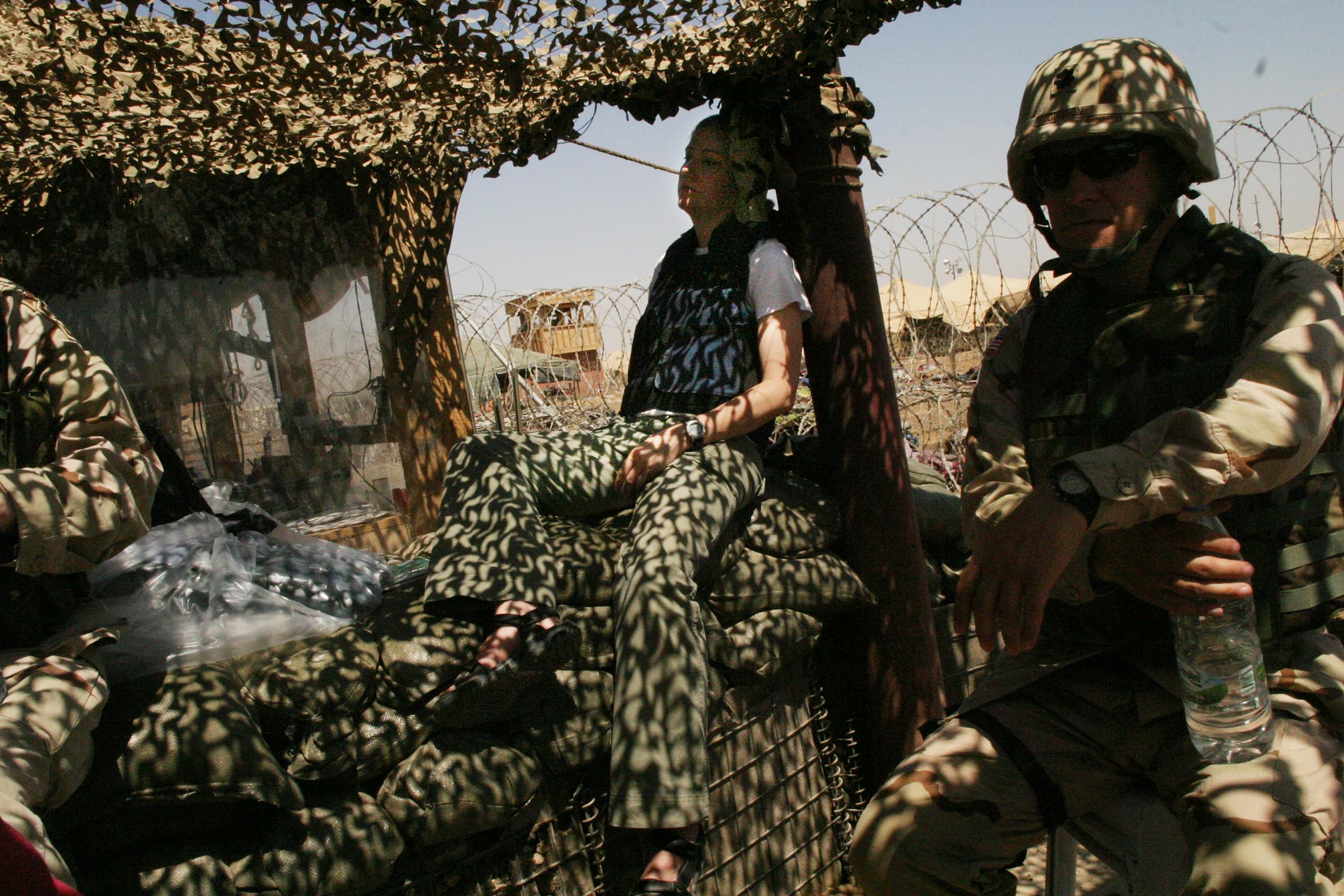
Jackie Spinner rests on a pile of sand bags at Abu Ghraib prison in Iraq while reporting for the The Washington Post. (Photo by Andrea Bruce)

It wasn’t ideal to cover a story this way, relying on someone else to report from the community where I was holed up in a fortified house with a garden and a swing set. It didn’t feel like journalism without seeing for myself what was happening, without looking at someone while I was interviewing them, watching body language, asking follow-up questions or pivoting based on a response. It was frustrating being in a war zone, itself a danger, and not really being able to cover the people living with the war. 

Unlike some of the other major media organizations, The Washington Post gave credit to our Iraqi team members who were out in the streets. They got bylines if they wanted them. We also took their safety seriously and supported them as best as we could with the gear they needed. After the U.S. correspondents left, after the story shifted to another part of the world and our bureau closed, we wrote letters of support for their refugee and immigrant applications. Once they arrived in America, many of us kept in touch, checking up on each other, telling stories of shared experiences, remembering.

Not everyone was physically okay. Not everyone was mentally okay.

PTSD seemed like a tornado that destroyed three houses in a row and left one, miraculously, mysteriously, untouched. I was nearly taken out by post traumatic stress and yet managed to emerge after a year or two of complete misery to a shining sun that awaited me. 

There are lessons in this for community newspapers whose videographers and photographers are on the frontlines of the pandemic, for our brothers and sisters in broadcast news whose camera people and reporters are still out covering the coronavirus. 

There are lessons for us who are able to work from home even if it’s not always easy within our protected walls. 

The lesson is grace.

The lesson is compassion.

The lesson is care.

Managers need to take particular care of their frontline reporters and photographers, supplying the tools they need to protect themselves and sending a message that risk can and should be calculated. They should not ask their photographers and reporters to go inside people’s homes. They should not ask that they get closer than they feel comfortable. No one should feel as if their career depends on them taking risks to tell this story. When reporters or photographers get sick on the job, they should be offered paid sick leave. My own publisher, Don Graham, told me when I left for Iraq the first time that no story was worth my life. I knew he meant it, and I carried his care with me into a different battlefield.

No story is worth exposing our team members to the coronavirus or to putting our communities further at risk even as we pledge–and we should, to stay on the story, to give people information that is vetted and fact-checked and put into context.

But this is hard. Many of us are trying to work while also caring for family members and home-schooling our children. Some of our colleagues are still reporting in the community and worrying about bringing the virus home. Or worry about getting sick, and if they do, how bad it will be. 

We need to be compassionate. Based on our individual life experiences, based on our biological make-up, based on whether we have experienced trauma in the past, we will all react differently to the threat of the coronavirus. It’s okay to be scared and frightened; it’s okay to be a little overwhelmed by the uncertainty, and that’s a message we need to send to each other.

The mothers and fathers on our team need extra compassion. The young members of our team who are isolated from friends need our compassion. We need compassion. This is a time to take care of each other, to listen, to pull back on the demands. Your news operation will not crumble if you do. Our news operation in Baghdad did not fall apart when we were kind to each other and cut each other some slack on the days we just couldn’t muster the courage to take another risk. Or when we were tired. Or when we missed home.

I learned grace being a journalist in a war zone, a grace that was hardest to offer myself. It’s not easy to balance this real responsibility we feel to our profession and to our communities with the need to take care of ourselves. We need to remind ourselves that it’s okay to stop to play a round of Candyland with a 3-year-old. We need to know that our supervisors understand, that our colleagues understand. We can be that supervisor. We can be that colleague.

On the other side of this, the world will have changed. But we will have changed, too. That’s a story we will eventually write. But we don’t have to write it today. 

A version of this story first appeared in Publisher’s Auxiliary, the only national publication serving America’s community newspapers. It is published by the National Newspaper Association. GJR is partnering with Pub Aux to re-print Jackie Spinner’s monthly “Local Matters” column on our website. Spinner is the editor of Gateway Journalism Review. Follow her on Twitter @jackiespinner.