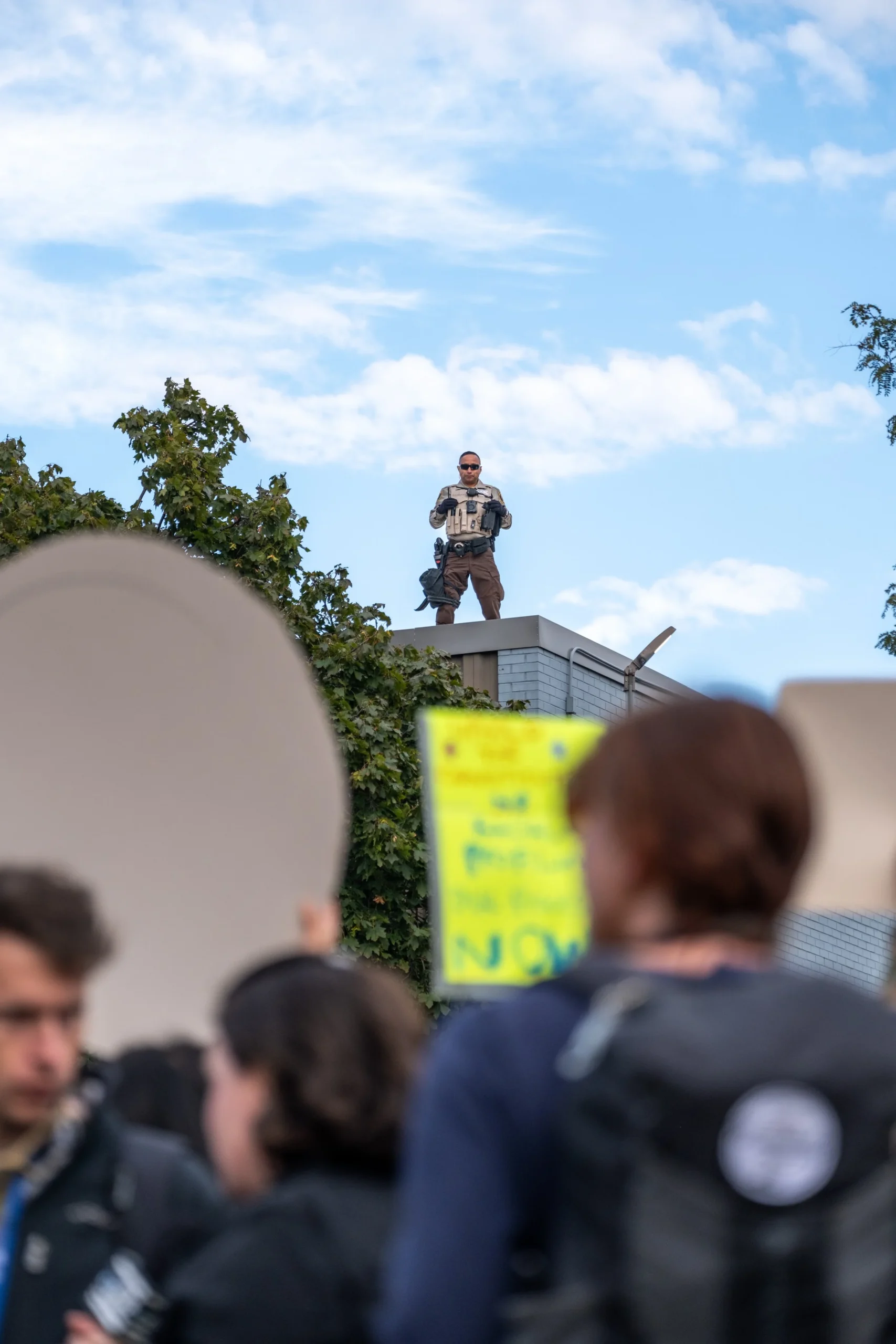
On a fall morning, freelance photojournalist Kenn Cook Jr. arrived at a protest outside a U.S. Immigration and Customs Enforcement facility in suburban Chicago.
As the crowd grew louder, Cook looked up. Federal agents stood on the roof, watching. An American flag moved in the wind beside them. He raised his camera and took the photo.
Weeks later, in Memphis, Cook documented a different kind of aftermath. Residents, shaken by immigration raids, weighed whether to speak publicly.
One woman let him into her home to photograph what was left behind after agents took her husband away.
Since last fall, as immigration enforcement has intensified in cities across the country, photojournalists say the conditions for documenting those moments have shifted, with tighter access, more aggressive tactics and growing uncertainty about how to safely do their jobs.
For Cook Jr., that has made safety a collective effort among photographers working in the field.
“A lot of photojournalists are very supportive of one another and sharing resources and tips to stay safe,” Cook Jr. said.
That reality is not limited to Chicago or Nashville. In December 2025, a surge of federal immigration agents in Minneapolis drew photographers from across the country, turning the city into a focal point for documenting enforcement activity.
For photographers on the ground, the scale and speed of those operations changed how they worked.
“There were thousands of agents in the street, so the strategy had to be a lot more, like, how do we find these people? How do we document what’s going on? How do we pick what’s important? How do we stay safe?” said Alex Kormann, a staff photojournalist for the Minnesota Star Tribune.
The scale of the operation forced photographers to rethink how they worked in real time. But beyond logistics, some said the coverage felt emotionally familiar.
“The overall impression that I had from the start is that it just felt like it was really similar to all of the other really tragic events that Minnesota has gone through in the past year,” said Zach Spindler-Krage, a staff photographer at Carlton College in Northfield, Minnesota, who has covered immigration as a freelancer.
Spindler-Krage also covered the aftermath of the Melissa and John Hortman assassination, when Vance Boelter shot both Minnesota House of Representatives Speaker Melissa Hortman and her husband, John Hortman, in June of 2025. Additionally, Spindler-Krage was one of the first photographers to arrive at the Church of the Annunciation after a shooting in August 2025.
“You get to these vigils and they all feel just eerily similar,” Spindler-Krage said. Community members of Minnesota have expressed their concerns that these deaths were avoidable. “It’s just like this profound sense of sadness and mourning,” Spindler-Krage said.
After the death of Reneé Good, a Minnesota woman shot by an ICE agent, it didn’t seem like there would be a stop to the raids. “My impression was that it felt very similar, and yet it felt like there was no ending point,” Spindler-Krage said.
When covering conflict, an important value to Cook Jr. is to remain unbiased.
“I am making the images that really tell the story,” Cook Jr. said. “I am telling it objectively so that people are getting the truth when they see this.”
As immigration enforcement intensified, that work drew photographers from across the country, turning cities like Minneapolis into a national focal point.
“At the peak of the immigration [enforcement] here, there were hundreds of photographers,” Kormann said.

The influx of national media can complicate coverage, particularly for local journalists who must continue reporting in those communities after the widespread attention fades.
“Local journalists have to be very intentional about their reporting because they’re going to continue to be reporting on those communities long after all of the national media attention goes away,” Spindler-Krage said.
That responsibility also shapes what photographers are looking for in the field and how difficult it can be to capture it.
Editors often look for what photographers call a “decisive moment,” a single image that conveys the height of action or emotion. But in immigration enforcement, those moments are fleeting and often scattered across a wide area.
“A lot of the time, I will be driving around in my car for eight hours a day, 120 miles, just all around Minneapolis,” Kormann said. “And I will see and be photographing ICE for a combined total of, like, five minutes, maybe 10 minutes.”
For Kormann, those few minutes are the ones that matter.
“Above all, I would be really compassionate towards the folks you’re photographing,” he said. “Because remember, you’re photographing potentially the worst day of their lives.”
Peyton Cook is a social media editor for Gateway Journalism Review. She is currently pursuing her MS degree in Professional Media and Media Management at Southern Illinois University Carbondale.
