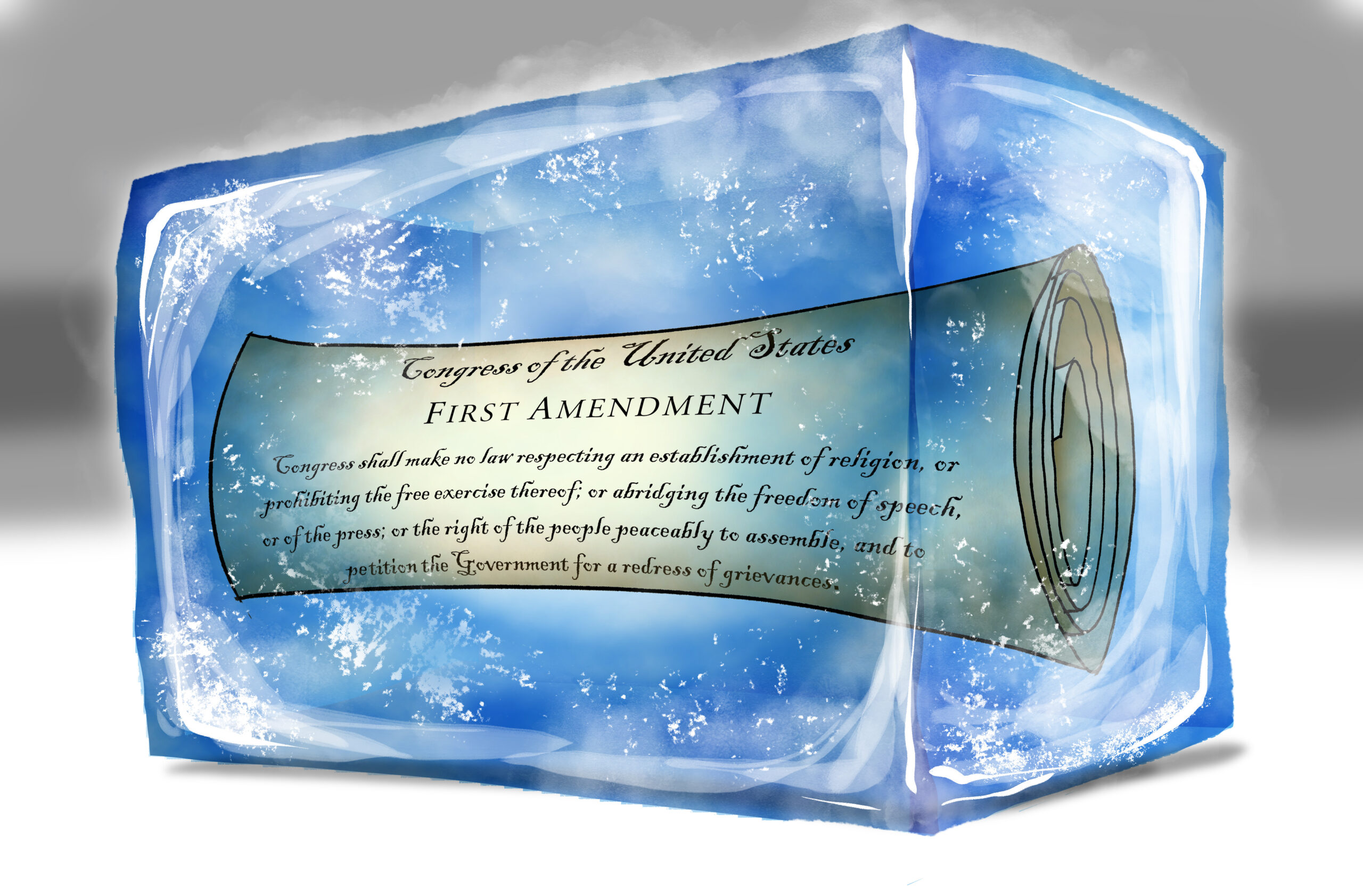
American legal analysis is filled with colorful metaphors: “fruit of the poisonous tree”; “slippery slope”; “opening the door”; the “penumbra” of the Bill of Rights. Some of these images require a bit of mental gymnastics.
But one legal metaphor perfectly describes public expression in the year 2025: “chilling effect.” The verb “to chill” means “to affect as if with cold; dispirit”; “to check (enthusiasm, etc.); to depress”. The noun “chill” refers to “a checking or dampening of enthusiasm, spirit or joy”; “a sudden numbing fear or dread.”
“Chilling effects” are effects of government action to chill, dampen or depress protected free expression. Such actions are First Amendment violations, in part because, to use a related legal metaphor, free expression always needs some “breathing space” to survive.
Trump’s threats
This year, as the Trump administration, by threats, regulations, lawsuits and other actions, has tried to dispirit or numb its adversaries, and silence or weaken expression it hasn’t liked, we have seen many attempts to create “chilling effects”:
- Threats to universities and businesses of adverse government action if they do not abandon their diversity, equality and inclusion programs;
- Lawsuits against news media organizations over standard reporting, sending the message that only pro-administration news coverage will be tolerated;
- Regulatory threats to television networks that carry jokes targeting Trump or his administration (even though the FCC, for example, is expressly forbidden to censor, and has no direct power over TV networks);
- Regulatory actions that demand compliance with the administration’s politics, not the relevant legal standards (e.g., corporate mergers allowed for entertainment and media companies only when the companies make their media subsidiaries compromise on news reporting issues);
- Threats to law firms, based on their representation of administration-disfavored clients, including denials of entry to government buildings and ability to communicate with government officials;
- Threats, investigations and sometimes even prosecutions, of officials who didn’t hew to the administration line, even if they merely (as with Senator Mark Kelly) recite basic principles of law;
- Arrests, imprisonment and even deportation, without due process, and sometimes without any valid legal basis. Such actions create ripple effects, chilling others from doing anything, including legal protests and expression that might bring them to the government’s attention.
- Disparagement and threats of impeachment against judges who follow existing law and deliver rulings the administration doesn’t like; and
- Encouragement of violence against news personnel and other opinion leaders.
Notably, these efforts to curb expression are directed most often at universities, the judicial system and the media — the three sectors of society which historically have been most resistant to authoritarian government, and most supportive of democracy, tolerance and the rule of law.
They are also, together with government research agencies, the sectors of society that make up what Jonathan Rauch, in his book “The Constitution of Knowledge”, called “the reality-based community,” where all propositions are subjected to fair, open and robust testing, and never adopted based on authority or orthodoxy. Put simply, the Trump administration is seeking to chill those who engage in open-minded thinking.
Are things worse than in the past?
It is not enough to note that a government has tried to chill opponents’ expression. Unfortunately, that has occurred often in America. Richard Nixon tried it. Woodrow Wilson and his attorney general Newton Baker tried it, extensively. Senator Joseph McCarthy was a master of intimidation and attempts to chill expression in many fields of endeavor, including the entertainment world. Even administrations often viewed as tolerant and enlightened have tried it, too.
But in recent times, concerns about chilling effects were often raised about threats in their incipiency, or threats made but successfully resisted. The phrase “chilling effect” was used essentially as a rallying cry by the media or other speakers, along the lines, “We must not let our expression be chilled!” Despite Nixon’s threats to broadcasters, for example, the industry (still then mostly owned and governed by people committed to journalistic ethics) largely stood firm. Indeed, many past “chilling effects” situations presented media advocates with a conundrum. Government officials were trying to intimidate journalists, but the journalists stood firm, meaning there was no proof of an actual effect.
Things are different now.
Threats are greater
On the threat side, we face a different, and significantly greater, campaign of threats and actual retribution. It is not focused on a single reporter, a single media company or even a single profession. It is a broad campaign to chill expressed opposition across multiple areas of society, focused most intensely on the expression-protective institutions of the media, universities and courts. And it has indeed intimidated many people and institutions.
Additionally, at this point, the normal checks and balances of our government only weakly constrain the administration. Congress’s Republican majority is largely compliant, many regulatory agencies have lost their independence, and the Supreme Court seems largely acquiescent, even to the extent of overruling longtime precedents that would have restrained Trump. Even the ultimate democratic check — elections — is at risk because of gerrymandering, voter intimidation tactics and refusals to accept results.
Looking at the effects on the targets of threats, experience this year suggests that our institutions may be weaker, and less resistant to threats, than in the past. The proof is in multi-million-dollar checks written to the government, the president, or their favored recipients; in institutions stepping back from controversy; in research no longer being conducted; in long-standing DEI policies revoked; and in the boxes of belongings being carried out of offices by those who refuse to submit.
Will the threats succeed?
If the administration will not change its actions, and internal government checks and balances won’t stop them, the outcome of the administration’s expression suppression efforts will come down to the target side of the equation: Can the media and other targeted speakers effectively resist the chilling of their expression?
Here it may come down to norms, laws, ethics, public opinion and maybe even heroes.
Norms. Social norms are society’s unwritten rules, like basic expectations concerning dress, etiquette and the tone of public discourse. They also include critical political expectations like bipartisan cooperation, respect for adversaries, toleration of diverse viewpoints and the bedrock norm of respect for the rule of law. All these norms are under attack. But norms can spring back if they are supported. As recent American Bar Association President William Bay has stressed, “The rule of law doesn’t defend itself. Lawyers do.” If key political norms are defended and revitalized, particularly by bipartisan leaders (as occurred at the time of the Nixon impeachment inquiry), they will provide an important bulwark against government retaliation and intimidation.
Public opinion and opinion leadership. Public opinion greatly influences events in America. The No Kings and other protests, and Trump’s currently slumping approval ratings, show that the Trump Administration is vulnerable. Because of the opinion dominance of the political right, through Fox News, social media and confirmation-bias-focused information sources, it isn’t easy to move public opinion today. Public opinion might shift, however, because of dramatic highly publicized case studies, which bring the threats home to ordinary people. A shift in public opinion killed McCarthyism in the 1950s, and it could do the same to Trump’s chilling effects initiatives.
Laws. Many laws and precedents prohibit government censorship, intimidation and retaliation. When litigants have challenged the Trump administration’s chilling effects actions this year, many trial courts have enjoined them. But the Supreme Court has, at least in preliminary rulings, so far set aside many of these orders and given a green light to the administration. So the jury is out on whether judicial action will be effective to stop the intimidation campaign.
Ethics. Professional ethics can significantly influence events. In multiple recent cases, lawyers, administrators and law enforcement and military personnel have resigned rather than take actions that they considered illegal or breaching professional responsibility. Timothy Snyder, in his “20 Lessons from the 20th Century”, noted the complicity of physicians, lawyers and judges under the Nazi regime, and pointed out that if they had followed the norms and rules of their professions, many atrocities would have been prevented.
In his recent speech at the Gateway Journalism Review’s First Amendment celebration, legendary editor Marty Baron urged a redoubled focus on bedrock journalism ethics, including “true independence and a reverence for evidence over our preconceptions.” And he also suggested strengthening media transparency and credibility, for example, by publishing source documentation in full. Journalists must help the public to better distinguish truth from falsity.
Heroes. In the past, courageous individuals helped turn the tide against repressive officials. Journalist reporter Edward R. Murrow and lawyer Joseph Welch courageously reported on, and directly challenged, McCarthy. More recently, Georgia Secretary of State Brad Raffensperger and Arizona Republican leader Rusty Bowers stood fast against pressure to subvert the 2020 election.
People continue to stand up in courage today, as other reports in this magazine show: Alan Greenblatt, a St. Louis based professional editor who resigned rather than self-censor by ignoring an important story; Jim Rodenbush, an Indiana University journalism professor who refused to censor the university’s student newspaper. They are free expression heroes.
It is telling and troublesome, however, that we may need heroes. In Bertolt Brecht’s play, “The Life of Galileo”, the scientist’s disciple, Andrea Sarti, after hearing his mentor’s forced recantation, declares: “Unhappy the land that has no heroes!” But Galileo responds, slowly and in sadness: “No. Unhappy the land that needs heroes.”
Mark Sableman is a St. Louis lawyer at Thompson Coburn who has taught Censorship and Free Expression at Washington University School of Law as an adjunct professor.
