Norah O’Donnell, “We the Women: The Hidden Heroes Who Shaped America,” New York: Ballantine Books. 406 pages, $35.00.
Book publishers are well aware that television news anchorpeople can emerge as popular authors and sell a lot of books. And St. Louis media enthusiasts got an illustration of that fact on March 12 when groundbreaking CBS News’ Senior Correspondent, Norah O’Donnell, visited St. Louis to discuss her new book about female innovators, “We the Women.” It is a carefully researched, wide-ranging treatment of over three dozen female Americans who made important contributions in a variety of fields with very little fanfare or attention, with their work largely unrecognized in most of the history books.
Appearing in conversation at the sold-out event along with the best-selling author of “First Women,” Kate Anderson Brower, who worked with O’Donnell on this project, the two talked about the development of this particular book and the manner in which the research was completed over a two-year period. They offered an illustrated overview of the many women visionaries and risk-takers included in the book: the scientists, physicians, lawyers, politicians, athletes, civil rights activists, authors, code-breakers and even journalists. Doris Kearns Goodwin said of the book: “By skillfully weaving together individual stories of groundbreaking women, this terrific book reveals the central, though often hidden, role that women have played at every stage of our nation’s history.” Presented by Left Bank Books and the Left Bank Books Foundation, the two authors appeared in the Lee Theatre of the Blanche Touhill Performing Arts Center.
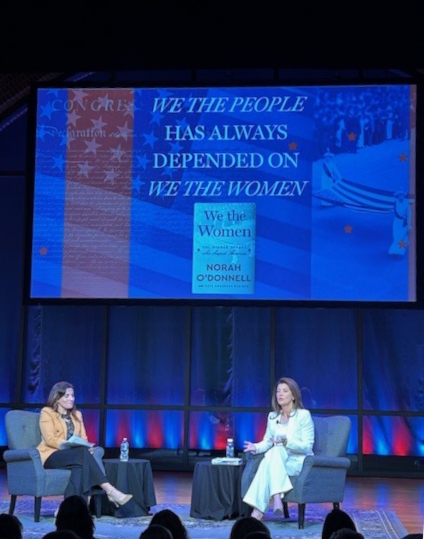
Among those mentioned in their summary presentation of the book’s contents were many who changed the course of American history in their respective fields while ironically, often largely, undetected. This included Mary Katherine Goddard who printed the first signed Declaration of Independence, raising a question by O’Donnell of why the guaranteed inalienable rights guaranteed in that founding document were yet to apply to the women during that same era? Also discussed was a summary of the life of Elizabeth Ellet, the first writer to record the lives of women contributing to the Revolutionary War and Mercy Otis Waren, dubbed “The Intellectual” in the book, who wrote the “History of the Rise, Progress and Termination of the American Revolution,” published in 1805.
Follow-up sections of “We the Women” discussed during the talk examined areas one might logically expect in some regards — such as contributions in the fine arts — but the book and the talk expanded to pioneer exploration and military service by women before they even acquired the right to vote, fighting for voting rights and also abolition. Kate Gannett Wells is included, an author who wrote an early Atlantic Monthly piece acknowledging the transition women were beginning to make in America as early as the 1880s, moving from work in the kitchen as homemakers to fairly sophisticated yet unrecognized assignments in laboratories and even newsrooms. As expected, there is attention to many women “firsts,” including Belva Lockwood, the first woman to argue before the U.S. Supreme Court, and both Dr. Elizabeth Blackwell, the first woman to be admitted to a medical school and Dr. Mary Edwards Walker, the first and so far, only woman to receive the highest military declaration, the Medal of Honor from a United States President.
While almost all of the individuals documented in this book operated “under the radar” in terms of public recognition, the one very dynamic exception to that rule included in this book was Eleonor Roosevelt. Dubbed by O’Donnell, “The Agitator,” a very careful and thoughtful accounting of Eleanor provides great detail on how this “First Lady” of America used her unique “Bully Pulpit” to bring attention to causes women in particular sought to support. An early example explained how she encountered a war victim who was severely burned. Asking him about his wounds, he told Eleanor that he hoped to be able to someday return to his passion of playing the piano. And she saw to it that his dream was answered, explaining how she had orchestrated his performance at the White House. One prominent Eleanor Roosevelt quote set off in the book reads: “You gain strength, courage, and confidence by every experience in which you really stop to look fear in the face. You are able to say to yourself, I have lived through this horror – I can take the next thing that comes along.”
O’Donnell, addressing her own challenges and many accomplishments as a senior CBS journalist, is currently regarded as her network’s key interviewer. She relayed her personal story about Irish ancestors and the struggles met by members of her own family, including her grandmother, Mary Teresa Monaghan O’Kane, immigrating as a young Catholic from predominantly non-Catholic Northern Ireland. Faced with limitations and the mantra of “No Catholics May Apply,” she arrived at Ellis Island in 1930 with $20 in her pocket. In the course of research for the book, O’Donnell discovered that her grandmother’s name appears in a book at the National Archives in Washington, D.C., listing profession as “hemstitcher.” And O’Donnell discussed the courage and fortitude required to relocate and prosper in her new country over years and how she would likely be very proud of a granddaughter who recently interviewed Pope Leo.
In the question-and-answer session following the presentation, O’Donnell also shared the journey leading to the publication of the book with chapters such as the one on Eleanor Roosevelt containing over forty copious reference notes, including interviews and both popular and primary source material from the Eleanor Roosevelt Papers Project, Columbian College of Arts and Sciences, George Washington University, as well as the Franklin Roosevelt Presidential Library and Museum. O’Donnell also shared personal stories from her own experiences while developing her career in the journalism profession, including getting started and her response to a CBS job interview, later shared widely with all of the women within that company, in which an interviewer asked how she would do a complex and demanding position while raising three small children. She replied: “Would you ever ask that same question of a man?”
O’Donnell expanded on the challenges of breaking what was once a solidified glass ceiling in television news and American business culture in general. And she noted how the Women’s History Museum found that less than fifteen percent of what is taught in today’s schools addresses the contributions of women, reflecting on how many lives, including her own life, might have been changed had she been provided a more complete view of the story of America — and women’s roles in it. She expected and hoped that aspect of her book of previously “hidden heroes” would provide some additional inspiration and broaden what is known about women innovators and pioneers with more background on what is now a lot more accessible to young women.
Michael Murray is a University of Missouri Board of Curators Distinguished Teaching Professor Emeritus and a former member of the Gateway Journalism Review Board of Advisors.
