Tag: Breonna Taylor

Two St. Louis police killings similar to George Floyd and Breonna Taylor deaths

ST. LOUIS — Five years before George Floyd died of “asphyxia-restraint” on a Minneapolis street, 27-year-old Nicholas Gilbert died in a St. Louis police holdover cell with six officers on top of him. He was handcuffed with his legs shackled while gasping, “It hurts. Stop.”

Three years before Breonna Taylor was killed by police in a flawed “no-knock” raid in Louisville, Kentucky, a St. Louis SWAT team killed Don Ray Clark, a 63-year-old Army veteran known as “Pops,” in his Dutchtown neighborhood. The SWAT team of 17 officers, acting on a no-knock warrant based on sketchy evidence, broke down the door and tossed a flashbang into the front room where Clark was sleeping. Police opened fire and Clark, who never had been charged with a crime, was shot nine times by Officer Nicholas Manasco.

Floyd’s and Taylor’s deaths were huge news events that brought worldwide attention to police killings. But Gilbert’s and Clark’s deaths only got passing attention. There were no national news stories or protests in the streets. But their deaths highlight both the banality and lack of accountability for such police actions.  

Death from “asphyxia-restraint” and no-knock raids are the leading causes of police killings both in St. Louis and nationwide. Across the nation, 134 people have died from  “asphyxia-restraint” in the past 10 years with 94 people killed during no-knock raids from 2010 to 2016. The Minneapolis police killing of Amir Locke on Feb. 2, 2022 during a no-knock raid targeting another man has reinvigorated the controversy about police reliance on the deadly tactic.

The families of St. Louisans Gilbert and Clark have brought attention to the killings of their loved ones by suing St. Louis and its police officers for violating their civil rights. 

The lawsuit by Jody Lombardo, Gilbert’s mother, has taken on national significance because the U.S. Supreme Court took notice in a surprising June opinion that could eventually make it harder for police nationwide to dodge accountability.

Until now, there has been a disconnect between the city’s legal position on prone restraint and the public statements of its mayors. The City of St. Louis has continued to argue in court that St. Louis police did nothing wrong, even as Mayor Tishaura Jones and her predecessor Lyda Krewson criticized Floyd’s murder and advocated for police reform.

The Gilbert family’s lawyer, Kevin M. Carnie Jr., said in an interview last month that he had been astonished by the disconnect between the mayors’ statements and the city’s strident position in court. “I’ve been shocked that the city has continued to pursue the case. They say they are shocked by George Floyd but they are not upset about what happened in their own backyard.”

But that is changing. When Mayor Jones’ chief of staff, Jared Boyd, was asked about this disconnect in an interview on Sept. 7, he said the mayor was taking steps to reconsider the city’s legal position. The mayor appointed a new city counselor to review the city’s legal position in police abuse cases, with less consideration for the financial loss such cases might mean for the city.  The new city counselor is Sheena Hamilton, the first Black woman to hold the job.

Already the city has gone to court to challenge the Law Enforcement Officers’ Bill of Rights passed on the last day of the legislative session in May. That law creates a new legal roadblock to police accountability by giving officers extra legal protections that citizens don’t enjoy.

The change in the City Counselor’s office  is part of a larger reform in which the mayor is proposing an Office of Public Accountability to put civilians with subpoena power in charge of police misconduct investigations, Boyd said.   

Carnie, the lawyer, said he was glad to hear the city is reconsidering its legal position. “My client is happy to hear that the city is taking a fresh, closer look at this case. Hopefully the city will implement a much needed change in policy and training as a result.”

Two common legal roadblocks

The Gilbert case highlights two of the steepest roadblocks to police accountability: objective reasonableness and qualified immunity. Objective reasonableness bars judges and juries from second-guessing the officer on the scene. Qualified immunity protects an officer from being held accountable for illegal practices if the courts have not clearly determined them to be illegal.

The two doctrines together give officers across the country the benefit of the doubt in cases of alleged police abuse and killings.

The City of St. Louis has argued in court that both doctrines should protect the officers involved in Gilbert’s killing.

In characteristically proactive language in the city’s legal brief last year, Deputy City Counselor Robert H. Dierker calls Gilbert’s mother’s arguments to the Supreme Court “agitprop” designed to “use published reports regarding the death of George Floyd as a cudgel to try to browbeat this Court into reviewing a case that is a straightforward application of basic Fourth Amendment principles. The only things in common between this case and the reports regarding George Floyd are drug use and heart disease.” 

But Carnie, the Gilbert family’s lawyer, said the nation’s horrified response to the death of Floyd under a police officer’s boot shows that police can’t be given the discretion to “put a handcuffed person face-down on the ground and push into him until he suffocates.”

Just before Christmas 2015, police found Gilbert in an abandoned home and discovered that he had failed to appear in court on a traffic violation. They arrested him. In the police holdover cell, Gilbert seemed to be putting something around his neck. Fearing a suicide attempt, officers piled into the 7-by-9-foot cell and were met with a struggle from the 5 feet 3 inch, 160 pound 27-year-old. They handcuffed him, manacled his legs and then pushed him into the floor. 

Gilbert  tried to lift himself up and yelled pleas for help, according to court records.

“It hurts. Stop.” Those were his last statements. After 15 minutes, during which six  officers weighing a combined total of 1300 pounds were on top of him, he stopped breathing. The officers couldn’t find a pulse. 

An autopsy found a fractured sternum and contusions and abrasions on his shoulders and upper body. A medical report stated that the “cause of death was forcible restraint inducing asphyxia,” while methamphetamine and heart disease were “underlying factors.”

A district court judge agreed that Gilbert had died from asphyxiation, but threw out the lawsuit based on qualified immunity: that no court had clearly ruled that it was illegal for police officers to put hundreds of pounds of pressure on a prone suspect who was shackled and resisting. Because the officers couldn’t be held accountable, neither could the city, the judge ruled.

The 8th U.S. Circuit Court of Appeals in St. Louis took it a step further. It said it didn’t even have to get to the qualified immunity issue. Applying the “objective reasonableness” standard, it found that no reasonable jury could decide that the officers used unreasonable force.  

The U.S. Supreme Court, at the end of its session in June, disagreed with the 8th Circuit and told it to take another look. It cited a “well-known police guidance recommending that officers get a subject off his stomach as soon as he is handcuffed” because of the risk of suffocation. 

“Struggles of a prone suspect may be due to oxygen deficiency, rather than a desire to disobey officers’ commands. Such evidence, when considered alongside the duration of the restraint and the fact that Gilbert was handcuffed and leg shackled at the time, may be pertinent” to how much of a threat could be “reasonably perceived by the officers.”

“Having either failed to analyze such evidence or characterized it as insignificant, the court’s opinion could be read to treat Gilbert’s ‘ongoing resistance’ as controlling as a matter of law. Such a per se rule would contravene the careful, context-specific analysis required by this Court’s excessive force precedent,” the court said.

In other words, the Supreme Court is saying that courts can’t say police are always acting reasonably when they apply pressure to a prone suspect who appears to be resisting. It was remarkable the court took the action without even hearing oral arguments.

Justices Joseph A. Alito Jr., Clarence Thomas and Neil M. Gorsuch — the three most conservative justices — disagreed with the Supreme Court’s action.  Alito wrote that the court should give the appeals court the benefit of the doubt in its opinion — which would amount to giving the benefit of the doubt to a court interpretation that was already  giving the benefit of the doubt to police. The benefit of the doubt on top of the benefit of the doubt.

Significantly, Chief Justice John G. Roberts Jr. didn’t agree with Alito even though he did the last time the court resolved a similar case — the 2015 Kingsley decision involving a pretrial detainee in Wisconsin who had been handcuffed, tased and allegedly knocked into a concrete bunker. In Kingsley, Roberts had joined the late Justice Antonin Scalia’s dissent, which stated, “The Constitution contains no freestanding prohibition of excessive force.” Even the infliction of “objectively unreasonable harm” by officers does not violate the Constitution, he said, accusing the majority of being “tender hearted.”

Not only did Roberts desert the conservatives in the Gilbert decision, but two new conservative justices — Brett M. Kavanaugh and Amy Coney Barrett — joined him in agreeing with the three liberal justices that cases of prone restraint needed more court scrutiny. Roberts is a savvy chief justice and most likely didn’t want to be opening the door to police abuse in prone restraint cases just as a jury in Minnesota was determining Floyd’s death to be murder.

Lombardo, Gilbert’s mother, says the only difference between her son’s death and Floyd’s was that St. Louis police “weren’t videoed.” Former St. Louis Police Chief Sam Dotson backed his officers but did take steps to introduce video in the holdover cells.

Lombardo said in an interview that she is angry that the police “smeared” her son’s name. “Why when the police kill do they have to attack his character?”

Lombardo acknowledges her son had drug problems but says he wasn’t homeless, as police claimed. “Nick was a happy, young man and full of life. He was funny and a jokester. His little sister, 10 years younger, struggles every day about losing her brother.  He was learning flooring from his dad and his uncles. They say he was homeless, but they knew my address.

“If Nick’s case had gotten notoriety … it could have saved (Floyd) and could have saved a lot of other people. … I can’t even watch the George Floyd video. I think of my own son.”

Even if the 8th U.S. Circuit Court of Appeals agrees that police acted unreasonably, the court would then have to consider qualified immunity. Because the 8th Circuit Court itself thought the officers’ actions were reasonable before, it’s hard to see how it could conclude they should have known they were illegal.

But Carnie points out that the Justice Department issued guidance in 1995 to all law enforcement officers to avoid pressing on prone suspects who were restrained for fear of suffocation. He argues that because this guidance is 26 years old, officers in St. Louis should have known it.

In a court filing this August, Carnie pointed to multiple federal appeals courts that have ruled that the law against putting force on a bound, prone prisoner has been “clearly established” and therefore should not allow officers to escape through the qualified immunity loophole.

Dierker’s response for the city was that the Supreme Court had actually “found no fault” with the 8th Circuit’s decision — even though it had sent it back to the appeals court with an opinion expressing disagreement. Dierker said the appeals court shouldn’t spend any more time on arguments before it “put(s) an end to this case.”

A flash-bang and then 9 bullets

No-knock drug raids date back to the Nixon administration’s war on crime in the 1960s. Local officials also began to use the tool of obtaining a no-knock warrant from a judge that enabled officers to break down the door without knocking. The tactic was supposed to be used in “exigent” circumstances where suspects were armed or might flush drugs before officers could seize them. One purpose was to safeguard officers from armed suspects.

A nationally notorious no-knock raid occurred in 1973 in Collinsville, across the river from St. Louis. Twelve law enforcement officers were indicted for a series of raids on 12 different homes, conducted without enough evidence of wrong-doing on the part of the accused. 

Clark’s family and lawyers say the fatal Feb. 21, 2017, no-knock raid on Clark’s home was based on false information.

The no-knock warrant obtained by Officer Thomas Strode was the 27th no-knock warrant of the year, all approved by a judge. Many of Strode’s applications used the same boilerplate language claiming unidentified — and unverified — confidential sources said guns and weapons were in the home so it was too dangerous to knock on the door and execute a search warrant. 

The warrant in Clark’s case portrayed the 63-year-old veteran in a way his children, Donald Ray Clark Jr. and Sherrie Clark-Torrence, didn’t recognize.

In a video about their father, they spoke of an Army veteran who was a disciplinarian who worked in security before multiple health problems diminished his eyesight and hearing and he required a cane. Clark had recently moved into his daughter’s house so that a younger daughter, 8, could have her own bedroom. Clark went to bed around 8 p.m. every evening on a couch in the front room. Worried about crime, he put extra screws into the front door to strengthen it. Clark had never been charged with a crime.

In contrast, the no-knock warrant portrayed Clark as being central to a three-home drug ring on California Avenue: Clark’s house at 4023 and his neighbors’ at 4025 and 4029.

After searching 4025 and 4029, more than 17 heavily armed officers of the SWAT team lined up to enter Clark’s home, where he was asleep after a difficult day riding the bus to doctor appointments.

The officers broke down the door and Officer Ronald Mueller threw a “diversionary device” into the front room where Clark slept. It went off with a loud flash and bang, disorienting Clark. Police did not identify themselves as they piled in, according to the lawsuit.

Moments later, Officer Nicholas Manasco opened fire with an assault rifle, hitting Clark with a hail of nine bullets. Manasco said he was responding to gunfire, but the lawsuit says Clark was unarmed. Clark fell to the floor and mumbled a few words. Manasco and Officer James Zwilling stood over Clark, pointing their weapons at him while other officers rushed by and searched the house, the lawsuit alleges. None of the officers immediately called for medical assistance. When Clark Jr. got to his father’s house, police wouldn’t tell him what had happened or where his father had been taken. He and his family didn’t receive  word of their father’s death until the following day.

Manasco said Clark had fired at him and police said they had found drugs. The lawsuit claims Clark didn’t have a gun and the drugs were brought into the house from a nearby house. Chief Dotson cleared his officers of wrongdoing.

Officer Manasco has killed two other civilians — including Isaiah Hammett a few months later in another SWAT raid for which he and the city were sued. Police entered Hammett’s residence with a flashbang and fired 93 shots, hitting Hammett 24 times. In 2011 Manasco killed Carlos Boles, took pictures of his bullet-ridden body and showed them to another officer. An investigation was announced, but the Boles episode did not remove Manasco from the SWAT team. Manasco retired from the department earlier this summer.

Last fall, Missouri legislators heard testimony from across the state about the abuses of no-knock warrants. But the Missouri Sheriffs’ Association and Missouri State Troopers’ Association, which have powerful voices in the Legislature, claimed they are used so rarely that there is no need for regulation.

Five other states voted to restrict no-knock warrants in response to Breonna Taylor’s death in Louisville, Kentucky.

Editor’s Note: This story first published on Dec. 21, 2021 in the print magazine.

William H. Freivogel is publisher of GJR, a professor of media law at Southern Illinois University Carbondale and a member of the Missouri Bar. 

Another side of protests: Small peaceful gathering in Waco

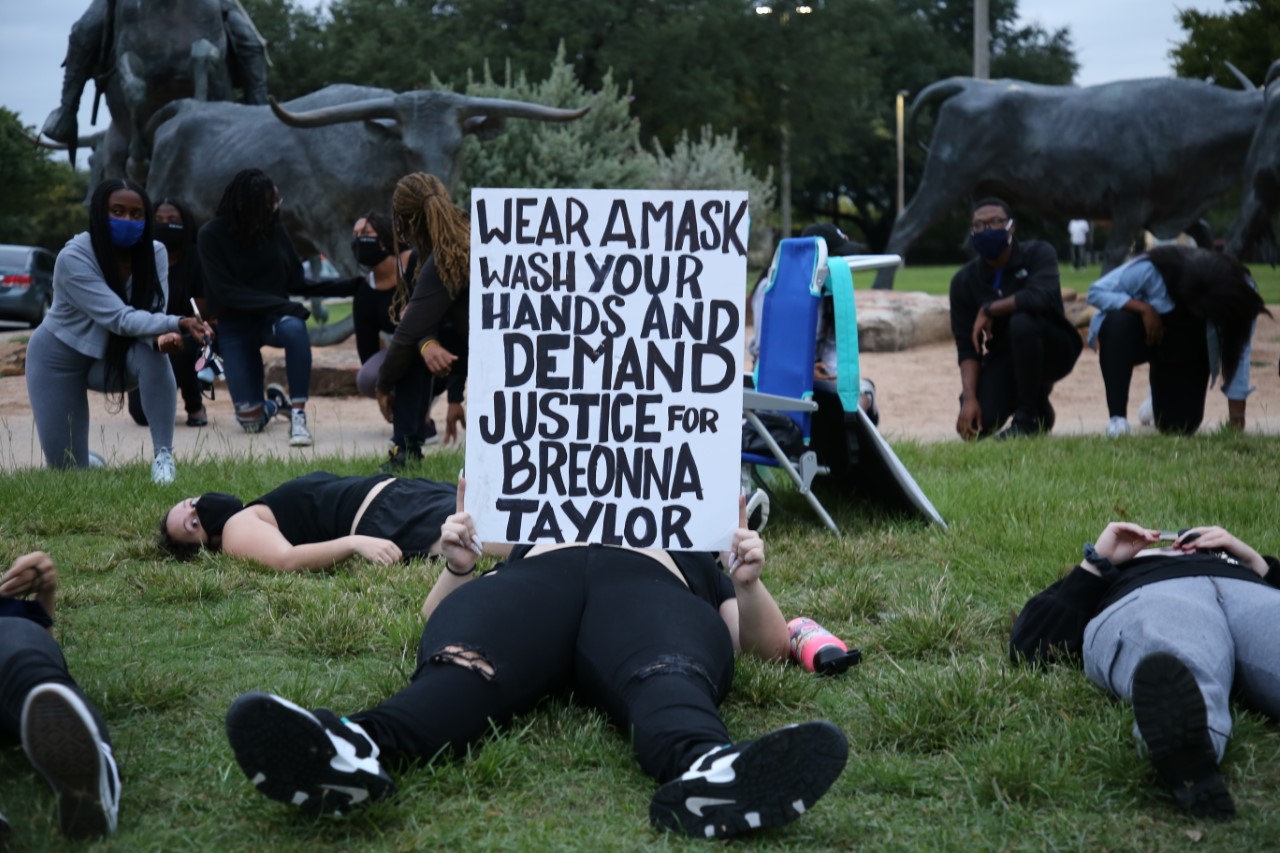
The protest that I covered in Waco, Texas on Sept. 23 was nothing like the large, occasionally violent ones held in other regions. More than 50 people attended and no one was tear-gassed or arrested. I saw only a couple of counter protesters actually approach the group, screaming “Do you know the facts of the case? Breonna Taylor was a drug dealer!” But they left quickly as they were far outnumbered by protesters. They were also the only two people I saw who weren’t wearing masks. (By the way, Taylor was not a suspected drug dealer.)

Grassroots protests such as the one I attended are actually more common than the occasionally violent ones you might hear about. The demonstration was organized by “three angry students” from Baylor University. They were unaffiliated with local Black Lives Matter chapters and other civil rights advocacy groups. The students organized the protest the same morning, when an officer who was involved in Breonna Taylor’s case was indicted on charges of “wanton endangerment.” for bullets that landed in a neighboring apartment. 

One of the protest organizers held a sign with a QR code to check attendees’ voter registration and register to vote. She walked around, addressing almost every group of people who had attended together, asking them if they needed help with their registration. 

Baylor student Brittany LaVergne urges protesters to follow social distancing guidelines during five minutes of silence at the protest against the indictment in Breonna Taylor’s case. (Photo by Meredith Howard)

The organizers encouraged participants to download the app “5 calls,” which provides shortcuts to call local legislators. Protesters called Texas senators and urged them to vote to end qualified immunity that limits police accountability and no-knock warrants like the one police were enforcing when they used a battering ram to break into Taylor’s apartment, prompting the gunfight in which she was killed. Organizers had signs with a script telling protesters how to address the senators and make their case. 

Even though it was hosted by three students with no structural support in planning, the protest was well organized. The protest’s flyer, which was posted online a few hours before it was held, listed many safety measures in place to ensure the gathering stayed peaceful. 

Some of the precautions included prior notification to local police units of the protest and its intention, restricting protesters from blocking sidewalks, the street and driveways and careful consideration in signage wording. 

The peaceful nature of the gathering was orchestrated, and the students who put it together expertly diffused any small situations that arose, including the two men who infiltrated the crowd yelling defamatory statements about Taylor. The protesters responded in a calm, assured manner when people walked or drove by jeering at them.

The crowd’s demeanor was productive anger. They lamented Taylor’s death and focused their energy on police reform. Protesters were unsurprised about the indictment, but expressed sorrow and disappointment that no officer was indicted for Taylor’s death. The crowd included Black people and other people of color, but there were also a lot of white allies. I felt compelled to attend this protest as a white journalist because small, peaceful protests aren’t widely discussed, and I wanted to add them into the protest narrative of this year. 

After the voter registration, calls to senators and Black Lives Matter chants, protesters  observed five minutes of silence and reflection while lying on the ground or kneeling, to imagine what it must be like to be a Black person in America fearing police brutality.  

Near the end of the gathering, the organizers asked if anyone wanted to step up and address the group with their thoughts on Black Lives Matter, experiences with police brutality or anything else they wanted to say. When no one stepped up, the organizers provided encouragement and understanding. They said they were empathetic to the exhaustion faced by Black people being asked to explain their experiences with racism on a daily basis, and they emphasized that the most important product for protesters to leave with was knowing they were cared about and listened to. After the protest, one of the organizers, Brittany LaVergne, offered rides to attendees so they wouldn’t have to walk home in the dark. 

Meredith Howard is a student journalist at Baylor University. She can be contacted at meredith_howard1@baylor.edu.

Reporter’s Notebook: Student journalists find a grieving city

When the Daily Egyptian decided to send staff to Louisville to cover the protests, we prepared to walk into a war zone. Instead, we found ourselves welcomed into a grieving community, where people were attempting to cope with the loss of Breonna Taylor.

Taylor was killed March 13. when three Louisville Metro Police entered her apartment with a battering ram while executing a no-knock raid in plain clothes. In the confusion of police entering the residence, Taylor’s boyfriend shot at police and officers responded by firing 30 bullets, killing Taylor. A grand jury decided the officers shouldn’t face criminal charges in her death.

See more: Correcting misinformation about Breonna Taylor


A protester reacts after the Louisville Police Department fired flashbangs into the crowd of protesters on Saturday, Sept. 25, 2020. (Photo by Isabel Miller )

We were discouraged from going to Louisville by three journalism professors at our school, Southern Illinois University at Carbondale. The three, all longtime journalists, told us it would be an unnecessary risk, that we would be walking into a dangerous situation, and we would not find anything the wires hadn’t already published.

During our discussions on whether or not we should go and how we should cover it, we realized the wires were mostly focused on event and protest coverage. The four of us, Jared Treece, Isabel Miller and the two of us did not want to sit this out. The director of our School, documentarian Jan Thompson, agreed and gave us the go-ahead, telling one of the nervous professors that this story was like the Vietnam protests of his generation.

One of the stories we were hoping to tell was of the religious community’s involvement during the protests. Before arriving, we reached out to a Catholic nun, Sister Beth Murphy in central Illinois to connect us to religious leaders or activists in Louisville.

Murphy immediately sent names, emails, phone numbers and any information about who could be helpful. Within 24 hours, multiple Catholic sisters had put us in contact with organizers and activists in Louisville. We connected with three of our sources. Sister Murphy told us we were in the prayers of dozens of Catholic sisters. Later, Brother Tim Duncan, whom we met during the nightly protests, said he is 63-years-old and couldn’t think of a more important time to be a journalist than right now and encouraged us in our work.

One of the first people we called was Sister Judy Morris, who directed us to Felicia Garr who declared herself our “Black mom in Louisville.”

Garr, a 52-year-old Black woman and Louisville native, gave us our first interview, let us know the lay of the land, directed us to all the protests and passed along any information she could. 

Garr has been involved with organizing and participating in protests since the details of the Breonna Taylor case first came out. She has a daughter the same age as Taylor.

When we got to our hotel, she called us again, gave us a safety speech with tips on how to conduct ourselves and directed us to “not eat the food because Coronavirus is real.” Once we had ourselves situated we hit the streets to walk towards Jefferson Square Park, ground zero for the Black Lives Matter Breonna Taylor protests in downtown Louisville.

We crossed into cordoned off downtown via Liberty Street and 2nd Avenue through the large concrete dividers placed to prevent vehicle traffic from entering the area in preparation of protests. The streets were devoid of the life and vibrance normally associated with a bustling downtown as we passed boarded up buildings up until we reached Jefferson Square Park or as the protesters dubbed it “Injustice Square.”

The small square – which is situated in the heart of Louisville’s legal buildings, with the county grand jury building to the south, the county court to the north, City Hall on the northwest corner, and the county jail on the southwest corner – held all the life and energy of the deserted downtown. There was a beautiful memorial in the center of the square in honor of Breonna Taylor surrounded by a community garden, free therapists, lawyers, medics offering medical care, and tents providing everyone with free food, water and masks.

A few hundred protesters milled around in the square, laughing, eating and dancing. There were young people, children, older people, people in wheelchairs or with walkers and individuals of every color.  

Our team – made up of three white journalists and one Latino journalist – felt completely safe and comfortable with the protesters. Most people were polite and happy to speak with us for interviews, which was a nice change from the treatment we normally receive from our own university’s administration.

We expected to be looked down upon for being student journalists, but whenever we introduced ourselves as “student journalists with the Daily Egyptian” people brightened, supported us and were put at ease. We even met some former Salukis and Southern Illinoisans.

Even the local journalists took us in and offered advice, assistance and community. (Other student journalists also were covering the protests).

One of the members of our group, Nick, the co-author, was a prior professionally employed photojournalist who had made connections through the various social media networks. He met one of the Louisville Courier-Journal photographers at the square who helped provide information. From sending texts to where the protesters were meeting, to giving advice on what to do if law enforcement agencies cleared “Injustice Square” after curfew, Max Gersh was an excellent connection to have in Louisville.

Another photographer, Michael M. Santiago, who works for Getty Images, gave our group Sudecon wipes, which are used to decontaminate the face and eyes after getting sprayed with irritants such as mace or tear gas. Fortunately we didn’t have to use them.

Santiago warned us and told us to be wary, but said protesters and the press had an understanding and looked after one another.

The protesters protected us, tried to feed us, give us water and even offered us rides to the “safe place,” First Unitarian Church. They felt protected by the media’s presence.

Whenever a tense moment arose between protesters and the police, they would call for the press to be front and center and ask us to record what was happening.

When the peaceful march through the East Market Neighborhood was met by a police blockade at East Market and South Hancock St. an organizer with a bullhorn shouted “all the press to the front! Show the world what they do to a peaceful protest!”

While the protests and marches during the day were peaceful on both sides, we were told that at night, all bets were off.

Curfew was terrifying. Police and law enforcement officers on roof tops would loudly announce if you did not disperse, you would be arrested.

The reporters and protesters around us wore all kinds of protective gear, from shin guards, bullet proof vests, goggles and helmets, to rifles and handguns. No one had any illusions of absolute safety and everyone was tense, knowing that at any moment, things could get rough. When people weren’t chanting, an eerie silence would fall over the square broken only by the helicopters buzzing overhead.

On Friday night, we walked around downtown after curfew and interviewed people at First Unitarian. Two young girls, one of whom we learned was 15 and another who looked as though she couldn’t have been older than 13, joined our group crying and screaming for help.

They got behind us and one grabbed onto our shirts and hid. A police car with its lights on jerked across the road. As it came speeding up behind the girls, they threw their hands up. The officer shouted at the girls through the window causing them to cry more.

They had been separated from their cousin and were lost trying to find the church to seek sanctuary and get off of the streets during the curfew.

Once the police realized we were press and saw that we had taken our phones out to record, they calmed down and let the girls stay with us. One girl begged for a ride because she sprained her ankle, but the officers refused and drove off. We sent two of our members ahead to the church to get a medic and walked with the injured girl until an older woman pulled over and offered to drive her.

During a peaceful afternoon Friday, officers performed kettling maneuvers and boxed protesters in on all sides, resulting in a tense standoff where the officers set off flashbangs.

A protester collapsed to the ground when this happened and one of our photographers, Isabel Miller, took photos. Another protester ran up, grabbed her and attempted to force her to delete her photographs.


She was able to convince him to let go of her by deleting one of the several photos she took of the moment. She later posted one of these takes to Instagram to emphasize what occurred during the police-protester clash.

Max Gersh, the Courier-Journal photographer, said this situation was the only time during his coverage of the protests he put on the helmet he carries with him.

We are in no way saying this is the experience of all journalists covering Louisville. Members of the press have been arrested and injured in the city on multiple occasions. We were only there two nights and there have been points during the 124 days of demonstrating where Louisville has been dangerous. Two officers were shot just last week in the wake of the grand jury’s decision.

But this was our experience; we are grateful to the community that accepted us and allowed us to tell their stories.

Nicolas Galindo is a current M.S. student at Southern Illinois University Carbondale and photojournalism mentor for The Daily Egyptian. He was formerly the chief photographer of The News-Star in Monroe, Louisiana, and can be found on Twitter @ngalindophoto.

Kallie Cox is the Editor-in-Chief of The Daily Egyptian, the student newspaper of Southern Illinois University Carbondale and can be reached at Kcox@dailyegyptian.com or on Twitter @KallieECox.