Tag: database

Police misconduct records secret, difficult to access

Police misconduct records are either secret or difficult to access in a majority of states – 35 of them plus Washington, D.C. But the breeze of openness is blowing. Seven big states have opened records in recent years – California, New York, Illinois, Colorado, Massachusetts, Oregon and Maryland.

Now 15 states have laws that allow these records to be mostly available to the public – up from 12 a few years ago.

Photo by Isabel Miller

Legal experts say transparency of police misconduct records is one of the keys to police reform. David Harris, a law professor at the University of Pittsburgh, put it this way: “One thing that has changed is greater transparency. We have seen a number of jurisdictions enhancing and changing the way police misconduct records have been handled. You can’t have real accountability with the public unless you are willing to share information.”

The modest uptick in openness is the result of a combination of court decisions and reform laws passed since the murder of George Floyd. New York, Massachusetts, Colorado, Oregon and Maryland enacted laws in the past year opening records that were previously closed. California passed a law opening some records in 2018.

In Illinois, the Invisible Institute won a court decision in 2014, Kalven v. City of Chicago, granting public access to misconduct records by striking down exemptions law enforcement agencies had claimed when denying public record requests.

New York state repealed section 50-a of the state’s civil rights law last year and this year made more than 300,000 police misconduct records public. Indiana passed a bi-partisan police reform bill last month that publishes the names of officers decertified for misconduct.

However, there are still barriers to accountability, even in some of the states that have begun to open up.

In Illinois, a widely touted police reform law passed this year included a provision that closed the state Professional Conduct Database of officers who resigned, were fired or were suspended for violating department policy. Not only are the names withheld but also the supporting documents. To get statewide records, a person would have to contact each of the almost 900 police departments and request these misconduct records individually.

In Pennsylvania, Gov. Tom Wolf signed a bill into law in 2020 that created a database to track police misconduct statewide and force agencies to check the database before hiring an officer. But the legislature closed the database to the public.

Indiana’s bipartisan law passed this spring required an Internet listing of the names of all officers disciplined, but closes the much more plentiful investigations that don’t end in punishment. Colorado opened records but its law was not retroactive and required requesters to have specific information about the misconduct. Oregon created a database of officers disciplined but did not open records of investigations that didn’t lead to discipline.

In New York, after the repeal of 50-a, the public records group MuckRock filed a public record request for police misconduct records from the Town of Manlius Police Department in New York and was told to pay $47,504 to see them.

Beryl Lipton, projects editor at MuckRock says “in New York the police unions have done solid work of trying combat the release of materials, with many agencies refusing to release records while those court battles played out; still others have claimed that the law does not apply retroactively to existing records, and the courts have landed on either side of that point.”

Last month, state Supreme Court Justice Ann Marie Taddeo issued an order agreeing with the Brighton Police Patrolman Association that the repeal of 50a was not retroactive. The order would close all misconduct records before the summer of 2020. Two other Supreme Court justices in other parts of the state have ruled it is retroactive, so a decision of the state Court of Appeals may be required.

Nationwide, the majority of law enforcement agencies still close records or make them hard to obtain. They claim they are personnel matters, privacy violations, or ongoing investigations that could be compromised. They are backed by strong law enforcement unions and the law enforcement bills of rights that protect the privacy rights of officers over the public’s right to know.

The National Decertification Index published by the International Association of Directors of Law Enforcement Standards and Training compiles 30,257 decertifications from 45 state agencies, but the names are closed to the public.

Sam Stecklow, a journalist with the Invisible Institute, a nonprofit journalistic group focused on public accountability, said in an interview some of the states where it has become easier to request records are Illinois, New York Florida, Utah, New York and some cities in Texas. He said Nebraska, Hawaii, Kansas and Virginia are closed to the public.

“There are some states that we haven’t even been able to work at all in because they … require you to be a resident to make a request,” Stecklow said. “So we just haven’t really tried there. That includes Tennessee and Delaware and Virginia as well.”

Stecklow said many more states release the names of officers only in the rare instances where complaints are sustained rather than the much more frequent instances where the department decides not to punish the officer.

“I think it’s important to make a distinction regarding sustained vs. not sustained cases,” he said. “Many states will allow the release of records about a case in which discipline is imposed, but that is a very small minority of police misconduct investigations.”

Stecklow said if state legislatures wanted to settle the question of requesting misconduct records, they could easily do so.

“They could very easily amend FOIA and explicitly say you know a record that either contains an allegation of police misconduct, or an investigation into an allegation of police misconduct or a disciplinary record regarding misconduct is always public,” Stecklow said.

Related Content: This story was funded through a grant from the Pulitzer Center on Crisis Reporting and distributed by the Associated Press in May 2021 

Kallie Cox is the editor-in-chief of The Daily Egyptian, the student newspaper of Southern Illinois University Carbondale and can be reached at Kcox@dailyegyptian.com or on Twitter @KallieECox. William H. Freivogel is a professor at Southern Illinois University and member of the Missouri Bar. Zora Raglow-DeFranco, a law student at Case Western, contributed to this report. This story is part of a project on police accountability funded by the Pulitzer Center on Crisis Reporting.

New Illinois police reform bill makes state police misconduct database secret

This reporting was supported by the Pulitzer Center on Crisis Reporting

Illinois’ historic criminal justice reform law, hailed as a national model, contains a little-noticed loophole that seals statewide records of police misconduct and hides them from courts and the public. 

The new law requires the Illinois Law Enforcement and Training Standards Board to maintain a statewide database of police misconduct.  But the same law that requires the statewide database then closes it.  

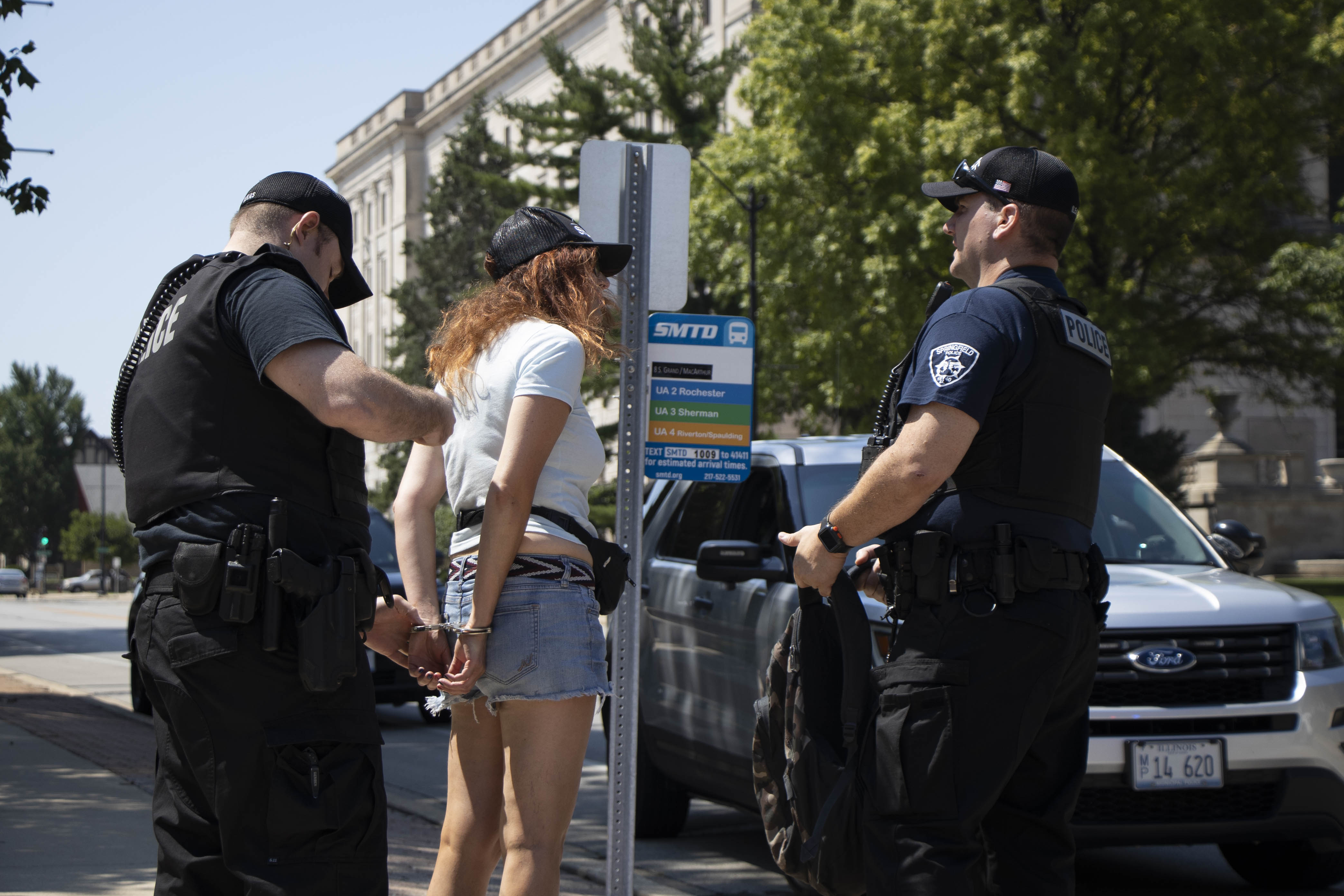
A protester was taken into custody by Springfield police officers after they spit on a counter-protester in downtown Springfield, Ill on Saturday, July 25, 2020.

A spokesperson for the Attorney General Kwame Raoul’s office defended the provision by saying the misconduct information remains an open record in the individual police stations. The reason the state database was closed, the spokesperson said, is “the records are available to anyone who wants them” from the individual departments.

The spokesperson acknowledged that anyone seeking statewide data on police misconduct would have to file FOIA requests with each of the almost 900 Illinois law enforcement agencies. 

The 2021 law strengthens the board’s Professional Conduct Database. Before it passed, departments were required to notify the board when an officer was fired or resigned under investigation for “willful violation of department policy.” The new law requires additional reporting. It requires departments to also report extended suspensions and actions that would lead to an official investigation for violating a government policy.  

In other words, this database contains alleged misconduct that did not lead to decertification, so it is much more comprehensive than a list of officers decertified.

Before the 2021 law passed there was no requirement for a department to check the database. Now there is.

“We have this misconduct database [under the old law], but there [was] no requirement that departments have to use it when they look to hire someone as part of that background check,” Sen. Elgie Sims (D-Chicago), a sponsor of the new law said in an interview. “Now you have to look to that database to check if there’s misconduct, or an individual resigned while there was an investigation going on. So those types of things, those updates are necessary; they are long overdue.”

But at the same time that the 2021 law expanded the information in the misconduct database and required local departments to check it, a last minute amendment closed the database to the public and courts.

That loophole is on pg. 669 of the text. It reads: “The database, documents, materials or other information in the possession or control of the Board that are obtained by or disclosed to the Board pursuant to this subsection shall be confidential by law and privileged and shall not be subject to discovery or admissible in evidence in any private civil action.” 

Sam Stecklow, a journalist with the Invisible Institute, said this provision in the bill creates a lack of transparency despite decades of court decisions in Illinois saying the public should have access to these records.

“When this bill came out the Attorney General’s office was like ‘well this is super transparent’ and what they were talking about was it encourages communication between law enforcement agencies, that was the transparency we are talking about. It’s not actual public transparency where the public has access to this information,” Stecklow said.

Stecklow wrote a piece for Injustice Watch about the reform bill and this loophole that can be viewed here.

Marie Dillon, policy director for the Better Government Association in Chicago, is leading the effort to amend the reform bill and make this database accessible.

Dillon said while there is no question police misconduct records in Illinois are public information, this new law makes the centralized database inaccessible to the public and forces requesters to go elsewhere to find the information.

“That’s what we’re arguing with them about right now, trying to get them to pass a trailer bill. We want language that specifically says that those documents are not redacted,” Dillon said. “We want to make sure the underlying records are FOIAable which we believe they are under the law.”

The Attorney General’s Office wrote this particular portion of the bill that deals with certification, Dillon said. She said they are working with her to fix the language.

“They, you know, said they did not intend to keep records from anybody. That was not their intent and they have been working with us on this language so you know I’m hopeful that we’re going to get it fixed. They have a pretty good record for being on the side of transparency and as I said they quickly said ‘hey we’ll work with you’ and we’ve had meetings with them so I hope they’re going to clean the language up,” Dillon said.

Dillon said she doesn’t understand why this language was placed in the law. But she believes it is partially due to fundamental misunderstanding between requesters like her and the AG’s office. 

“They didn’t understand you know why it’s important to us to feel like we should be able to get it. I feel like a public document in the hands of any public body is public,” Dillon said. “If it’s in your possession and it’s a public document I should be able to get it under FOIA you know they were more like ‘well you can still get it from the police department, you can still get it from the police force’ so that’s kind of a fundamental difference of opinion here but again they are working with us so.”

Nothing has been filed to amend the bill in the current legislative session as of publication deadline.

“Because the criminal justice bill was so big and you know they passed it in lame duck session so it was really fast too there’s a lot to clean up in it,” Dillon said. “My understanding is that will be an omnibus bill which means you know we won’t see it till right at the end again and it will roll all the fixes into one thing.”

A representative from the Attorney General’s office said the reason why the Professional Conduct Database was made private/inaccessible via FOIA was because of “pushback” and “give and take.” 

The office declined to blame one particular group for the pushback and instead said it was part of the overall negotiations involving all of their partners on the bill.

When asked whether or not the AG’s office planned to fix the loophole and make the database accessible to the public, all the representative would say is that there have been “conversations” about it but ultimately it is “up to the legislators.”

Kallie Cox is a senior at  Southern Illinois University Carbondale studying political science and journalism and can be reached at Kcox@dailyegyptian.com or on Twitter @KallieECox. This story is part of a project on police accountability funded by the Pulitzer Center on Crisis Reporting.