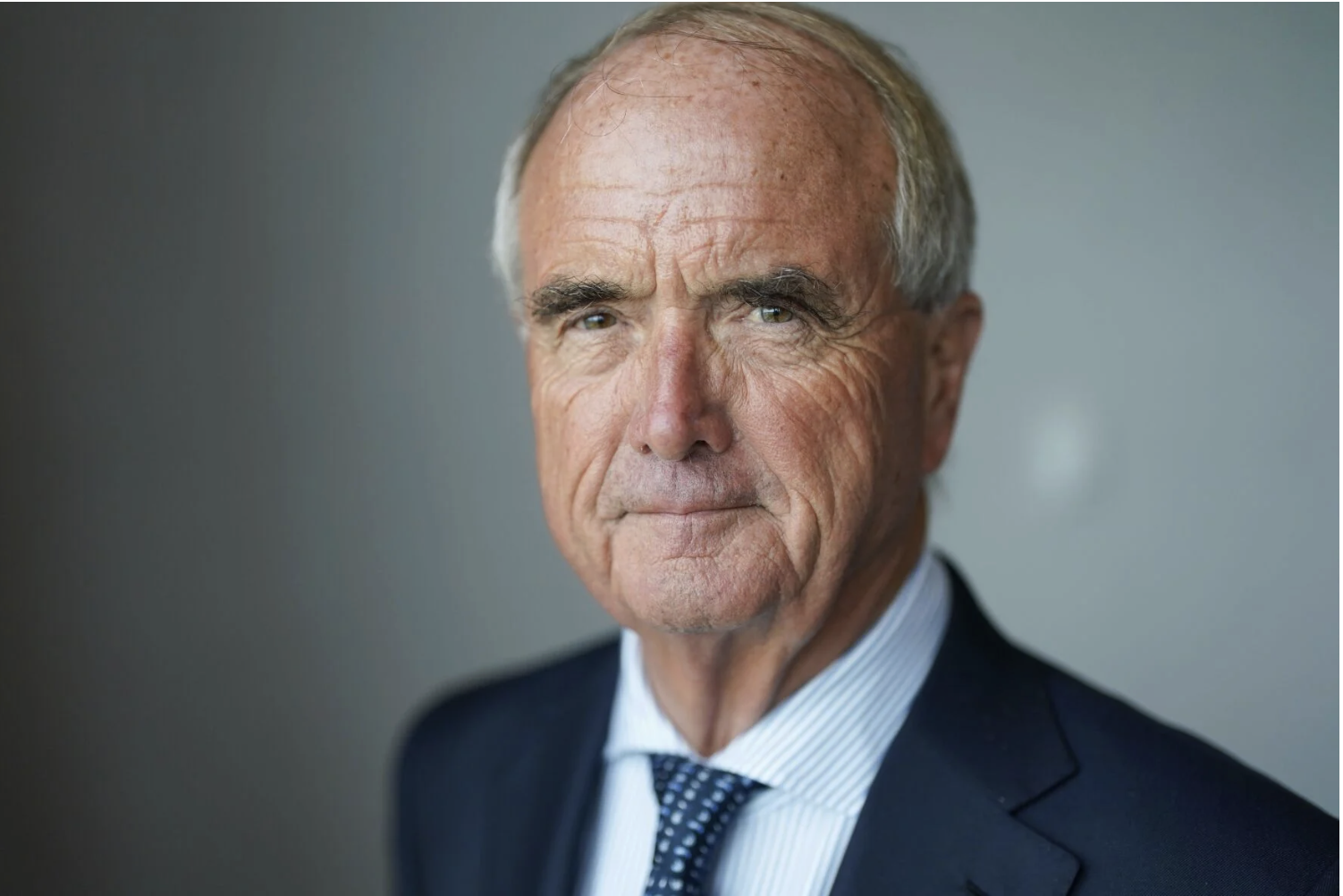
Is David Hoffmann breathing new hope into local news, as his splashy introduction to readers of the Post-Dispatch promised? Or does his overwhelming presence in the A section of the July 5 paper show desperation and no hope for local news?
As the chairman of the board of Lee Enterprises, Hoffmann wields concentrated power over news outlets owned by Iowa-based Lee, including the Post-Dispatch. His lengthy, self-congratulatory biography – from small-town boy and star prep athlete to the owner of 127 companies and plans to acquire more, including local radio powerhouse KMOX – points out he won the 2023 Horatio Alger Award for people who have overcome obstacles to success.
His quote, embedded next to his super-sized color photo on the front page of the Post-Dispatch, clearly sets out his next quest:
“I believe in newspapers, and I believe in community, and I think in this country and in this world, it’s never been more important.”
But given the weakened state of journalism in general and newspapers in particular, are a strong faith in local news and a big bankroll enough to buck the tide that has been undermining print news products for years? And will his bold front-page presence instill confidence in a product that has seen a long-term downward trend in that same time period? The story accompanying his head shot says Hoffmann is “on a mission to save your newspaper.” Will it turn out to be Mission Impossible?
One of Hoffmann’s changes is called The Bright Side, which the story published in the Post-Dispatch calls “an initiative to tell local stories that are uplifting and positive. There is no shortage of these, and the response from readers has been, well, positive.”
With limited space and limited staff, of course, the issue becomes whether the time and talent assigned to such stories will result in a shortage of substantive news that may not shine so bright. Who remembers Good Morning News from the departed Globe-Democrat?
Combine that feel-good initiative with Hoffmann’s expressed view that he thinks Post-Dispatch coverage tends to be “a little too left” – a warning sign for anyone who thinks coverage should be based on facts, not ideology – and the brightness dims even more.
Is that approach what is needed to save American newspapers, the Post-Dispatch among them? Veteran journalists who have suffered through the profession’s downward spiral, in St. Louis and elsewhere, have serious doubts about his approach and its possible success.
We asked some local journalists, most of them veterans of the Post-Dispatch newsroom hierarchy, what they thought of the Hoffmann spread in the July 5 newspaper. Here is what they had to say:
Rob Koenig:
Hoffmann’s front-page mandate cheapens every publication in his growing media empire. It was especially disturbing that the puff piece and headline were dictated by Lee Enterprises, with newspapers given no leeway to make changes.
Even Hearst knew that the best way to increase circulation is with news scoops — not with puffery. If Hoffmann is serious about his “mission” to save newspapers, he should avoid such decrees and focus on giving publications more resources to report great stories.
Sylvester Brown Jr.:
Personally, I don’t fault the newspaper for its over-the-top, syrupy, endorsement of the parent company’s new chairman, David Hoffmann. Times are tough, the newspaper industry is on life support, so a little sucking up is somewhat understandable.
What bothered me most is not what was written about Hoffmann but what wasn’t.
What’s his commitment to giving voice to African Americans and other people of color in our region? Will he stand for truth and accountability from national, state and local politicians in a landscape that’s increasingly cowering to power no matter how selfish, racist, incredulous and insane it may be?
I respect Hoffmann’s love for print journalism and his commitment to have newspapers run “toward some things that everybody else is running away from.”
But what does that mean, really?
The P-D’s puff piece on Hoffmann — a true media behemoth — didn’t tell me if he will fight to return the Fourth Estate to its true mission as the ultimate check on government and corporate overreach. Or will he follow the pattern of other major media outlets and compromise true journalism to merely survive?
This inquiring mind would like to know.
Margaret Wolf Freivogel:
One important test of any news organization is how it reports on itself. In this case, Lee failed.
Both the Post-Dispatch and St. Louis Public Radio have previously taken pains to maintain independence for journalists who report on their own employers. Lee, in contrast, ordered all its papers to feature a piece about David Hoffmann that includes not a shred of independent perspective on his intentions or competence.
Nor do I feel reassured by his dedication to covering high school sports and running “Bright Side” stories. Sure, these things can be an important part of the mix. But they’re not the stories that test whether a news organization can be trusted.
I hope David Hoffmann will learn from the great legacy of St. Louis journalism that, in the words of the first Joseph Pulitzer, journalists should “always be drastically independent” and “never tolerate injustice or corruption.”
Laszlo Domjan:
On glancing at the two-and-a-half-page Sunday Hoffmann spread, I first reacted by looking for a contest coupon to guess the name of a media tycoon’s (spoiler alert) boyhood sled. For months the paper had merely noted that Hoffmann was majority shareholder at Lee, in small type below the bar code at the bottom of the front page. Now it had gone full blown TMI. Possibly the closest such spectacle was in 1984 when publisher Dunc Bauman named himself Man of the Year at the Globe-Democrat.
Hoffmann’s efforts at saving newspapers resemble breakthrough medicines that cannot promise to cure a disease but at best keep the patient stabilized. As a former newsboy (South Bend Tribune), copyboy (Globe-Democrat) and reporter and editor (Post-Dispatch), I share Hoffmann’s passion for news printed on paper. But I’m leery of gauzy-hazed memories of newspaper clippings as a viable economic model today. Scrapbooks today are viewed more by swiping than thumbing paper pages. Nostalgia seems a problematic selling point for metro papers. Hoffmann appears to know his choice is not binary. He states a commitment to growing digital and print delivery of news. So we hope.
One early test of that commitment hasn’t been encouraging. When Hoffmann gained control of Lee, he switched from having the Post-Dispatch printed in Peoria, Ill., to using presses couple of hours closer to St. Louis in Washington, Mo. You’d think newsroom deadlines would have been pushed back as a result. Instead, they were moved up to even more atrociously early hours. Timeliness is essential to daily newspapers. Journalists proudly say they write the first draft of history. At least for the print edition, Post-Dispatch journalists have to work the second draft.
Jan Paul:
My esteemed former colleagues have made excellent points. My concern addresses editorial independence. Many readers may not understand that the news coverage is never to be shaped or directed by the company’s managers. Many people no doubt think that it is. Rather, only journalists should be directing coverage without pressure or influence from the management. That separation has been breached in the current climate, where Paramount’s acquisition of CBS has led to stories on “60 Minutes” being killed, or at the Washington Post where Jeff Bezos ordered the editorial editor not to endorse Kamala Harris.
This case is equally egregious. That a publishing company’s CEO would order several newspapers he controls to publish a feel-good story about the chairman, portraying him as a savior of local journalism, would have been inconceivable during the time the St. Louis Post-Dispatch was owned by the Pulitzer Publishing Co. Further, to take up 60 percent of the real estate on 1A for a feature story on the paper’s owner is shameful and self-serving.
Certainly, it is important to cover Mr. Hoffmann’s acquisition of a majority ownership of Lee Enterprises, as a business story or even as a local news story on its perceived impact on the St. Louis community. But the writer should have had the latitude to interview others who are independent of Mr. Hoffmann (not family members or employees) and who could give a more nuanced portrait of the man. Better that it would have run on the cover of the Business section or inside the A section. Page A1 should be reserved for only the most consequential news.
This intrusion into the newsroom’s independence is a sad harbinger of what is to come.
Kathy Kiely, retired professor, Missouri Journalism School
Bravo to David Hoffmann for wanting to make such an important investment in civil society and for recognizing that healthy communities rely on robust, reliable information ecosystems. But if he wants to protect his investment, he’ll have to learn not to interfere with it. A perception that the news report is being rigged is death to a news outlet’s reputation.
Take a hint from another small-town Missourian who also built himself a pretty stellar career: Walter Williams, the Missouri School of Journalism’s founding dean. “A public journal is a public trust,” Williams famously said.
It should never be a vehicle for self promotion. And editors never, ever should be told what to put on their front pages. The way to build a reputation and win the respect of your community and your publishing peers is by respecting the independence of the people who work for you. Save the precious real estate on page 1 for stories about other leaders in the communities you want to serve.
The glowing profiles will come — and how much more credible they will be if they are written and published by people who aren’t on your payroll.
