Tag: election 2020

Illinois gun media flourish with stories downplaying failed Jan. 6 insurrection, claiming election fraud

From new chat sites, to Facebook knock-offs, to print and radio, right-wing organizers are finding new ways to spread their message after being banned from social media following the failed Jan. 6 insurrection against the US government. 

Common messages in the media are that Donald Trump supporters weren’t responsible for the insurrection and that the presidential election was stolen from the former president, even though that is false. One magazine prints tips for armed citizens burying guns.

The Illinois Shooter and Gun News are two of the larger pro-2nd Amendment newspapers in Illinois. 

The Illinois Shooter is the Quarterly Journal of the Illinois State Rifle Association. It contains political content and the organization has lobbyists in Springfield. 

It has over 30,000 current subscribers and its Winter edition’s front page ran three featured stories: Its main was “Michigan Senate’s Election Fraud Hearing” Side bar: “Media Spikes Stories Helpful to Trump: Skews Election” and below the fold: “Justice Alito Warns of Threats to Our Rights.” 

The editor of the publication, Richard Vaughan, also runs Publishing Management Associations Inc. which specializes in Christian and conservative magazines and speciality publications. He said in an interview this past year he has seen an uptick in subscribers to the Illinois Shooter and his other publications and he attributes the increase to censorship on social media. He says there will be a print Renaissance because of it.

“I think magazines are going to have a kind of a Renaissance because people realize that it’s hard to cancel a publication because they are all owned by different companies and they’re, you know, the post office has to send it out,” Vaughan said.”So it has a bit of freedom that you don’t have when you’re under a platform like Facebook, Google, you know all the others that involve censorship.”

 The Shooter/ISRA also runs a weekly email newsletter and legislation alerts.

Gun News is another 2nd Amendment and right wing print publication in Illinois. It is published monthly by “Guns Save Life,” a lobby group founded 20 years ago in the state and separate but associated with the NRA and ISRA. It is sent to each member and distributed to businesses in Springfield, Decatur, Rantoul, Bloomington, Chicago and the Pontiac/Dwight region. It is also inside the Capitol in Springfield. It has been in publication since 1999 and the editions are typically 24 pages.

Some of the stories in their recent editions included: “The good American” a column denying the Jan. 6 attack on the Capitol was a full insurrection and comparing those who called it an insurrection to “Nazis” and fascists from 1933 Germany. Another story ran next to it titled “Rep. Mo Brooks says ‘Evidence Growing’ Antifa ‘orchestrated assault on Capitol.”  Another story was headlined, “Hope for the best, prepare for the worst. Got shovel? Strategies to avoid the loss of your guns.” It had  detailed instructions on how to bury guns in safe containers made of do-it-yourself materials or piping. At the bottom of the page is a graphic with two rifles and the caption says “when democracy turns to tyranny… the armed citizen still gets to vote.” 

John Boch, executive director of Guns Save Life and editor emeritus of Gun News, said they distribute about 17,000 copies each month and the distribution network is 100% volunteer. 

When asked how he finds a balance between publishing political issues and topics relating to gun interest, Boch said he tries to shy away from politics outside of gun rights and the right to self-defense.

Boch said he doesn’t necessarily believe people are returning to print in general, but he thinks Gun News has a unique, niche market that is appealing to the gun owner demographic.

“Without that I think we would be like your local newspaper that’s shedding readers faster than a German Shepherd sheds hair. But we have had, I suppose in a sense, that upswing in political content simply because there’s more going on politically,” Boch said. “Back when Donald Trump was president, gun control was going nowhere. Back before last fall’s election we had a narrow majority in the Illinois House and Senate that blocked gun control legislation and as such there was really nothing notable or very little newsworthy. When it came to politics there was less politics on the table.”

Boch said the media is doing a “pretty good job of shooting itself in the foot.”

“The media are Democratic by line, Democratic operatives with bylines in today’s world. And as a result Americans are tuning out from media,” Boch said. “In large part the collapse in readership and viewership of print and video publication, news related to the expression get woke go broke, there’s more than a little truth to that if you watch and see what happens to the world of media out there.”

Aside from traditional forms of media such as print, those on the right are also turning to alternative forms of social media in the wake of Jan. 6 where many, including Trump, were purged from mainstream networking platforms such as Facebook and Twitter.

Some of these sites include MeWe, Telegram, Gab and Parler. These are popular among the right because of the lack of censorship and the encrypted chat features they offer.

MeWe is an alternative form of social media that looks similar to Facebook and operates like a blend between Twitter, Instagram and Facebook. After the social media purges took place in January on Facebook and Twitter, many rightwing groups moved to MeWe where founder Mark Weinstein says he won’t censor posts and values privacy. 

 Posters on MeWe spread false information/conspiracy theories. Some of these include posts saying masks don’t work, others say the election was stolen and others involve hateful rhetoric towards the Black Lives Matter movement.  


One of these groups where members of the right wing and Trump supporters congregate, includes IGOT-Illinois Gun Owners Together, who moved to the platform after their Facebook pages were shut down multiple times.

Some of the posts from their group include: A photo of Kyle Rittenhouse, who is charged with killing two protesters in Wisconsin last summer, with his gun  and a depiction of Jesus over his shoulder whispering in his ear “You see that man over there? He’s a pedo. That guy over there, he beats his girl. This other kid is not a medic he’s a burglar.” The post was captioned by an administrator named “Panda Man” and said “Kyle is a god Damm hero.”

Another post by Mary Jene Howe with a photo of a statue with a woman on her knees who appears to be having sex, with the caption “They made a statue to honor Kamala Harris.”

And another captioned “Why does anybody need 30 rounds?” With a photo of 30 masked individuals who seem to be peaceful protesters.

See more: The state of Illinois’ gun advocacy networks.

Some on MeWe use the platform to buy and sell guns in much the same way as one would sell a couch on Facebook Marketplace. Southern Illinois Firearms Enthusiasts  a group with 491 members who can buy, sell or trade firearms, accessories or ammunition by making a post or using the site’s chat feature. This group also occasionally post’s information about  gun legislation.

One of the more recent posts to the site reads “WTS-VP9 Tactical, tru dot night sites, 2 – 15 round mags, grip inserts to adjust for the perfect fit. Lighlty used, safe queen since I always reach for my VP9 set up for 3 gun instead of the tactical. $600. This one isn’t optic ready. Located in Pekin/Peoria.”

MeWe is one of the fastest growing social networking sites for the right and it gained 2.5 million users in the week that followed Jan. 6, according to USA Today.      

Telegram is a text/chat site similar to WhatsApp,  rightwing groups praise its privacy because it lacks monitoring and it provides encrypted chat features that make it difficult to track and monitor. 

Free Illinois has 512 members but more join every couple days. Many users share alternative news and spread conspiracy theories. Every third or fourth message is a petition, or someone collecting signatures about legislation.

See more: Why right-wing extremists’ favorite new platform is so dangerous

Right-wing social media sites show there is a return to radio, including HAM radio and Radio Redoubt groups creating a safe haven.

The FCC warned in a statement following the insurrection that ameteur radios may be used as an alternative to social media for organizing.

A member of Illinois Gun Owners Together – a group active on MeWe – told this reporter that they use these radios to communicate during demonstrations in the event that their cell phones don’t work. The group has an IGOT Radio Operators group where they learn to use HAM radios for these situations and survival situations.

Right-wing social media also contains frequent references to AmRRON, which stands for The American Redoubt Radio Operators Network. The Redoubt movement is an anti-government movement rooted in Christianity that claims Idaho, Montana, Wyoming and the eastern parts of Washington and Oregon as the “Redoubt” region. The movement was popularized and the term coined by James Wesley Rawles, a former U.S. Army intelligence officer, according to the Southern Poverty Law Center.The content is encrypted.

Kallie Cox is a senior at  Southern Illinois University Carbondale studying political science and journalism and can be reached at Kcox@dailyegyptian.com or on Twitter @KallieECox.  

Pseudo news outlets push false claims around election

On Nov. 4, the day after the election, the Milwaukee City Wire inaccurately reported that more votes were cast in seven wards in the city than there were registered voters. Right-wing pundits and conspiracy theorists rushed to tweet the story, and retweet those tweets. Fox’s Sean Hannity weighed in. Some down-the-middle journalists also followed suit.

But USA Today found the claim was wrong.

The Milwaukee City Wire is one of more than 1,300 new sites run by noted Illinois conservatives Brian Timpone and Dan Proft. The news outlets, extending across the country, disguise right-wing political propaganda as local news.

Illinois Rep. Jeff Keicher, a Republican from Sycamore, has long since decided not to talk to a local news site that is part of the Timpone-Proft group.

Jeff Keicher and his daughter at the Illinois House in spring 2019. (Photo by Christopher Heimerman)

Even though he hasn’t talked to The DeKalb Times’ website in years, Keicher’s name appeared Nov. 13 in the headline of three of the five lead byline stories.

Since Keicher began declining to speak with the pseudo-local news outlet, he’s winced as he’s seen website quotes and social media posts appearing in Times’ stories, most of them out of context.

“I’d continually see that my words were used in an incomplete way to fill a narrative that wasn’t my own,” said Keicher, who cruised to a 17-point victory in the recent election to secure a second term in the statehouse. “They are a thorn in my side. It does nothing but undermine quality access to good information.”

This kind of misinformation is damaging, Keicher said. “When it spreads with speed and gets retweeted and quoted by others, wrong information in the wrong hands that confirms an ideology is very difficult to dislodge. It does us, as a culture, a disservice.”

The DeKalb Times is one of at least 1,300 nationwide outlets run by Proft, a controversial, conservative talk-show host on 560-AM in Chicago and a former Republican gubernatorial candidate, and Brian Timpone, a former TV reporter-turned-entrepreneur. Timpone went to the University of Missouri School of Journalism and later was a spokesperson for a Republican House Minority leader Lee Daniels.

The sites go by innocuous names as The DeKalb Times, the St. Louis Reporter and Milwaukee City Wire. They create and disseminate misinformation; regurgitate unedited news releases from right-wing lawmakers, candidates, interest groups and public relation firms; and pluck quotes from legislators’ sites to fit a conservative narrative.

The Times in Ottawa, Illinois, caught Timpone’s operation red-handed in 2016, after his Illinois Valley Times twice plagiarized the local paper’s election reporting by running direct quotes and claiming they were made to the Times.

Things seemingly haven’t changed. The DeKalb Times on Nov. 8 published a story on COVID-19 informing school districts’ return to in-person learning includes quotes from three local superintendents – all lifted directly from the Daily Chronicle, a legitimate Shaw Media newspaper that covers DeKalb County.

One of the superintendents, Griff Powell from DeKalb School District 428, confirmed he’d only spoken with the Chronicle, not the DeKalb Times.

Brian Timpone and Dan Proft

‘I hang up’

Keicher first heard from The DeKalb Times in fall of 2016, when he began his first campaign to work in the statehouse.

He didn’t recognize the area code. Reporters for “pink slime” pubs work from hundreds of miles away from the cities they “cover.” Some even live overseas. They make about $25 a story.

Whenever Keicher is asked for an interview, he vets the reporter and asks for credentials. When it’s someone from The DeKalb Times, he declines and tells them not to call him anymore. He’s not sure what their response would be.

“I don’t know, because I hang up,” he said.

Literal fake news has made interacting with the media an arduous task. Keicher subscribes to several publications, from the New York Times to the Daily Chronicle in DeKalb. He nearly reflexively turned down a recent interview with a reporter from the LaSalle Times, another legitimate Shaw publication, because the call came from an outside area code.

At least one of Keicher’s GOP colleagues in the statehouse, State Rep. Sue Rezin (R-Morris), has regularly given interviews to another outlet in the network, the Illinois Valley Times, which in turn has painted her in a favorable light.

The New York Times pounced on that revelation and linked the operation to Proft. Also linked were two sitting Republican officeholders, including former gubernatorial candidate Jeanne Ives, who “paid Mr. Timpone’s companies $55,000 over the past three years, according to state and federal records.”

Rezin did not respond to Gateway’s email and phone requests for comment.

Keicher said there’s nothing wrong with publications that lean left or right – as long as they report accurately and are up-front about their bias.

“That level of honesty would go a long way,” he said. “It changes the conversation from being fake news to news viewed through a lens of different opinion.

“We’re decimating our ranks of quality journalists – nationally and in Illinois,” Keicher said. “We barely have any press reporters in the Springfield press pool.”

He lamented that publications more interested in slinging mud and advancing an agenda under the guise of objectivity are as old as time. He recently read Ron Chernow’s “Washington: A Life” and marveled at the history of slanted, disingenuous journalism.

“Unfortunately, I think it’s a hallmark of the human condition, to tear down people you don’t agree with,” he said.

But today, those attacks are instantaneous.

“While it’s an issue that spreads quickly today without a check, back in the day, it would be a published broadsheet and circulate from person to person in taverns and roadside inns,” Keicher said.

Election year surge

Metric Media’s website lists 966 of the sites linked to Timpone and Proft in 49 states, while LGIS runs the 34 websites in Illinois, according to its website.

Metric Media states on its home page that it boasts more than 1,300 sites, nearly three times the about 450 sites that Columbia Journalism Review identified one year ago.

In 2017, Gateway Journalism Review published an expose of LGIS, for Proft was a principal, published 11 newspapers and 20 websites around the state. LGIS was a sister organization of the Illinois News Network, which boasted 60 print, digital and broadcast news outlets statewide.

At that time, Profit’s Liberty Principles political PAC had received more than $10 million from Rauner and two wealthy friends, and used it to fund pro-Rauner candidates. Proft shut down the Liberty Principles PAC in January, along with another PAC.

Metric Media’s map stretched across the country. There are 57 sites in Texas, 51 in Ohio, 49 in Florida, and 48 in North Carolina, but just 23 in New York. California is home to 74 of them.

The closure of one in five newsrooms nationwide has created an ideal environment for these pseudo newsrooms to multiply.

“It’s the confluence of a huge election season and news season, the decline of local news that’s left an incredible vacuum, and of course, the rise of social media platforms,” said Kjerstin Thorson, an associate professor and director of graduate students at Michigan State University, who specializes in online misinformation consumption. “The other piece of that is that while people might see network news as biased, they are more likely to trust local news.”

That lends to the effectiveness of creating websites that, at a glance, look like perfectly reputable news sources.

Timpone’s companies have changed names and rebranded multiple times over the years. He founded Journatic in 2006 and, after admitting in June 2012 to NPR’s “This American Life” that Journatic used 300 freelancers writing under fake bylines, and after traditional media shops reported on plagiarism in Timpone’s products, he rebranded Journatic as Locality Labs in 2013. It’s now known as LocalLabs.

Neither Timpone nor Proft responded to Gateway’s multiple email, phone, and social media requests for comment.

Timpone told GJR three years ago, “You don’t understand what a free press is. You have no concept of the history of media in this country. How much of a departure the last thirty years has been.”

Asked why his reporters often don’t live in Illinois, he responded, “Do you think it is any different than the Chicago Tribune using reporters in Chicago to call local people downstate? All they do is use the telephone.”

Timpone said, “We are not beholden to anybody…. With other papers, the reporters listen to government agents. They are biased toward government. We give voice to people who have never been heard.”

WISN, an ABC affiliate in Milwaukee, was able to reach Timpone for the TV network’s investigation of Milwaukee City Wire’s false reporting. The City Wire had said the mistake had been caused because the city had not updated its voting records, but USA Today found that was not true. Timpone told WISN “The change in the records doesn’t change the story’s point materially at all.”

However, records show more registered voters in each of the seven wards than votes – the opposite of what the Wire had reported.

Fighting misinformation

The lead story of the Nov. 11 edition of the New York Times was on election officials in all 50 states finding no evidence of voter fraud.

“Their lead story on A1 was about something that didn’t happen,” said Matt Hall, editorial and opinion director at the San Diego Union Tribune, as well as president of the Society of Professional Journalists. “News by definition is on something that did happen. That speaks to the climate we’re living in.”

He said decisions on whether to report on misinformation are complex, and that newsrooms should weigh the information, where it’s from, and how widely it’s been spread.

“There’s a certain calculus that needs to take place,” Hall said. “Context and counting paragraphs matters.”

Misinformation, when not put into context, thrives in the light.

“There’s a real risk that in just reporting on misinformation, there are some who are going to read it not for the reporting, but for the bad information,” Hall said. “One of the struggles for journalists at any time, and especially now, is when to amplify false information and in what context, and how to debunk it.”

“In general, you don’t want to repeat it,” Thorson said. “If you have to repeat it, put it inside a truth sandwich.”

Hall said some large newsrooms have actually hired and assigned reporters to the misinformation beat. In absence of that luxury, he said newsrooms should approach fact-checking holistically, and instill the importance of reporters watching for misinformation in their respective beats.

“Less important than any one particular episode of fact-checking is the entirety of your newsroom’s effort and your information effort,” he said.

Thorson said it’s on journalists to “debundle” content from a source, then address it within the context of the facts.

“We have to give people credit. It’s really hard to find out what’s credible information,” Thorson said. “I would not blame an 18-year-old for being confused about what’s good and bad information.”

So it’s the journalist’s burden to report the truth and debunk lies. She admits that’s a challenge, with newsrooms being cut to the bone by financial hardships. “The time to do that debundling is no longer available to us,” she said

Laurel White, a reporter for Wisconsin Public Radio, has been plenty busy on the Wisconsin election misinformation beat. On Nov. 12, she wrote a piece that added six more false claims to her running list, from felt tip markers disqualifying ballots to the Associated Press’ accidental report of inaccurate results proving the presence of election fraud.

Wisconsin Elections Commission head Meagan Wolfe, who did not respond to Gateway’s request for an interview, conceded that the AP made an honest mistake, which was quickly corrected. Wolfe has had to refute countless false claims since Election Night.

What was conspicuously missing from White’s report was Milwaukee City Wire’s fraudulent report.

“I hadn’t even seen [the Milwaukee City Wire] story,” said her fellow WPR reporter Corri Hess, who in September began her term as president of the Milwaukee Press Club.

She said just Nov. 12, the club was discussing the fake news epidemic, the way mainstream media is discredited, and the way journalists are vilified whenever they write something the reader doesn’t agree with.

“The way these past 4 years have gone, with the president saying ‘fake news,’ it’s gotten to the point I don’t even think people know what they’re saying when they say ‘fake news,’” she said. “When they don’t like something in the news, they call it fake news.”

Hess said the press club is discussing hosting forums on that very topic in 2021.

“It is really hard, because I’ve seen things on Twitter that are wrong,” she said. “It’s hard as a reporter. I want to respond and say, ‘Actually the fact is this.’ But you don’t want to appear partisan. It’s really hard these days because you don’t want to be labeled.”

Downplaying concern

For the past 10 years, Thorson and her team at MSU have been studying young adults’ social media timelines.

“The biggest thing we see is no news,” she said of the 18- to 35-year-olds’ feeds. “There’s this misconception that everybody sees a lot of politics in their feed, but we’ve found people’s news feeds are not awash with this content.”

She conceded that most people see more than you can glean from a 90-minute review of their timeline, that many follow any number of groups. But she added that if they’re local groups, they usually ban political posts.

While it obviously has great reason to make such a claim, Facebook recently said in a statement that political posts make up just 6 percent of its users’ feeds.

She said she takes comfort, ironically, in the limited impact of counterfeit media.

“Most of the existing studies show it’s not having a huge effect on people,” she said. “In some ways, I wish it were the case that the media had huge effects.”                        

Christopher Heimerman is a former editor of the Daily Chronicle in DeKalb, Illinois, and freelance journalist covering media practices in the Midwest. He wrote the memoir “40,000 Steps” which details his war with alcoholism and the marathon he ran after rehab. He lives in DeKalb. Follow him on Twitter @RunTopherRun.

Community news outlets should build on high voter turnout in presidential election

More than 160 million people voted in the US presidential election, more than any other election in US history.

About two-thirds of eligible voters cast ballots, the most since 1900 when more than 7 in 10 eligible American voters cast ballots, according to numbers from the United States Election Project.

The youngest voters, ages 18 to 29, were key to the surge in voting. As the last votes were being counted, Gen Z and Millennials turnout topped 53 percent, besting the previous high of 51 percent, set in 2008, according to the Center for Information & Research on Civic Learning and Engagement at Tufts University.


Voters in Des Moines, Iowa, precincts 44, 58 and 59 cast their ballots at Callanan Middle School. (Photo by Phil Roeder via Flickr)

This creates an incredible opportunity for us to make the case for our own role, as journalists, in civic engagement, particularly to that young demographic we so far have been largely unsuccessful in courting as subscribers. It is our responsibility to remind our readers the importance of staying involved now that a president has been elected. After all, we will be the ones holding elected officials accountable for the promises they made as candidates. Our role as fact-checkers will continue.

It won’t be easy. Our country is deeply divided along partisan lines, and people tend to remain in their own bubbles with similar viewpoints, creating echo chambers that leave them unchallenged and too often uninterested in facts that don’t support previously held beliefs. A Pew Center report this fall found that roughly four-in-ten registered voters say that they did not have a single close friend who supports the other major party candidate.

Journalists are no exception. Our readers suspect that we are in the “liberal” camp of voters, and a 2020 study from three academic researchers confirmed that indeed, a dominant majority of journalists identify as liberal or Democrats. But the study also found little evidence that our political leanings impact our journalism. We have failed to communicate the latter to our readers.

Still, even if many of our newsrooms are operating virtually at the moment because of the pandemic, we risk letting our own echo chambers reinforce how we see the world if our colleagues are the people with whom we primarily interact around the election. We have an obligation to seek out viewpoints that differ from our own and to do it purposefully, through our work and through our personal social media networks.

Since the hand-wringing of 2016, national news organizations visited our smaller communities to understand how President Trump could be elected. That continued as journalists tested his popularity in the days leading up to the election. Most published caveats about national polling for fear of getting caught again with a narrative that doesn’t match a reality that we well knew in our smaller communities.

I don’t need to read an op-ed in the New York Times about why white Midwesterners voted for Trump. These are my people. I grew up with them and am friends with them on Facebook. (I worked with several at our college newspaper in Southern Illinois.) Many of my family members support Trump.

After the election ended–and when the pandemic ends, we will still send birthday greetings, gather for Thanksgiving and celebrate milestones.

Likewise, our communities will still gather. People who supported Donald Trump will share church pews and mosque carpets with those who supported President-Elect Joseph R. Biden. People who think the coronavirus is the same as the flu will share the grocery store aisles with nurses from our local emergency room. Teachers who came out for Biden will have the children of voters who cast ballots for Trump in their classroom.

These groups will speak to each other and argue and point fingers and retreat to their bubbles for reassurances.

No matter what happens, we need to be there.

A version of this story first appeared in Publisher’s Auxiliary, the only national publication serving America’s community newspapers. It is published by the National Newspaper Association. GJR is partnering with Pub Aux to re-print Jackie Spinner’s monthly “Local Matters” column on our website. Spinner is the editor of Gateway Journalism Review. Follow her on Twitter @jackiespinner.

‘When you get between your readers and a liar, the liar loses’

This was always going to be a close election. America is bitterly divided, and both sides were awake this year. My Facebook feed is full of friends who can’t understand how fellow Americans could be so blind to the stakes of what this election means for people other than themselves.

I voted for social justice, for science and competency, for the environment, and for a chance to rebuild the economy. I voted for my neighbors, the outdoors, and my family. I voted my anger at how the Supreme Court was handled, and what that means for people on the margins of our society — many of whom are friends and neighbors who receive death threats by mail or by medical bills. No exaggeration. And I don’t think a random voter in Missouri will care. I have no idea why that citizen voted the way they did. I just hope it wasn’t out of shallow mean-spiritedness.

But of course, given the last four years, the last four days, and the last four hours — how could we not be blind to each other?

Polling lulls us with ever-more-sophisticated accounts of how people INTEND to behave without factoring whether they’ll DO what they say. How does a 90% chance of victory become a 50-50% race? Turnout, spread across several voting options — all of which, by the way, seem to have worked smoothly.

It took each of us, massive participation. It’s a buck that couldn’t be passed, and clearly, it mattered now more than ever. We did it. There was record turnout, and it’s a good thing: If any of us had sat this out, it would have been a blowout for the other side.

If only it felt better.

(Photo by The Hawk/Mitchell Shields )

But I think the tone of this election was a symptom, not the problem. We’re feeling a moment marked by simultaneous turning points. One generation with different (and divergent) memories of America’s past is passing the torch to a new generation, as the demographic make-up of the United States shifts to a more diverse and urban population, and as the economy that once sustained the American Dream transitions into uncharted territory benefiting few, recommended by no one, and understood by none of us right now.

Unexamined, those moments of existential crisis create despair, desperation, frustration — all of which should sound familiar. (I liked your post about it.) But examined, the fault lines under America can provide hope and forge new connections — even spell out an exciting task list for all of us to make this divided country the place where we want to live and leave for our children.

But we have to examine them. Even before COVID isolated many of us in our homes, those forces isolated us in our communities and our experiences. Maslow’s Hierarchy of Needs has cruelly pushed Americans into even deeper isolation.

Will we be safe? Will there be food? Will I have a future? Will my family?

I bear no ill will to people of good will. As a former journalist, I was late to form “opinions,” though I hold a few very deeply now. They’re informed by experiences that probably aren’t yours — but that probably share a lot with everyone’s.

My whole life has been about talking to everyone, and my jobs and family life drive it home. The phone calls I made to swing states the last few weeks filled in details.

My experience tells me two things: What we have now is not sustainable. And changing it will take courage and the work of a generation.

That’s a hard thing to ask right now. We’re exhausted.

And as votes show, there is no “wave” to sweep away our problems for us. It’s you. It’s me. It’s what we do next, and we have to triage:

We need to count the votes and weather the immediate emotional storm, then turn quickly to critical care for COVID and our economy, and settle into the long and generational task before us to rebuild and repair the hollowed-out middle class of our society. And we need to widen the circle to include the more diverse and urban America we are becoming.

Count the votes, and learn from them. Something this close is a message. Other things shouldn’t be open to interpretation: Wear masks to contain the out-of-control growth of COVID, so we can test and contact trace a more manageable and smaller infected population. And then get a vaccine, and then TAKE the vaccine. We need a consistent message.

I had a preferred candidate to accomplish that, but anyone can do it.

Congress needs to pass short-term economic relief for the 8 or 9 million people who haven’t just lost jobs in this mess, but who have slipped below the poverty level. That was cynical; let’s move on, please.

And then let’s build an economy worthy of handing from one generation to another. That means investing in an education system that prepares our kids for the kinds of problems they’ll have to solve, and that’s not a knife-fight of privilege for the slots connected to advantage.

Old industries don’t provide enough jobs; new industries will have to replace them. That’s incentives and tax breaks with strings attached. Our infrastructure was build for the 1950s. 2050 will look different, and it’s closer at hand. Grab a shovel.

We’ll have more mouths to feed than ever — let’s figure out how to feed ourselves and share the bounty. The world is changing and it’s worse in many places outside our borders. More people will seek opportunities from an America that’s always been defined by that. (Remember, children of immigrants?) In return, they bring fresh ideas, fresh energy, great recipes, the perfect word for what you’re feeling, and the kind of faith in opportunity that refreshes all of us.

And as things get more crowded, we’re going to have to take much, much better care of the Earth. New power? New modes of transportation? New infrastructure? Jobs. Jobs, plus clean water to fish in.

Along the way, we might just restore our faith in institutions. If we don’t trust the bank where we keep our money, the newspaper where we get our news, the neighbors who want to contribute to our community, where do we stand? Permanent uncertainty. What fixes all of that? Transparency, communication, and the courage to engage with one another. I know, because I spent 20 years in the news business, and the last and best thing I did was help connect the journalists of the Chicago Tribune with the people who read it. The result was a built-in BS detector that kept the conversation relevant and on-point. I only regret more people don’t do it, because I learned when you get between your readers and a liar, the liar loses. Every time. Institutions shouldn’t be impersonal. They’re us.

Can we do it? We put a man on the moon.

We’re Americans.

No candidate is going to do those things for us. The hero we all desperately want is us. Let’s do it, and others can come with.

We’ll have to agree together about how to do it, and how much to do, and where.  Some of those ideas will be radical, but when we actually do it, it’ll feel normal.

But where we need to go is obvious: It can’t be where we’re standing, right now.

Confidence in the election?

If we can do the next thing together, I’m confident.

If we allow America to be a zero-sum game, I’m confident we’re in bigger trouble than it seems like now.

James Janega is a former Chicago Tribune reporter and newsroom engagement manager. He now works in commercial real estate.

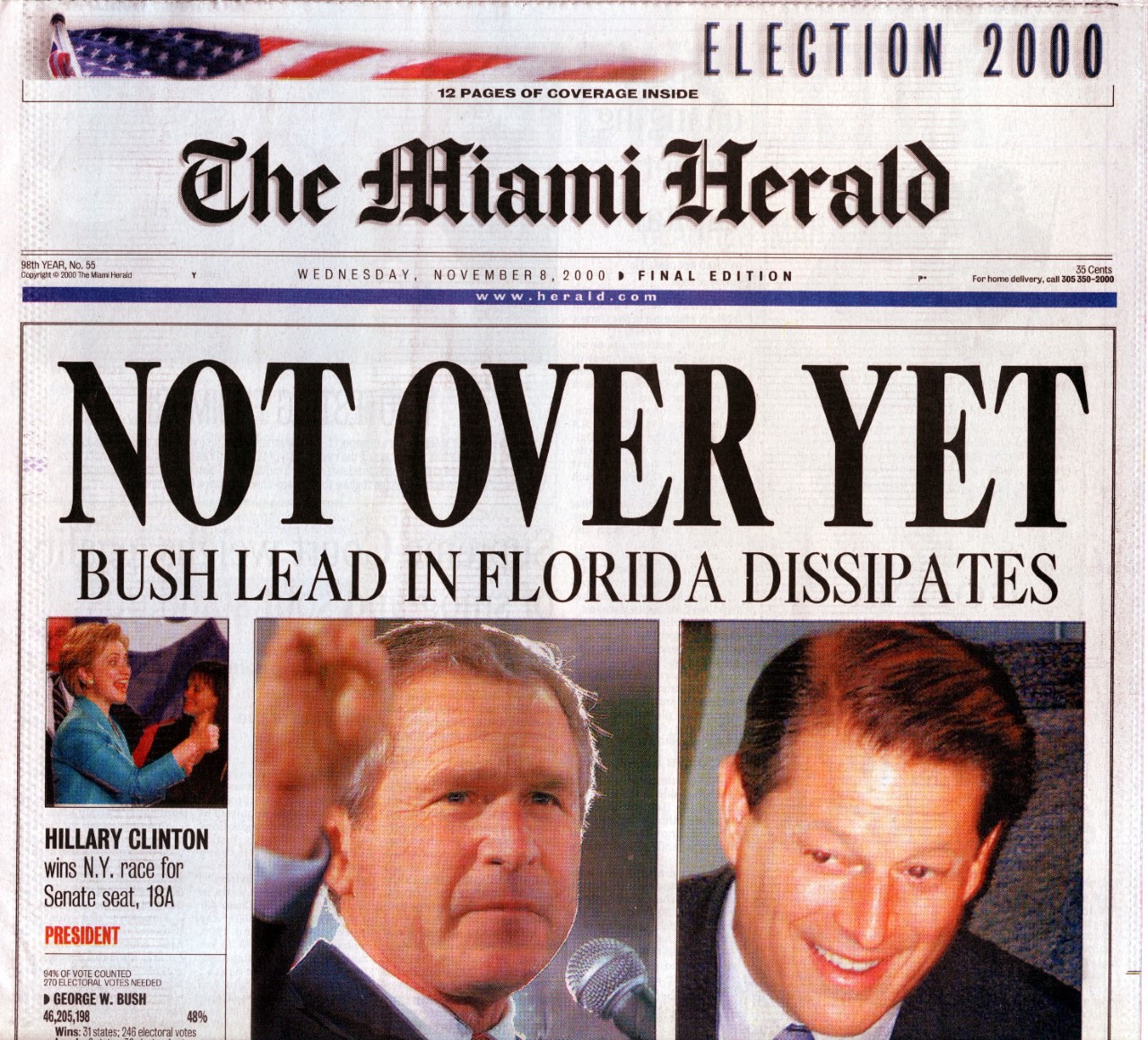
Throwback to another close election: Florida editor reflects on the difference between 2000 and 2020

Everyone knows the famous line. It’s screamed on TV and in the movies by breathless editors who have news that will change the world.

“Stop the presses!”

We felt that drama 20 years ago in the Miami Herald newsroom. Bush vs. Gore. Election Night 2000. Florida.

But first, we had to stop the trucks. They were about to hit the road with stacks of newspapers shouting “Gore wins” in the early editions bound for distant reaches of the state. The news changed, and the headline needed to change. So it became BUSH WINS IT.

A few hours later, as the final edition deadline passed, we learned Bush didn’t win it. Not yet anyway.

Now we had to stop the presses.

I bolted from my desk to make sure the foreman got the word. I arrived breathless, from the whiplash of running the copy desk and running down three flights of stairs from newsroom to pressroom. I approached the press boss as the floor-to-ceiling machines rumbled. I had news that would change the world.

We quickly replaced the page with a new headline, NOT OVER YET. We could have used that one for this election, 20 years later.

Back then, it was butterfly ballots, hanging chads, days of counting, a legal assault.

Now, it’s COVID-19, mail-in ballots, days of counting, a legal assault.

For journalists like me working behind the scenes, 2020 may sound all-too familiar. But it isn’t. The pace and expectations are far different now in our newsroom.

Except for that mad dash to the pressroom, the 2000 election seemed to unfold in slow motion. The story plot moved glacially each day. Reporters arrived and camped out at the canvassing boards to monitor the counting. Day after day, week after week. The reporting was done on a newspaper schedule, with stories filed toward the end of the day, just in time to make the final edition. No Twitter jolts to worry about. No continually updating homepage. Digital was an afterthought in 2000, with the online team stashed away somewhere, maybe on another floor, scraping stories from the newspaper pages to post in the dead of night.

Fast-forward to this year’s campaign and election.

Reporters and editors need to keep a finger on the “post” button 24/7, all while getting bombarded with conflicting information and disinformation. This is no slow-melting glacier. It’s more like Niagara Falls, with tweets flying like missiles.

While we prepared for possible unrest on the streets, assigning journalists to a quick-response team just in case, we also have been told to take it slow. Our editor reminds us to be careful with how we handle what we’re hearing. That takes reporting, not just reacting.

All the while, deadline is … well, deadline is right now. And the focus isn’t on that one big headline at the end of the day. It’s on the many headlines on stories and blogs posted online through the day and into the night, headlines that must grab the attention of Google searches and social scrollers.

COVID has complicated things, of course. We can’t be everywhere we need to be. A local race in the Florida Keys, for instance, was so close that it needed to undergo a recount. But because of coronavirus restrictions, we couldn’t be in the same room as the elections staff and canvassing board. The supervisor set up a TV, chairs and table outside the front doors, everything under a portable tent, to protect observers from the daily dousing in South Florida. And on Election Night, we didn’t only send reporters to precincts to cover in-person voters, but also to mail drop-off boxes to capture those avoiding the inside of polling places.

Unlike 2000, Florida is not at the forefront of the counting drama this year. The state was called for Trump on Election Night. Most local races had clear winners and losers. Ballots didn’t get lost and machines didn’t break down. There were no confusing ballot designs or hanging chads, those bits of cardboard that didn’t get punched all the way through 20 years ago. Floridians now fill in bubbles with a pen, just like a high school test taker, with ballots fed into machines for scanning.  

Yet not everything is different. Readers are still turning to us to make sense of elections. With that comes thoughtful analysis of what is happening. In Miami, for instance, we took a step back from all the noise to look at why President Trump did as well as he did in Miami and across Florida. Another story explained how Joe Biden helped Democrats win the county mayor’s race, resetting local politics.Those are stories typically not aired on local TV or cable news.

While the uptempo pace has changed for us, our purpose has not. Reporters are still digging, analyzing and breaking news. But just like that long-ago newspaper headline that almost got out of our building, one wrong move can destroy our credibility. There’s pressure to be fast and first. We can no longer wait until the end of the day to publish a story. But we also need to tap the brakes as we check and confirm. It’s hard. It’s tiring. It’s crucial.

There will be no running into the pressroom this year for a “Stop the Presses” moment. We no longer have our own pressroom, and my priority these days is digital.

But I’ll always savor the chance of saying that iconic line. It sure beats, “Delete the tweet.”

Jeff Kleinman is the day editor at the Miami Herald. In 2000, he was copy desk chief.