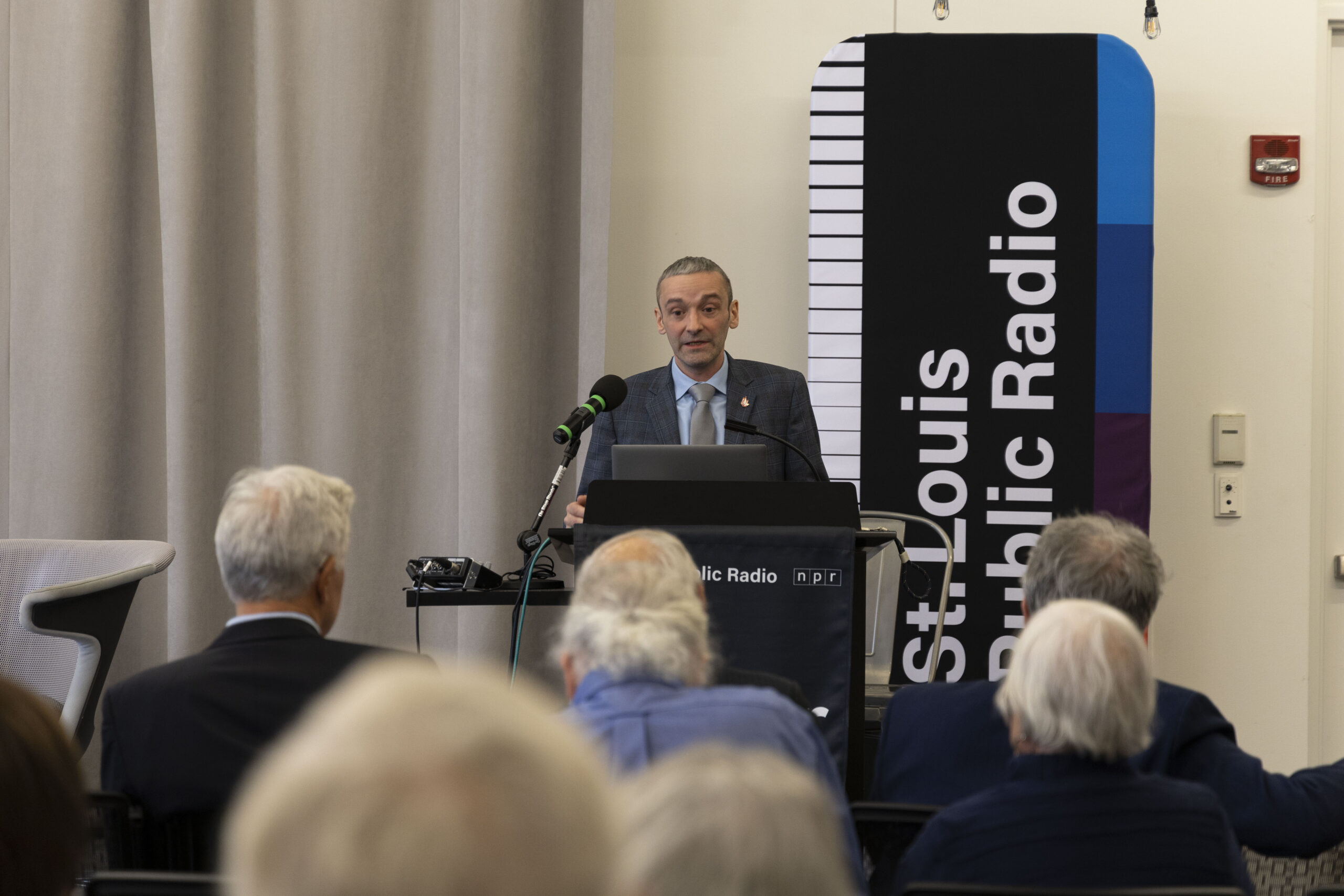
I’m Sean Stevens, FIRE’s chief researcher. I can sum up our organizational mission pretty simply: If speech or expression is protected by the First Amendment, we’ll defend it. No questions asked.
So, we’re all here tonight to discuss a question, is the First Amendment at risk?
And well, yeah it is.
One could even say that “to ask the question is to answer it.”
And while I’d submit that the First Amendment is never really not at risk, there are plenty of reasons for heightened concern and the problem is particularly acute at our colleges and universities right now.
FIRE’s always had a particular focus on higher education — we were the Foundation for Individual Rights in Education for over two decades before expanding our mission a few years ago — so that’s what I’m going to focus on in my remarks.
Over the past few years we’ve recorded a record number of campus censorship campaigns targeting students, faculty, invited speakers, performances, film screenings, and art exhibits or individual pieces of art. These campaigns are initiated by forces on-campus — students, faculty, and administrators — and by forces off-campus — alumni, activist organizations, the general public, trustees, and government actors. And they come from across the ideological spectrum, with attempts coming from the right of the expression equalling or surpassing attempts from the left in recent years.
What’s particularly troubling is that we just recorded more attempts to censor campus speech that involved elected officials and unelected appointees last year than we did over the prior 25 years combined.
That should set off some alarm bells about the First Amendment being at risk.
So, how bad is it really on campus?
Seven years ago we started ranking colleges by their free speech climates. We decided to do this because despite two decades of work writing letters on behalf of students and faculty, or even defending their rights in court, our concerns about how widespread the problem of campus censorship was were looked at with skepticism because individual cases are anecdotal. They’re one-off incidents. Outliers.
The College Free Speech Rankings have changed that, and admittedly become far more influential than we could have ever imagined.
Briefly, the rankings are an annual evaluation by the Foundation for Individual Rights and Expression (FIRE) that assesses the state of free speech and open expression on U.S. college campuses based on student experiences, institutional policies, and how campuses handle speech controversies. Student experiences are assessed by our rankings survey — questions ask students about their political tolerance, their comfort expressing political views, their frequency of self-censorship, and how well their school’s administration protects expressive rights on campus.
The data we’ve collected over the past six years includes survey responses from almost 300,000 undergraduates from over 250 schools in all 50 states and the District of Columbia.
And I’m sorry to report that since we started doing the rankings that undergraduate students’ political tolerance has declined, self-censorship remains frequent among many students, and student trust in their school’s administration to defend freedom of speech has declined. On some campuses, including some of our most elite colleges and universities, students report that the ability to discuss the Israeli-Palestinian conflict openly and honestly has become almost impossible.
The too long; don’t read summary of what our massive dataset says is that the majority of schools receive a failing grade. So, even the schools with the best climates for free speech still have plenty of room for improvement, and the worst [sigh], well here’s what some of them have done over the last few years:
- Barnard College, the lowest ranked school in our most recent rankings, repeatedly investigated, and then even briefly suspended, the same student journalists because of their presence at a campus protest in the campus library.
- At Northeastern University, administrators demanded that a Jewish student organization holding an event on campus provide the university police with a list of all registered attendees.
- At the University of Washington multiple campus events have been disrupted causing them to end early.
- And, at Indiana University, administrators called the state police to stop students from setting up a pro-Palestinian encampment protest and the police, in their infinite wisdom decided it was good idea to put some snipers on the roof of the student union building.
The students noticed.
When asked, on the annual rankings survey, to describe a time they felt they could not express their views on campus because of how other students, faculty, or administrators would respond one Indiana student said:
When I, as a student leader and representative of my entire campus, had a sniper gun pointed at me when trying to defend a protest that was in compliance with school policies.
Another said:
The president has called snipers on protestors before.
I am guessing both of those students may think the First Amendment is at risk too.
But what about here in Missouri?
Well, there’s some reason for optimism. First, the average ranking of the six schools we surveyed in the state last year is 75 out of 257. Two schools rank in the top 20; the University of Missouri’s flagship campus checks in at 16th, while the campus right here in St. Louis is even better, ranking 11th. The University of Missouri in Kansas City ranks 57. Wash U. is 72nd. And, even though the grades these schools’ speech climates received ranged from a D- to a C, they are all at least passing grades. Something the majority of colleges and universities we rank don’t attain.
The other two schools ranked — Missouri State and Southeast Missouri State don’t do as well.
And sorry, but neither does Southern Illinois in Carbondale, who ranks well below all of the Missouri schools, primarily because of its speech policies.
But at least the state of affairs here is better on most of these campuses than on many others around the country. However there is still plenty of room for improvement.
We’ve also surveyed St. Louis University, but never ranked them and didn’t survey them last year. The reason for this is because our evaluation of their speech policies is that they prioritize other values over freedom of speech and expression, so we give them a “Warning” rating. Comparing them to schools that at least on paper say that they do is an apples to oranges comparison.
But, what I can tell you about SLU is that it generally has the most politically liberal student body among the five or six warning schools we’ve surveyed — all of whom have some kind of religious affiliation — and when compared to just these schools SLU typically has one of the better speech climates. That doesn’t necessarily mean a good one, just that it’s better than other warning schools like BYU, Baylor, or Liberty.
SLU also frequently shows up in our Campus Deplatforming database — although a number of these attempts come from the Cardinal Newman Society, a Catholic non-profit organization focused on higher education, ran an over decade long, and mostly futile, nationwide campaign to get performances of The Vagina Monologues canceled at Catholic colleges and universities.
So, how can schools improve?
Let me tell you about the University of South Carolina.
Three years ago they were the third-worst school in the rankings. This was the result of a number of factors. Their speech policies received a “yellow light” rating from our Policy Reform team, meaning that the institution has at least one speech policy that restricts a more limited amount of protected expression or, by virtue of vague wording, can too easily be used to restrict protected expression. The outcomes of multiple campus speech controversies also caused South Carolina to lose points. And, while I wouldn’t necessarily draw a casual inference, their student survey responses were also not very good.
Now they rank 22nd.
How?
The new incoming chancellor who started in his position after South Carolina’s poor ranking, made it a goal for the school to improve. Instead of ignoring or dismissing the school’s poor ranking, he asked us why South Carolina ranked where it did and what they could do to improve. Our Policy Reform team worked with them to revise their speech policies so they obtained a “green light” rating — meaning that the policies do not seriously imperil speech. South Carolina also adopted the Chicago Statement, a model free speech policy statement that affirms a university’s commitment to free expression.
An important element of this story is that South Carolina didn’t quietly make these changes. They publicly announced them, explained why they were making them, and why they were important. Controversy came a few months later when the campus chapter of Uncensored America organized a roast of Kamala Harris weeks before the 2024 Presidential Election. The appointed roastmasters were Milo Yiannopolous and Gavin McInnes. Students, student groups, alumni, local politicians and the NAACP opposed the roast and demanded the university cancel the event because of the pair’s past history of “racism,” “bigotry,” “misogyny,” and “white nationalism.”
South Carolina responded to the furor calmly, simply stating that student groups are free to invite speakers of their choice, regardless of their views, because that right is protected by the First Amendment. The roast was held successfully.
The best part? The next year, South Carolina moved up from a ranking of 248th to 34th, and about two-thirds of this increase was actually a result of improvements in their student survey responses, not the policy changes.
Another test occurred a few weeks ago. U.S. Representative, and current South Carolina gubernatorial candidate, Nancy Mace as well as other public officials, and conservative social media influencers criticized South Carolina for announcing its 28th annual Birdcage Drag Show. Mace publicly condemned the event on X and threatened consequences related to the university’s funding, arguing that taxpayer resources should not support such programming.
The university’s responded to Mace directly:
Thanks for the tag! This event isn’t sponsored by tax dollars. Student orgs host hundreds of events on campus every year and they are free to choose the programming as long as it’s protected by the First Amendment.
Simple. Principled. Gets right to the point.
So, while the First Amendment is at risk, that doesn’t mean its decline is inevitable. What we’ve seen in our data, and in cases like South Carolina, is that institutions can get better when leaders decide that free expression is not a slogan, but a commitment.
And that commitment matters not just for students and faculty, but for all of us. Because our colleges and universities help shape the norms people carry with them into newsrooms, courtrooms, boardrooms, government offices, and civic life.
If students learn that speech should be managed, chilled, or punished whenever it causes controversy, they will carry that lesson with them. But if they learn that the answer to bad speech is more speech, better speech, and the confidence to hear each other out, they will carry that lesson too.
That is why defending the First Amendment on campus is not a side issue. It’s where the future of a free society is being tested.
Editor’s Note: This is the text of a speech delivered at a forum on the First Amendment on April 22 at St. Louis Public Radio. The forum was sponsored by GJR and the Pulitzer Center, which was celebrating its 20th anniversary as a national leader in generating journalism around the world. FIRE is the Foundation for Individual Rights and Expression. The speaker provided a written transcript of the speech. It was edited lightly for print.
Sean Stevens is chief researcher for FIRE – the Foundation for Individual Rights and Expression- FIRE
